

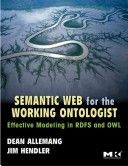
Semantic web for the working ontologist
Introduction: Taming the Data Deluge with Meaning
Introduction: Taming the Data Deluge with Meaning
Nova: Welcome back to the show. Today, we're diving into a book that, despite being a cornerstone of knowledge engineering for nearly two decades, remains surprisingly relevant: Dean Allemang’s "Semantic Web for the Working Ontologist."
Nova: : That title alone sounds like it was written for a very specific, perhaps slightly intimidating, niche. When I hear 'Semantic Web' and 'Ontologist' in the same breath, I picture dense academic papers, not practical advice. What makes this book essential reading?
Nova: That’s the genius of it! The authors, Allemang and Hendler, deliberately targeted the 'working' professional—the programmer, the data architect, the domain expert—who needs to things, not just theorize. They took the grand vision of the Semantic Web and distilled it into actionable steps using RDF, RDFS, and OWL.
Nova: : So, it’s less about Tim Berners-Lee’s original utopian vision and more about the nuts and bolts of creating machine-readable knowledge structures? A practical manual, then?
Nova: Exactly. It’s a guide that tells a coherent story from beginning to end on how to manage a world-wide distributed web of knowledge in a way. It’s about moving from just having data to having that computers can actually reason over. It’s the difference between a pile of bricks and a blueprint for a cathedral.
Nova: : A cathedral of data. I like that. So, let's start there. Who exactly is this 'Working Ontologist' they are addressing, and why do they need a book this specific?
Key Insight 1: Data Persistence Over Application Fads
Defining the Working Ontologist: Beyond Philosophy
Nova: The book positions the Working Ontologist not as a philosopher, but as a crucial type of data architect. They are the ones responsible for building the knowledge scaffolding of an enterprise.
Nova: : That sounds like a high-stakes job. What’s the core challenge they face that necessitates this structured approach?
Nova: The biggest takeaway, which Allemang emphasizes repeatedly, is that applications come and go, but the data persists. He frames it brilliantly: Data is what actually endures through an enterprise's lifetime. If your meaning—your ontology—is baked only into the logic of your application, when that application is replaced, the meaning vanishes.
Nova: : That’s a powerful point. We’ve all seen legacy systems where the business logic is trapped in code that nobody dares touch. The ontology, in this context, acts as a durable layer of shared understanding, right?
Nova: Precisely. It makes the implicit knowledge explicit. For instance, if you have a database field called 'Cust_ID', that’s just a string of characters. But if you define it in an ontology as an 'IdentifierForCustomer' which 'UniqueEntity', suddenly every system that reads that ontology knows exactly what that string represents and how it relates to other concepts like 'Order' or 'Supplier'.
Nova: : So, the ontologist’s job is to formalize the vocabulary and the rules of engagement for that data, making it understandable across different silos and future applications. Are there specific examples of this persistence in action?
Nova: Absolutely. Think about regulatory compliance. Regulations change constantly. If your compliance rules are hardcoded in Java, you rewrite Java. If your compliance rules are expressed as logical axioms in OWL, you update the ontology, and every system consuming that ontology—reporting tools, validation services—inherits the change automatically. It’s about decoupling meaning from implementation.
Nova: : That sounds like a massive reduction in technical debt, but I imagine the initial setup is complex. What kind of pushback does a working ontologist face when trying to impose this level of formal structure?
Nova: The pushback is often cultural. People are comfortable with spreadsheets and relational tables. Allemang addresses this by showing how to model common problems—like hierarchies, part-whole relationships, and temporal data—using the Semantic Web stack. It’s not abstract; it’s solving real-world modeling problems.
Nova: : So, the book isn't just saying 'use OWL,' it's showing to use OWL to model a customer relationship or a supply chain structure effectively. It’s a practical cookbook for meaning-making.
Nova: Exactly. It’s about moving from 'this looks like a good structure' to 'this structure adheres to formal, machine-interpretable semantics.' It’s the difference between a suggestion and a specification that a machine can execute.
Key Insight 2: Mastering the Modeling Languages
The Practical Stack: RDF, RDFS, and OWL in Action
Nova: Let's talk about the tools of the trade that Allemang champions. The book is deeply rooted in the W3C standards: RDF, RDFS, and OWL. For our listeners who might only know SQL, can you quickly frame what these three layers offer?
Nova: : I know RDF is the triple store—Subject-Predicate-Object. It’s the basic sentence structure of the Semantic Web. But RDFS and OWL feel like the real heavy lifting. What’s the distinction?
Nova: That’s a great way to put it. Think of it as a progression of complexity and power. RDF is the foundation—the data interchange format. It lets you state facts: 'Paris IS_CAPITAL_OF France.'
Nova: RDFS, the RDF Schema, adds basic vocabulary control. It lets you define classes and properties, like saying 'City' is a type of 'Location,' and 'hasCapital' relates a 'Country' to a 'City.' It provides basic hierarchy and structure.
Nova: : So RDFS gives us the basic taxonomy, the organizational chart for our concepts. Where does OWL, the Web Ontology Language, step in to justify its reputation for complexity?
Nova: OWL is where the real reasoning power comes from. RDFS tells you that Paris is a City. OWL lets you define what a City. For example, OWL allows you to state axioms like: 'A City must have exactly one capital city property pointing to it,' or 'If X is a City, then X cannot also be a Supplier.' These are logical constraints.
Nova: : Ah, so OWL introduces formal logic, allowing machines to infer new facts that weren't explicitly stated. If I state that all 'Employees' are a subclass of 'People,' and I state that 'John' an 'Employee,' the system can infer that 'John' a 'Person' without me ever stating it directly.
Nova: Exactly! And Allemang’s book excels because it doesn't just define these languages; it provides concrete examples showing how to use them to solve common modeling problems. One review mentioned it provides examples to illustrate the use of these technologies in solving.
Nova: : That’s the key differentiator. It moves beyond the theoretical 'what if' to the practical 'how to.' Did the book cover any specific modeling patterns that are considered best practice today?
Nova: Yes. It heavily emphasizes the importance of defining the scope and purpose upfront—the 'why' before the 'what.' It guides the reader through developing a coherent story for the knowledge base, ensuring the resulting model is both expressive enough for the task and simple enough to maintain. It’s about disciplined modeling, not just throwing every OWL feature at a problem.
Nova: : So, if I were a programmer today, familiar with graph databases like Neo4j, this book would teach me the formal semantics that give my graph structure and inferential power, which Neo4j alone doesn't provide out of the box.
Nova: Precisely. Graph databases store the relationships; the ontology defines the and governing those relationships. This book is the bridge to making that graph truly intelligent.
Key Insight 3: Principles of Effective Modeling
Designing for Robustness: The Anatomy of a Good Ontology
Nova: Moving into the core design philosophy, what are the hallmarks of a 'good' ontology according to Allemang? We know it needs to be persistent, but what makes it robust and reusable?
Nova: : I imagine reusability is huge. If you build an ontology for one project, you want to be able to plug it into the next one without rewriting everything. Is that a major theme?
Nova: It is. A major theme is the separation of concerns, often referred to as modularity. The book advocates for building ontologies that are focused on a specific domain or purpose, rather than trying to create one massive, all-encompassing 'upper ontology' that tries to model everything in the universe.
Nova: : That sounds like good software engineering principles applied to knowledge. Don't build a monolith; build focused microservices of meaning.
Nova: Exactly. They stress the importance of defining clear boundaries. For example, an ontology modeling 'Medical Procedures' should be distinct from an ontology modeling 'Billing Codes,' even though they interact. This modularity aids in maintenance and alignment later on.
Nova: : Alignment—that’s where the Semantic Web really shines, isn't it? Connecting disparate knowledge bases. How does the book prepare the working ontologist for that inevitable need to link their work to others?
Nova: By insisting on standards and clarity. If you use standard RDFS/OWL constructs correctly, and you clearly define your terms—your classes and properties—you make it easier for others to map their terms onto yours. The book implicitly argues that good modeling is inherently an act of good communication with future users and systems.
Nova: : I read somewhere that the book is very didactic, meaning it teaches by example. Can you give us a flavor of the kind of real-world modeling challenge it tackles?
Nova: They often use examples related to time, space, or organizational structures—things that are conceptually simple but surprisingly tricky to model formally. For instance, how do you represent a 'meeting' that happened last Tuesday, involved three people, and resulted in a decision? You have to model the event, the participants, the roles, and the outcome, all linked by temporal properties. The book walks you through building that structure using OWL axioms.
Nova: : That’s where the rubber meets the road. It’s easy to say 'use a graph,' but it’s hard to formally define the constraints on a 'meeting' so that a reasoner can flag an error if someone tries to assign a 'Meeting' the property 'hasDuration' of 'negative five minutes.'
Nova: Precisely. It’s about building in the guardrails. And that rigor is what separates a simple data catalog from a true knowledge graph capable of supporting complex AI reasoning. The book is essentially a masterclass in building that rigorous foundation.
Key Insight 4: Explicit Knowledge vs. Statistical Inference
The Legacy: Ontologies in the Age of LLMs
Nova: We have to address the elephant in the room. We are now in the era of Large Language Models—LLMs—which seem to infer meaning statistically from massive text corpora. Does a book focused on formal, explicit ontologies still hold water?
Nova: : That’s the million-dollar question. If ChatGPT can answer complex questions by reading the entire internet, why bother spending months building a formal OWL ontology?
Nova: That’s where the book’s core message about and becomes even more critical. LLMs are fantastic at fluency and breadth, but they are notoriously weak on precision, hallucination, and traceability. They are statistical parrots, not formal reasoners.
Nova: : So, the ontology provides the grounding layer. The LLM generates the creative text, but the ontology provides the verifiable facts and the business context.
Nova: Exactly. Dean Allemang’s work is now more relevant than ever because it provides the necessary structure to generative AI. You can use an LLM to summarize a document, but you need an ontology to ensure that when the LLM talks about 'Customer,' it’s using the enterprise’s defined, persistent concept of a customer, not some generalized internet definition.
Nova: : I see. The ontology acts as the enterprise’s single source of truth for concepts, while the LLM acts as the interface or the content generator.
Nova: It’s the perfect synergy. The book teaches you how to build that single source of truth—the knowledge scaffolding. It helps you define the constraints and relationships that prevent the AI from making logically impossible or contextually wrong statements. For example, an LLM might struggle to consistently apply complex regulatory rules, but a formal OWL axiom handles that perfectly.
Nova: : Are there any modern applications or case studies that show this synergy in practice, perhaps leveraging knowledge graphs built on these principles?
Nova: While the book is foundational, its principles underpin modern knowledge graph initiatives at major corporations. The shift to graph databases and knowledge graphs is essentially the industry adopting the data model proposed by the Semantic Web standards. The fact that the book is in its third edition shows its concepts are continually being updated to meet modern needs, like integrating with graph databases and supporting AI applications.
Nova: : So, the challenge of the working ontologist today isn't just building the structure, but ensuring that structure is accessible and usable by these new, powerful statistical tools. It’s about making sure the meaning is explicit enough for the machine to trust it.
Nova: That’s the final evolution. The book gives you the blueprint for the knowledge layer that makes the next generation of AI reliable, auditable, and context-aware. It’s about building knowledge that lasts longer than the current tech cycle.
Conclusion: Building Knowledge That Endures
Conclusion: Building Knowledge That Endures
Nova: We’ve covered a lot of ground today, moving from the abstract promise of the Semantic Web to the concrete reality of building knowledge structures with Dean Allemang’s guide.
Nova: : It’s clear that the 'Working Ontologist' isn't a niche academic role, but a critical data engineering function focused on longevity. The key takeaway for me is the emphasis on data persistence—building meaning that survives application upgrades.
Nova: Absolutely. We learned that the power lies in the progression: RDF for facts, RDFS for basic taxonomy, and OWL for formal logic and inference. Mastering this stack allows you to create knowledge that is not just stored, but by machines.
Nova: : And perhaps most importantly for our current moment, this explicit, rigorously defined knowledge is the necessary anchor for the statistical power of modern AI. It’s the structure that prevents the LLM from hallucinating business facts.
Nova: If you are someone who deals with complex, interconnected data, and you feel like your meaning is constantly being lost in translation between systems, this book offers the methodology to build a durable, shared vocabulary. It’s about engineering trust into your data layer.
Nova: : A powerful lesson in making implicit knowledge explicit. Thank you, Nova, for guiding us through this foundational text.
Nova: My pleasure. Keep building knowledge that lasts. This is Aibrary. Congratulations on your growth!