

** The Self-Care OS: Installing Micro-Habits for a Competitive Edge
Golden Hook & Introduction
SECTION
Nova: In a field like marketing, we're told the key to getting ahead is to hustle harder, work longer, and always be 'on.' But what if the real competitive edge isn't found in another late night at the office, but in something as simple as giving up alcohol for 30 days, or... putting your phone away?
online-chengzi: That's a pretty radical thought. It goes against everything we're taught about what success looks like, especially early in your career.
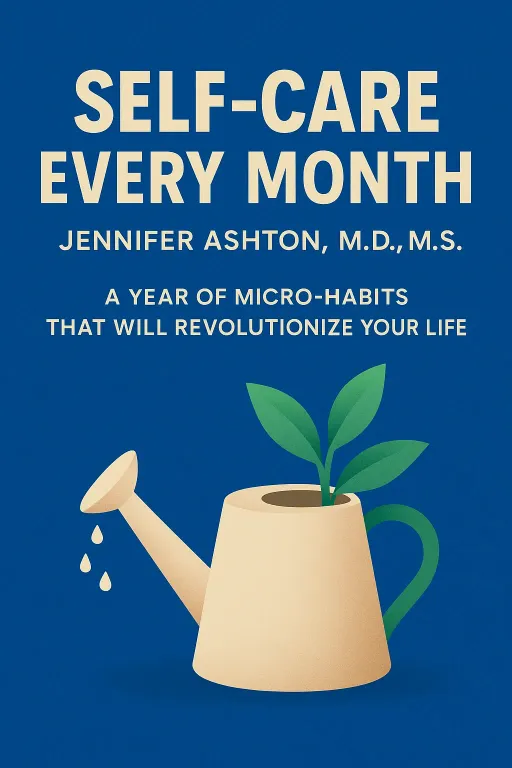
Nova: It really does. And that's the radical idea behind Dr. Jennifer Ashton's book, "Self-Care Every Month." Today we're so excited to have online-chengzi, a recent marketing grad who's all about upskilling to stay competitive, to help us unpack this. We'll dive deep into this from two perspectives. First, we'll explore the book's brilliant framework of 'monthly challenges' and how to think about them like a marketer running a personal A/B test.
online-chengzi: I'm already intrigued by that framing.
Nova: Right? Then, we'll discuss the most critical 'system upgrades' for your personal operating system—the specific habits that deliver the biggest cognitive bang for your buck. So, online-chengzi, when you hear 'self-care,' what's the first thing that comes to mind? For many of us, it feels... a little fluffy, maybe even self-indulgent.
online-chengzi: Exactly. It sounds like bubble baths and spa days, which are great, but they don't feel like a strategy for getting ahead professionally. They feel like a reward you get you've burned yourself out.
Nova: That's the perfect way to put it. But Dr. Ashton's approach is anything but fluffy. It's structured, it's data-driven, and it all started with a simple, personal experiment.
Deep Dive into Core Topic 1: The 'Monthly Challenge' as a Personal A/B Test
SECTION
Nova: Dr. Ashton is a physician, and she had this moment of realization. She was constantly advising her patients to moderate their alcohol intake, but she knew her own habits weren't perfectly aligned with her advice. You know, a glass of wine after a long day, social events... it adds up.
online-chengzi: The classic 'do as I say, not as I do.' I think we can all relate to that in some area of our lives.
Nova: Totally. So, instead of making some vague, lifelong resolution, she decided to run an experiment. For just one month—January—she would give up alcohol completely. No ifs, ands, or buts. And to hold herself accountable, she announced it on national television, on.
online-chengzi: Wow, that's high-stakes accountability. No backing out of that one.
Nova: None whatsoever. And she was floored by the response. She said you would have thought she was offering free candy, not a month of sobriety. People were excited to join her. But the real shock came from the results. Within weeks, she noticed her skin was clearer, she'd lost a bit of weight, she had more energy, and her sleep was dramatically better.
online-chengzi: So, tangible results. It wasn't just a feeling.
Nova: Exactly. She wrote that she learned more about herself and her relationship with alcohol in those 30 days than she had in years. And the experiment was so successful, it became the blueprint for the whole book: a new, small, manageable challenge every single month for a year.
online-chengzi: That's brilliant. It's not 'I'm quitting drinking forever,' which is incredibly intimidating and feels like a failure if you slip up. It's 'I'm running a 30-day test.' As a marketer, that resonates so deeply. We run campaigns all the time with a defined start, a defined end, and clear success metrics.
Nova: What would those metrics be in this case?
online-chengzi: Well, her 'KPIs'—her Key Performance Indicators—were clearer skin, more energy, pounds lost. It's a data-driven approach to self-improvement. You're isolating one variable—alcohol—and measuring its impact. At the end of 30 days, you have the data. You can look at the ROI, the return on investment, and decide, 'Okay, was this worth it? How do I want to integrate this learning going forward?'
Nova: I love that. And the social accountability piece you mentioned is huge. She didn't just do it in secret.
online-chengzi: It's like launching a product or a campaign. You create buzz, you get your community involved, whether it's your friends or, in her case, a national audience. It transforms it from a lonely, private struggle into a shared journey. That's an incredibly powerful motivator. It makes you want to see it through.
Nova: It completely reframes the idea of changing a habit from a chore into an exciting, limited-time project.
online-chengzi: A project with a clear outcome. It's so much more appealing than just a vague desire to 'be healthier.'
Deep Dive into Core Topic 2: Optimizing Your 'Personal OS' for Cognitive Performance
SECTION
Nova: I love that 'personal campaign' analogy. And if the 'monthly challenge' is the, let's talk about the. Dr. Ashton's year gave her incredible data on which habits give the biggest ROI for mental performance. Let's call them 'Personal OS Upgrades.' Two of the biggest were, for me, quite surprising: managing our technology and prioritizing sleep.
online-chengzi: Two things that are the first to go when you're in a demanding job.
Nova: Precisely. Let's start with tech. For her August challenge, she focused on 'Mindful Tech.' She tells this story about realizing she was constantly 'phubbing' her kids—you know, phone-snubbing them. She'd be physically present but mentally a million miles away, scrolling through her phone.
online-chengzi: I think we've all been on both the giving and receiving end of that. It feels terrible.
Nova: It does. So her challenge was simple: she started taking phone-free walks. And this is where the story gets so vivid. Imagine walking the same streets of New York City every single day, head down, buried in your phone, just trying to get from point A to point B. Then one day, you put the phone in your purse and you just... look up.
online-chengzi: Hmm.
Nova: She described looking up and seeing Lincoln Center, a place she passed all the time, and it looked like a 'dazzling ancient temple' in the morning light. She realized she hadn't seen it in years. She felt calmer, more present. And the science in the book backs this up. Studies show that just having your phone on the table, even face down and on silent, reduces your available cognitive capacity.
online-chengzi: Wow. So it's literally running in the background of your brain, even if you're not touching it.
Nova: Exactly! It's like a background app that's constantly draining your mental battery.
online-chengzi: That 'background app' metaphor is perfect. In marketing, we're constantly context-switching—jumping from email to a social media trend to a strategy doc to a Slack message. That cognitive drain is real. The idea that simply removing the phone from my immediate vicinity could free up mental bandwidth for actual creative work... that's a huge, low-effort win.
Nova: It's a system upgrade that costs absolutely nothing! And that brings us to the second big OS upgrade: Sleep. This was her November challenge. And like many high-achievers, Dr. Ashton thought she was a great sleeper. She was disciplined, went to bed at a reasonable hour...
online-chengzi: She had it all figured out, or so she thought.
Nova: Exactly. But when she started tracking her sleep with an app, she was shocked. She was getting far less quality sleep than she thought. So she forced herself to get a consistent eight hours a night. And the results were, in her words, fantastic. She felt 'more self-possessed, even-tempered, spirited, and mentally sharper.'
online-chengzi: That sounds like a superpower.
Nova: It really does. And here's the kicker for anyone in a creative or strategic role. The book links a lack of sleep—even just getting six hours a night—to impaired judgment that is equivalent to being legally drunk.
online-chengzi: That is a terrifying thought. We glorify the 'hustle' and pulling all-nighters to meet a campaign deadline. But this data suggests that's completely counter-productive. You're essentially showing up to a critical brainstorming session 'drunk.' The most strategic move might be to go to bed, not to get another coffee.
Nova: It turns the whole hustle culture narrative on its head. The real power move is being the most well-rested person in the room. You're literally thinking on a different level.
Synthesis & Takeaways
SECTION
Nova: So, when we put it all together, we have this powerful one-two punch. First, a manageable, experimental framework of monthly challenges that feels more like a fun project than a daunting life sentence.
online-chengzi: The personal A/B test.
Nova: Exactly. And second, a focus on these high-ROI habits like sleep and tech mindfulness that directly fuel the cognitive engine we need to be competitive and creative in our careers. It's not about being selfish; it's about being strategic.
online-chengzi: It's about maintaining your most important asset, which is your own mind and body. You can have all the marketing skills in the world, but if your 'OS' is buggy and slow, you can't execute.
Nova: So well said. This whole conversation makes me want to start my own challenge right now.
online-chengzi: Me too. It's not about overhauling your entire life tomorrow. It's about asking, 'What's my one 30-day experiment?' For me, after this conversation, I think a 'Mindful Tech' month is calling my name. The potential ROI on my focus and creativity seems too high to ignore. Just putting my phone in another room while I work... that seems like a test worth running.
Nova: I love that. It's a perfect first step. So for everyone listening, what's your experiment? What's the one micro-habit you'll test for the next 30 days? The results might just revolutionize more than you think.









