

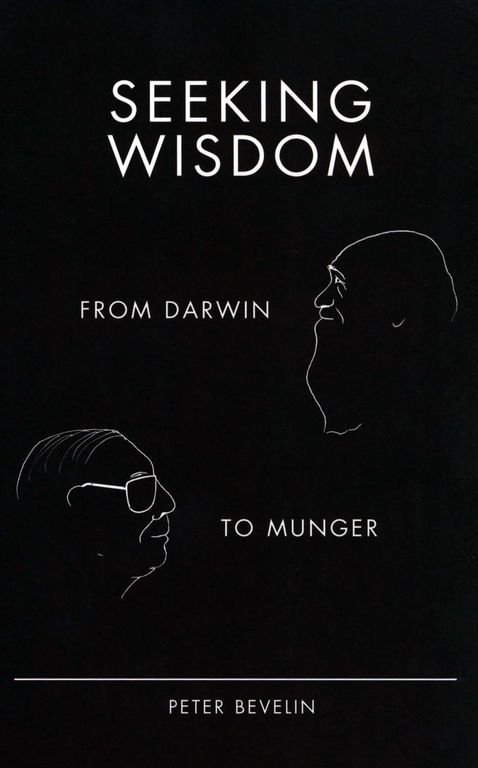
Seeking Wisdom
Introduction
Nova: Have you ever wondered why incredibly smart people sometimes make the most bafflingly stupid decisions? I am talking about world-class CEOs, brilliant scientists, or even just that one friend who is a genius but cannot seem to get their life together.
Nova: Well, that is exactly what Peter Bevelin explores in his masterpiece, Seeking Wisdom: From Darwin to Munger. Bevelin is a Swedish investor who became obsessed with how we think, why we fail, and how we can train ourselves to be just a little bit less foolish every day.
Nova: More than you would think. Bevelin argues that to truly understand how to make better decisions, you have to look at the biological hardware we inherited from our ancestors and the psychological software that runs on top of it. Today, we are going to dive into his toolkit for better thinking and see if we can find some of that elusive wisdom ourselves.
Key Insight 1
The Stone Age Brain in a Space Age World
Nova: Let us start with the Darwin part of the equation. Bevelin points out a fundamental problem: our brains were designed for a world that no longer exists. We are walking around with Stone Age hardware in a high-tech, digital world.
Nova: Exactly. For most of human history, survival was about immediate threats. If you heard a rustle in the bushes, you did not sit there and perform a cost-benefit analysis of whether it was a tiger or the wind. You ran. The people who stopped to think were the ones who did not pass on their genes.
Nova: Precisely. Bevelin explains that our ancestors lived in small groups where social status was life or death. If you were kicked out of the tribe, you died. That is why we are so hypersensitive to what others think of us. It is why social proof is such a powerful force. We look to see what everyone else is doing because, for a million years, following the crowd kept us alive.
Nova: And it goes deeper. Think about how we handle rewards. In the wild, if you found a berry bush, you ate as much as you could right then because you did not know when you would find food again. Now, that same instinct leads to overeating and short-term thinking in finance. We are wired for the immediate, but modern success often requires the long-term.
Nova: Spot on. Bevelin says we have to understand our biological limitations before we can even begin to fix our thinking. We have to learn to override the autopilot.
Key Insight 2
The Psychology of Human Misjudgment
Nova: This brings us to the Munger part of the book. Charlie Munger is famous for his list of twenty-five tendencies of human misjudgment. Bevelin uses these as a roadmap for how our psychology trips us up.
Nova: One of the most dangerous is what he calls incentive-caused bias. It is the idea that if you tell someone they will get a bonus for a certain outcome, they will find a way to make that outcome happen, even if it is unethical or stupid. As Munger says, never, ever, think about something else when you should be thinking about the power of incentives.
Nova: They are. Another big one is the consistency and commitment tendency. Once we make a public statement or take a stand, we feel an intense pressure to stick with it, even when the facts change. We hate being wrong, so we filter out any information that contradicts our current beliefs.
Nova: Bevelin also talks about the availability heuristic. We tend to give more weight to information that is easy to recall. If you just saw a news report about a plane crash, you might be terrified of flying, even though statistically, the drive to the airport was much more dangerous. Our brains mistake vividness for frequency.
Nova: Bevelin suggests that we need to actively seek out disconfirming evidence. We should be trying to prove ourselves wrong rather than right. It is a very scientific way of looking at life, but it is incredibly hard to do because it goes against our ego.
Key Insight 3
The Latticework of Mental Models
Nova: One of the most famous concepts in the book is the idea of a latticework of mental models. Bevelin argues that you cannot really know anything if you just remember isolated facts. You have to hang them on a framework of ideas from many different disciplines.
Nova: Think of it this way. If you only know economics, you will try to solve every problem with economic tools. If you only know psychology, everything looks like a behavioral issue. Munger calls this the man with a hammer syndrome: to a man with a hammer, everything looks like a nail.
Nova: Exactly. Bevelin says you need the big ideas from the big disciplines: biology, psychology, physics, chemistry, and math. You do not need to be an expert in all of them, but you need to understand the core principles. For example, the concept of critical mass from physics or feedback loops from engineering.
Nova: Think about a new social media app. It does not matter how good the tech is until it reaches a certain number of users. Once it hits that critical mass, it explodes. If you understand that model, you can see why some businesses fail despite having a great product. It is a universal principle that applies across different fields.
Nova: Precisely. Bevelin emphasizes that wisdom comes from the synthesis of these ideas. When you can see how a biological instinct is being triggered by a psychological bias, and how that is being amplified by a mathematical power law, you are operating on a much higher level than everyone else.
Key Insight 4
The Power of Inversion and Checklists
Nova: Now, let us get practical. How do we actually use all this? Bevelin is a huge fan of a technique called inversion. It comes from the mathematician Carl Jacobi, who said, invert, always invert.
Nova: Exactly. Instead of asking, how can I be successful, you ask, what would guarantee that I fail? If you want a happy marriage, do not just think about what to do right. Think about what would definitely ruin it: being unfaithful, being disrespectful, not listening. Then, you simply avoid those things.
Nova: Bevelin argues that it is much easier to avoid stupidity than it is to seek brilliance. Most of the time, we do not need to be geniuses; we just need to not be dumb. By identifying the ways things can go wrong, you can build defenses against them.
Nova: Exactly. And to help with that, Bevelin is a massive advocate for checklists. Even the smartest pilots and surgeons use checklists because they know that under pressure, the human brain is prone to skipping steps or forgetting the basics.
Nova: Especially for the pros. Bevelin suggests having a checklist of the common psychological biases we talked about. Before you make a big investment or a life-changing decision, you go down the list. Am I doing this because of social proof? Am I being swayed by a vivid story? Am I just trying to be consistent with a past mistake?
Conclusion
Nova: We have covered a lot of ground today. From our evolutionary roots to the psychological traps we fall into, and the multidisciplinary tools we can use to climb out of them. Peter Bevelin's Seeking Wisdom is not just a book; it is a manual for a more rational life.
Nova: That is a perfect summary. Bevelin reminds us that the goal isn't to be perfect. It is to be slightly less foolish than you were yesterday. If you can avoid the big mistakes, the successes will often take care of themselves. Remember that quote he uses from Confucius: A man who has committed a mistake and does not correct it, is committing another.
Nova: It absolutely is. And the more models you add to your latticework, the clearer the world becomes. So, start building your own checklist, practice your inversion, and keep questioning those Stone Age instincts.
Nova: My pleasure. This is Aibrary. Congratulations on your growth!