

The Hidden Hand: How Institutions Shape Our Lives and Beliefs
Golden Hook & Introduction
SECTION
Nova: You know, Atlas, I think we all grew up with this idea that money is just… money. A neutral medium of exchange, a tool, like a hammer. You use it to buy things, pay for services, and that’s it. Simple, right?
Atlas: Oh, absolutely. I mean, it's just numbers in a bank account, or coins in your pocket. It's the universal translator of value. It's just a thing we created to make transactions easier. That's what I've always been taught.
Nova: Exactly! But what if I told you that this seemingly simple, neutral tool, this universal translator, is actually one of the most culturally loaded, morally charged, and historically manipulated inventions humanity has ever conjured? What if money isn't just a tool, but a narrative, a story we tell ourselves about who owes what to whom, and why?
Atlas: Whoa, hold on. That sounds like you're about to blow up my entire understanding of… well, everything. That's a pretty big claim, Nova. Are you saying my credit card isn't just about my spending habits?
Nova: It’s precisely that kind of re-evaluation we’re diving into today, as we explore the hidden hands that shape our lives and beliefs. We often take our social systems for granted, but the institutions we build, from money to government, have powerful, unseen effects. They profoundly shape our culture, our beliefs, and even our very identities.
Atlas: That makes me wonder about so many things. So today, we're really pulling back the curtain on these invisible architects of our reality?
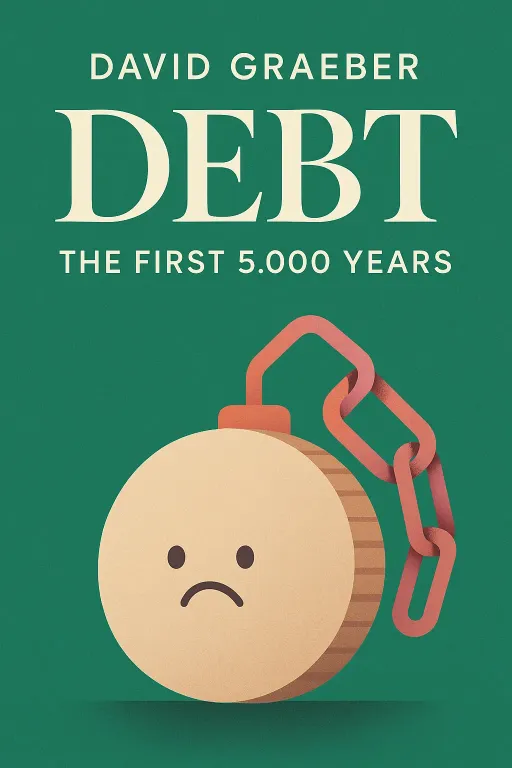
Nova: Absolutely. And to do that, we’re going to look at two truly groundbreaking books. First, we’ll challenge our fundamental understanding of money and debt with the late, brilliant anthropologist and anarchist activist, David Graeber, and his seminal work, "Debt: The First 5,000 Years." Graeber's unique perspective as an anthropologist who also actively engaged in social movements gave him an unparalleled lens to critique our economic assumptions.
Atlas: An anarchist anthropologist tackling debt? That sounds like a recipe for some serious paradigm shifts. I’m already intrigued.
Nova: You should be. Then, we’ll turn our analytical gaze to the equally insightful James C. Scott, a political scientist and anthropologist known for his deep studies of peasant societies and resistance to state power. His book, "Seeing Like a State: How Certain Schemes to Improve the Human Condition Have Failed," will uncover how states, in their quest for order, often inadvertently sow chaos.
Atlas: So, from money and debt to the very structure of the state, we’re talking about systems that are so ingrained, we barely even notice them. This is going to be a deep dive.
The Cultural Fabric of Debt and Money
SECTION
Nova: So, let’s start with Graeber. His core argument is revolutionary: debt often precedes money, and economic systems are built on moral frameworks, not just pure exchange. We tend to think of money as emerging from barter – I have a cow, you have chickens, we need a medium to trade. Graeber argues that this is largely an economic myth.
Atlas: That's a classic economics 101 lesson, though! Barter to money to credit. That’s the story. Are you telling me it’s not true?
Nova: He suggests that for much of human history, social life was structured by reciprocal obligations and promises. If I helped you build your house, you owed me a favor. If I gave you a bushel of grain, you owed me one back next harvest. These were social debts, deeply personal, and often unquantified. Money, in its early forms, often emerged from these social debts – or from military conquests and tribute, not necessarily from peaceful market exchange.
Atlas: Okay, so it’s less about a marketplace and more about a community ledger of favors. That makes sense from a social perspective, but when did it become this impersonal, numerical thing?
Nova: That’s the key. Graeber shows that when societies grew larger, more complex, and especially when they engaged in war and conquest, these personal obligations started to be quantified and enforced impersonally. Think about ancient empires demanding tribute. That tribute wasn't just gold; it was a debt owed by a conquered people. And the concept of "debt" became a tool of power.
Atlas: So, the idea of an impersonal debt, where I owe a specific amount to a faceless entity, emerged from conquest and control, not just convenience? That's a stark contrast to how we view it today.
Nova: Exactly. Consider this: in many ancient societies, if you couldn't pay your debts, you could be enslaved. Not just you, but your entire family. This wasn't just an economic transaction; it was a moral judgment, a loss of freedom, a profound social transformation. The debt wasn't just about money; it was about your very humanity.
Atlas: Wow, that’s kind of heartbreaking. So, when we talk about our national debt today, or student loans, or even just our credit card balance, we’re not just talking about neutral numbers. We’re carrying the echoes of these ancient moral narratives and power dynamics?
Nova: Precisely. Graeber challenges us to see that the morality embedded in our concept of debt – the idea that a promise must be kept, that a debt must be repaid, no matter the cost – is not universal or natural. It’s a human construct, a cultural artifact that has been used to justify everything from slavery to austerity measures. It's a powerful story we collectively believe.
Atlas: That's actually really inspiring, in a way. If it's a human construct, it means we can potentially reconstruct it, or at least challenge its assumptions, rather than just accepting it as an immutable law of the universe.
Nova: That’s the profound insight. It means our economic systems are not just objective forces; they are reflections of our values, our power structures, and the stories we choose to tell ourselves about obligation and responsibility. And when you understand that, you can start to question why things are the way they are.
The Perils of Legibility: When States Simplify Humanity
SECTION
Nova: And that naturally leads us to the second key idea we need to talk about, which often acts as a counterpoint to what we just discussed – the idea of institutions, particularly states, attempting to impose order by simplifying the complex world around them.
Atlas: So, we move from the unseen cultural narratives of money to the visible, yet often destructive, structures of state control?
Nova: Exactly. James C. Scott, in "Seeing Like a State," introduces a concept he calls "legibility." He argues that states, in their desire to govern, tax, and control their populations and resources, need to make things "legible"—that is, clear, measurable, and easily understood from a centralized perspective. They need to simplify the messy, complex reality of human life and natural systems.
Atlas: So you’re saying governments aren't trying to understand the world as it truly is, but rather to simplify it into something they can manage? Like trying to fit a vibrant, chaotic ecosystem into a neat spreadsheet?
Nova: Perfect analogy. Think about it: a diverse, sprawling, ancient forest, full of different tree species, undergrowth, varied terrain, and local knowledge passed down through generations about its specific quirks – that’s not legible to a centralized state looking to maximize timber revenue. So, what do they do?
Atlas: They probably clear-cut it and plant rows of a single, fast-growing species – all the same height, same age, easy to count and harvest.
Nova: Precisely! Scott gives the example of 18th-century scientific forestry in Germany. The state wanted predictable, uniform timber yields. So, they replaced these complex, biodiverse forests, managed by local villagers with deep, practical knowledge, with monoculture forests – rows and rows of identical trees, like a giant, green graph.
Atlas: So the cause was the state's desire for predictable yields, the process was eradicating traditional knowledge and diverse ecosystems, and the outcome was… initial success, I imagine, followed by disaster?
Nova: You nailed it. Initially, it looked like a triumph of rational planning. The trees grew fast, the yields were predictable. But then, the unforeseen consequences kicked in. These "legible" forests, devoid of their natural complexity, became incredibly vulnerable to pests, diseases, and nutrient depletion. The soil degraded, the ecosystems collapsed, and ultimately, the timber yields plummeted. It was a well-intentioned scheme that failed catastrophically because it ignored the inherent complexity and local wisdom of the natural system.
Atlas: That sounds rough. And it's not just about trees, is it? I imagine this applies to urban planning, or even attempts to understand citizens through simplified data points. For our listeners who are managing complex systems, or dealing with large-scale data, this concept must feel incredibly relevant.
Nova: It absolutely is. Scott calls this approach "high modernism" – the seductive belief that human reason, combined with scientific and technological progress, can design and re-engineer society from the top down, creating perfect, rational order. The problem is, it often ignores "metis" – that local, practical, nuanced knowledge that people gain from living in and interacting with a specific environment for generations.
Atlas: So, it's not that central planning is inherently evil, but that when it tries to oversimplify and ignore the messy reality of human and natural systems, it inevitably creates more problems than it solves. It's a warning against hubris, essentially.
Nova: A powerful warning. It shows that complexity, while sometimes inconvenient, is often essential for resilience and functionality. When we try to make things too neat, too legible, we often strip away the very things that make them work.
Synthesis & Takeaways
SECTION
Nova: So, bringing these two powerful ideas together, what we see is a profound common thread. Whether it's the invisible, moral structures of debt that Graeber uncovers, or the visible, yet often destructive, simplification efforts of the state that Scott illuminates, both books reveal that our most fundamental systems are human creations.
Atlas: And with those human creations come vast, often unintended, consequences for individuals and societies. It’s like we build these elaborate machines, and then forget that we built them, and that they have their own internal logic that shapes us.
Nova: Exactly. They are not neutral. They are embedded with values, assumptions, and power dynamics. And our blind spot, our tendency to take these systems for granted, means we often don't see how deeply they are shaping our behavior, our culture, and our beliefs.
Atlas: So, the core insight here is that we need to actively question the systems around us. We need to be historians and analysts of our own present, dissecting these complex systems to understand their true impact, not just accepting them as "the way things are."
Nova: It’s about cultivating a critical awareness, a kind of institutional literacy. It's about recognizing that the "rules of the game" aren't handed down from on high; they're constructed, and therefore, they can be deconstructed, understood, and perhaps even reimagined.
Atlas: That’s a truly profound insight. It gives us agency. It says that understanding these hidden hands isn't just an academic exercise; it's a vital step towards a more conscious, more equitable future.
Nova: Absolutely. And that brings us to our deep question for you, our listeners: What seemingly neutral system in your world – perhaps the way your company structures feedback, or how your city plans its public spaces, or even the unwritten rules of your social circle – might actually be shaping behavior and culture in ways you haven't considered?
Atlas: Take a moment to really think about that. What are the 'legible' simplifications or the 'moral debts' embedded in your daily life? We'd love to hear your thoughts and reflections on this.
Nova: Share your insights with us. We're always eager to engage with your unique perspectives and intellectual curiosity.
Atlas: This is Aibrary. Congratulations on your growth!