Overcoming the Cult of Productivity and Finding True Play
Golden Hook & Introduction
SECTION
Nova: Every morning, millions of people wake up and treat their own lives like a startup that is perpetually on the brink of bankruptcy. We optimize our sleep, we track our macros, we listen to podcasts at double speed, and we treat every spare moment as a resource to be mined.
Atlas: That sounds exhausting just hearing you say it. It’s like we have this internal spreadsheet where we tally up our worth based on how many boxes we checked before noon. If the list isn't done, we feel like we are failing at being human.
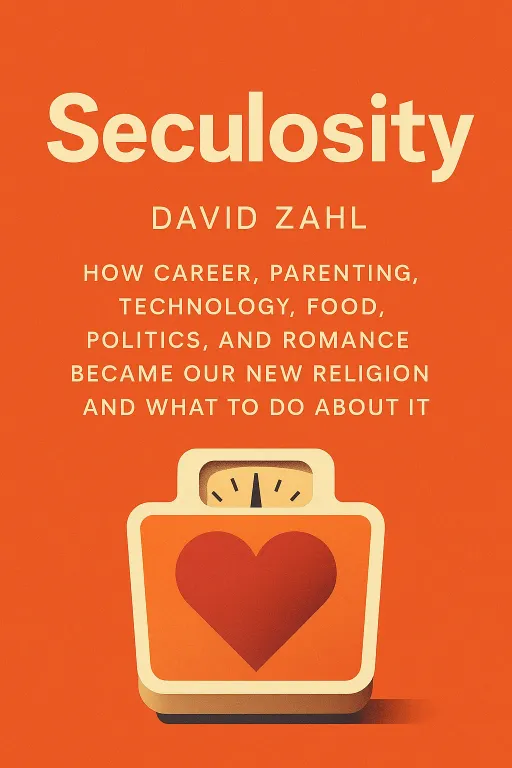
Nova: Exactly. And that feeling is exactly what David Zahl explores in his book, Seculosity. He argues that we have effectively replaced traditional religion with a new, secular set of gods—work, parenting, and fitness. We are chasing a phantom called enoughness, and it is leaving us chronically burned out.
Atlas: I know that feeling all too well. But then I see the other side of the coin, where experts tell us to just go play. Like, take a break. But how do you just turn that off? Dale Sidebottom addresses this in his book, All Work No Play. He breaks down the science of why play isn't just for kids, but is actually a biological necessity for lowering cortisol and rebooting our creative circuits.
Nova: Today, we are going to pull those two threads together. We are looking at why we feel this crushing pressure to be constantly productive and how we can reclaim our vitality by actually scheduling time to do absolutely nothing of value.
The Cult of Enoughness
SECTION
Atlas: Let’s start with that idea of enoughness from Zahl’s work. When you say we’ve turned work into a religion, that sounds like a strong statement. Most people would say they work because they have bills to pay. How does he justify calling it a religion?
Nova: Think about what a religion actually does for a person. It provides a source of identity, a sense of purpose, and, crucially, a way to measure whether you are a good or bad person. Zahl observes that in our modern culture, work is where we go to find those answers. We don't just work to pay rent. We work to prove that we exist.
Atlas: That hits home. It explains why a Tuesday evening, when you are theoretically off the clock, still feels heavy. You aren't just sitting on the couch; you are sitting on the couch while thinking about the emails you didn't send. You are judging your own downtime.
Nova: You are judging your downtime because you are judging your worth. If you aren't producing, you start to wonder if you are losing your edge. Zahl points out that this spills into everything. Look at fitness. We used to exercise for health or fun. Now, we track our steps, our heart rate variability, and our calorie burn. We treat our bodies like high-performance machines that need to be optimized, not vessels we inhabit.
Atlas: Right. It’s like the gym isn't a place to move your body anymore; it’s a place to accrue data points that prove you are disciplined. And if you have a week where you don't hit the gym? You feel a sense of moral failing, not just physical sluggishness.
Nova: That is the core of the issue. When your worth is tied to your output, you can never truly rest. Rest becomes a transaction. You tell yourself, I will rest for ten minutes so that I can be more productive for the next four hours. That is not rest. That is maintenance.
Atlas: I have definitely done that. I treat sleep like a battery charger. I need to get eight hours so I can be a high-functioning human the next day. I don't sleep because I love the sensation of resting; I sleep because I am afraid of being groggy and unproductive.
Nova: And that is the trap. You are living for the next day, the next project, the next milestone. Zahl’s argument is that this pursuit of enoughness is a treadmill that only moves faster the harder you run. You reach one goal, and the bar for enoughness moves higher. It is a cycle of performative busyness that never actually arrives at a destination.
The Biological Case for Play
SECTION
Atlas: If that treadmill is the problem, then Dale Sidebottom’s work on play seems like the emergency stop button. But I have to ask, how do you schedule play without it just becoming another item on the to-do list? Because I can see myself trying to play and then getting annoyed that I am not playing efficiently.
Nova: That is the ultimate irony, isn't it? We try to optimize our fun. Sidebottom’s perspective is that play needs to be unstructured. The moment you start tracking your play, or trying to achieve a specific outcome from it, you have turned it back into work.
Atlas: Explain that. What does he mean by play in an adult context? Because when I hear play, I think of board games or sports, which are often competitive. Competition feels like work to me.
Nova: Sidebottom is talking about something deeper. He looks at play as a state of being, not a specific activity. It is about engaging in something where the process is the point. Think about a dog chasing a ball. The dog doesn't care if it catches the ball. It cares about the chase. The joy is in the movement, the spontaneity, the lack of an expected outcome.
Atlas: So, if I am gardening, and I am obsessed with having the perfect tomato plant, that is not play. That is work. But if I am just digging in the dirt because I like the texture of the soil, that is play.
Nova: Exactly. You are focusing on the sensation, not the harvest. When you engage in that kind of play, your body undergoes a chemical shift. You are lowering those cortisol levels we talked about. You are moving from a sympathetic nervous system state—that fight-or-flight, high-alert mode—into a parasympathetic state, where your brain actually has the room to connect disparate ideas.
Atlas: That makes sense. I have noticed that my best ideas never come when I am staring at a spreadsheet. They come when I am doing something mindless, like washing dishes or walking without a podcast playing in my ears.
Nova: That is the creative problem-solving boost Sidebottom highlights. When you stop forcing your brain to focus on a narrow, productive task, you allow your default mode network to activate. That is where the creative magic happens. You are letting your subconscious connect the dots you couldn't see while you were busy trying to force them together.
Atlas: It’s like trying to find a word that is on the tip of your tongue. You can strain and force it all you want, but it only pops up when you stop trying and start talking about something completely different.
Nova: Precisely. Play is the intellectual equivalent of letting that word come to you. It is a surrender of control. And that is why it is so hard for us. We are terrified of surrendering control because we think control is the only thing keeping us afloat.
Breaking the Cycle
SECTION
Atlas: This brings up a practical reality check. We live in a world that rewards control. If I just stop working to go play with clay or walk in the woods, the emails don't stop coming. The responsibilities don't vanish. How do you reconcile this need for play with the reality of having a job and a life?
Nova: You have to treat play as a non-negotiable boundary, similar to how you treat a doctor’s appointment or a meeting with a client. If you had a meeting with your boss, you wouldn't skip it because you were busy. Why is your mental health, your creative vitality, any less important?
Atlas: I guess because the consequences of missing a meeting with a boss are immediate and clear. The consequences of not playing are subtle. You just get a little more tired, a little more cynical, a little less creative over time. It is a slow fade rather than a sudden disaster.
Nova: That is the danger. The slow fade is harder to notice until you are already burned out. Sidebottom suggests starting small. Fifteen minutes. That is all. Fifteen minutes of unstructured, non-productive time in your calendar every single day.
Atlas: Fifteen minutes. That feels manageable. But what do you do in those fifteen minutes? If I just sit there, I will probably start worrying about my to-do list.
Nova: That is where the activity matters. It needs to be something that occupies your physical self so your mind has to follow suit. Sketching, playing an instrument, throwing a ball against a wall, gardening, even just walking without a destination. The goal is to occupy your hands and your senses so your brain cannot fixate on the future.
Atlas: I like the idea of occupying the hands. When my hands are busy, my brain is quieter. It is like the manual labor of the hobby acts as a guardrail for my thoughts.
Nova: And remember what Zahl said about the cult of enoughness. When you are in those fifteen minutes, you are practicing the radical act of being enough without doing anything. You are proving to yourself that your value is not tied to your output. That is a spiritual practice in its own right.
Atlas: That is a profound way to look at it. It is not just about relaxation; it is a rebellion against the idea that we are only worth what we produce.
Synthesis & Takeaways
SECTION
Nova: It really is a rebellion. When you realize that the pressure to be productive is a story we are telling ourselves, you gain the power to change the narrative. The goal is not to stop working, but to stop working to fill the void of your own identity.
Atlas: So, the takeaway is to shift the question. Instead of asking, "How much did I get done today?" we should be asking, "Did I live today?" Did I allow myself space to exist outside of the metrics?
Nova: Exactly. And the path there is through that small, deliberate act of play. It is the reminder that you are a human being, not a human doing. You need that reset, that moment of purposeless joy, to maintain your humanity in a world that wants you to be a machine.
Atlas: I am going to try it. Fifteen minutes tomorrow. No phone, no podcast, no objective. Just fifteen minutes of doing something for the sheer sake of doing it. I have a feeling that might be the most productive fifteen minutes of my entire day.
Nova: That is the paradox we all have to learn. Sometimes, the most productive thing you can do is absolutely nothing at all. Thank you for joining us in this exploration of reclaiming our time and our selves.
Atlas: It has been a pleasure. Until next time.
Nova: This is Aibrary. Congratulations on your growth!