Debugging Your Financial Future: A Coder's Guide to Kiyosaki's 'Second Chance'
Golden Hook & Introduction
SECTION
Nova: If your personal finances were a piece of software, would you say it’s running on clean, modern code, or is it filled with legacy bugs from the 1950s? We're often told to follow a simple script: go to school, get a good job, save money. But what if that script is fundamentally flawed? What if the entire operating system it runs on is designed to make you lose?
hongleiyang056: That's a powerful way to put it. As an engineer, you know that running old code on a new system is a recipe for disaster. Things crash, and you don't always know why.
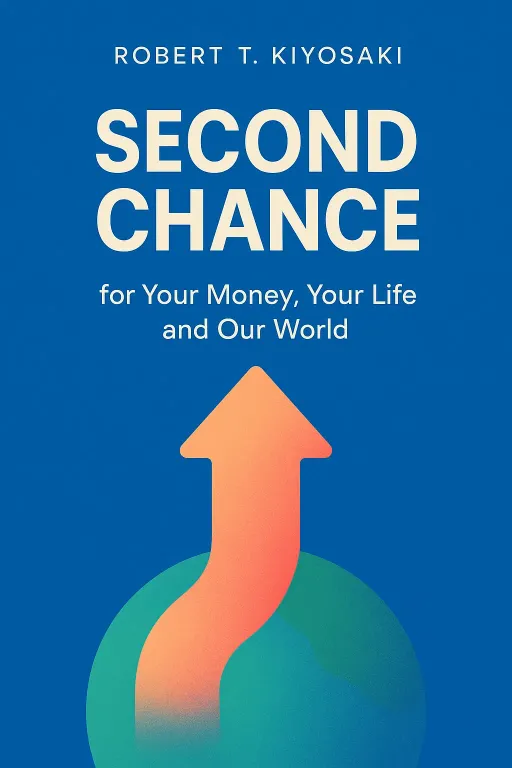
Nova: Exactly! And that’s the provocative premise of Robert Kiyosaki’s book, 'Second Chance,' and today, we're going to debug it with our guest, software engineer hongleiyang056. I'm so glad you're here, because your analytical mind is perfect for this. Today we'll dive deep into this from two perspectives. First, we'll explore the hidden 'backend code' of our financial system and why it's designed to work against you. Then, we'll discuss the single most important 'rule change' you can make: redefining what an asset truly is.
hongleiyang056: I'm excited. I love breaking down complex systems to their fundamental rules. It sounds like that's exactly what Kiyosaki does with money.
Deep Dive into Core Topic 1: The Financial System's 'Backend Code'
SECTION
Nova: It is. So let's start with that hidden system. Kiyosaki calls this the 'Invisible Age,' where the biggest threats are things we can't see. He tells a powerful story about this that really brings it home. He ran into an old friend he hadn't seen in years, a successful professional, who was now working behind the counter at a Starbucks.
hongleiyang056: Oh, wow. What happened?
Nova: The 2007 market crash. This friend had done everything 'right'—good job, nice house, savings. But when the market crashed, his company downsized and he lost his job. He and his wife burned through their entire retirement and savings just trying to stay afloat. Eventually, they lost their house.
hongleiyang056: That's devastating. And it feels so common. You hear stories like that all the time.
Nova: It's heartbreaking. And the friend even made a dark joke about it, saying, "Get it? I work for bucks at Starbucks?" To try and get back on his feet, both he and his son were going back to school to get Master's degrees, funding it all with student loans. So they were getting deeper into debt just to hopefully get a better job someday.
hongleiyang056: So he was hit by a crisis he didn't see coming, and his solution was to follow another part of the old script—'get more education'—which put him in an even more precarious position with debt.
Nova: Precisely. And Kiyosaki asks, what was the invisible force that caused this? It was the derivatives market. Now, that word sounds complicated, but it's basically a bet on a bet. And in 2007, this market was a $700 trillion house of cards. By 2014, when he wrote the book, it had grown to over 1.2 dollars. That's a thousand trillion.
hongleiyang056: A quadrillion? I can't even visualize that number. It's an abstraction.
Nova: It is! It's invisible. Warren Buffett famously called derivatives "financial weapons of mass destruction." They're unregulated, unseen, and can cause a global meltdown, wiping out people like Kiyosaki's friend.
hongleiyang056: Wow. So that's the hidden architecture. It's like a memory leak in a global application. It runs silently in the background, consuming resources, and then suddenly the whole system crashes. The average user—like the friend at Starbucks—has no idea what hit them. They just see the blue screen of death on their life.
Nova: That is the perfect analogy! And Kiyosaki argues this isn't an accident. He calls it GRUNCH—a funny acronym for a terrifying idea: the Gross Universal Cash Heist. It's a system that invisibly steals wealth from the average person through things we're told are normal, like inflation, taxes, and these complex financial games the rich play.
hongleiyang056: So, as an individual, you're essentially an end-user with no admin privileges. You're subject to the rules of a system you can't see or control. The first step, then, has to be learning the system's language, right? To at least be able to read the 'error logs' and understand why things are crashing.
Nova: Yes! You have to become financially educated. You have to learn to see the invisible.
hongleiyang056: It reminds me a bit of my interest in someone like Ruth Bader Ginsburg. She didn't just accept the system as it was; she learned its language so well that she could challenge it from the inside and change the rules. It seems like Kiyosaki is advocating for a similar approach to personal finance.
Nova: I love that connection. It's about empowerment through understanding the system. And that's the perfect transition, because learning the language starts with the most basic vocabulary. And Kiyosaki argues the words 'asset' and 'liability' have been completely corrupted. This is the critical patch we need to install in our financial thinking.
Deep Dive into Core Topic 2: The Fundamental Rule Change: Redefining 'Asset'
SECTION
hongleiyang056: Okay, I'm ready. What's the patch?
Nova: It's beautifully simple. His 'Rich Dad' taught him this over and over: Assets put money in your pocket. Liabilities take money out of your pocket. Period.
hongleiyang056: That's it?
Nova: That's it. But think about the implications. Based on that definition, is your car an asset or a liability?
hongleiyang056: Well, it takes money out for gas, insurance, maintenance... so it's a liability.
Nova: Exactly. Now for the big one. The cornerstone of the American Dream. Is the house you live in an asset or a liability?
hongleiyang056: Hmm. The bank tells you it's your biggest asset. But... there's the mortgage payment, property taxes, insurance, repairs... all of those take money out of my pocket every single month. So, by this definition, it's a liability.
Nova: Bingo! And that one idea is a bombshell. It’s why so many people feel "house rich and cash poor." They're pouring money into a giant liability every month. Kiyosaki uses a great example to illustrate the difference in mindset this creates. He contrasts a real estate with a real estate.
hongleiyang056: Okay, what's the difference?
Nova: The agent works hard to sell, say, 10 houses a year. She earns a commission, which is income, and she pays a high percentage of that income in taxes. She's working for money. The entrepreneur, on the other hand, works to 10 rental houses a year. These houses, if chosen correctly, generate positive cash flow each month after all expenses. That cash flow is an asset putting money in her pocket, and because of depreciation and other tax laws, it's often tax-free income.
hongleiyang056: So the agent is on a hamster wheel of earning and being taxed, while the entrepreneur is building a system that generates money for her automatically.
Nova: You got it. After 10 years, the agent might have earned a lot of money, but the entrepreneur is the one who is truly wealthy and free. She owns the system.
hongleiyang056: Okay, that's a beautifully simple, logical distinction. In programming, we'd call that a functional definition. It's not about what an object called—a 'House' object—but what it. Does its primary method return a positive or a negative cash flow? That clarifies everything. It removes all the emotion and marketing language.
Nova: Right? It cuts through all the noise. And once you see it, you can't unsee it. You start looking at everything differently—your phone plan, your subscriptions, your car...
hongleiyang056: It also changes the goal. The goal isn't to 'own a house.' The goal is to 'acquire assets.' A house be an asset, but only if you, say, rent it out and it generates positive cash flow after all expenses. The focus shifts from the noun, 'ownership,' to the verb, 'cash flow.'
Nova: And that's the second chance! That's the click. It's the moment you stop playing their game, the game of accumulating liabilities you're told are assets, and you start playing your own game: the game of acquiring true, cash-flowing assets.
Synthesis & Takeaways
SECTION
Nova: So, let's bring this all together. It feels like we've covered a lot of ground.
hongleiyang056: We have. But it boils down to two powerful ideas for me. First, acknowledge that the financial system has a hidden 'backend' that isn't necessarily designed for your success. You have to learn to see it.
Nova: And second, install that critical patch in your thinking: the real definition of an asset. An asset feeds you, a liability eats you.
hongleiyang056: Exactly. It's about shifting from being a passive user of a flawed system to becoming an active developer of your own financial future. You start by understanding the system's rules, then you begin to write your own.
Nova: So for someone listening, like you, who's just starting out in their career and wants to improve their personal finance, what's the first practical step? It can feel overwhelming.
hongleiyang056: Well, based on this, the first step isn't to rush out and buy a stock or a property. It's to gather data.
Nova: I love that. Tell me more.
hongleiyang056: Kiyosaki says the very first step is to take out a piece of paper and create your own personal financial statement. Not for a bank, but for you. List your monthly income and your monthly expenses. Then, on the other side, list your assets and liabilities using his strict definition.
Nova: It's a diagnostic tool.
hongleiyang056: It's exactly that. It's like running a profiler on your own code to see where the performance bottlenecks and memory leaks are. Where is your money really going? What is actually putting money in your pocket versus taking it out? It's a simple, data-driven approach. Before you can optimize, you have to measure. That's a first step any analytical person can get behind.
Nova: That is the perfect, most empowering place to start. It's not about having all the answers, it's about starting to ask the right questions about your own financial code. Hongleiyang, thank you so much for debugging this with us today.
hongleiyang056: This was fascinating. Thank you for having me.