

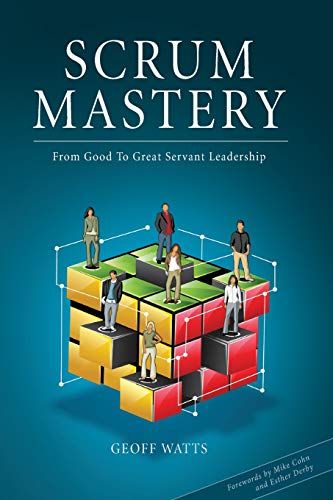
Scrum Mastery
From Good To Great Servant-Leadership
Introduction: Beyond the Scrum Checklist
Introduction: Beyond the Scrum Checklist
Nova: Welcome back to the show. Today, we're diving deep into a book that many experienced practitioners consider essential reading: Geoff Watts' "Scrum Mastery: From Good To Great Servant-Leadership." Alex, how many teams have you seen that are technically 'doing Scrum' but still feel completely stuck?
Nova: Exactly. And that's the entire premise of Watts' work. He argues that the difference between a 'good' Scrum Master and a 'great' one isn't about knowing the Scrum Guide by heart. It’s about a fundamental shift in mindset and behavior. He’s writing for people who already know the rules but aren't seeing the results.
Nova: For me, it was his relentless focus on servant leadership as an active, sometimes uncomfortable, practice. He doesn't just say 'be a servant leader'; he shows you the behavioral patterns that separate the admin from the true coach. We’re talking about moving from being the team’s secretary to being their catalyst. Ready to explore how Watts suggests we make that leap?
Key Insight 1: Respect is Earned Through Behavior
The Mindset Divide: Admin vs. Servant-Leader
Nova: Watts starts by establishing that respect is the foundation. He suggests that a great Scrum Master must earn respect, and he ties this directly to two core qualities: humility and personal integrity. It’s not about having a title; it’s about how you show up.
Nova: He frames it as the willingness to admit you don't know the answer, especially when it comes to the team's technical work. Watts strongly cautions against becoming the 'Scrum Police'—the person who enforces every rule because they fear chaos if they don't. That behavior, he notes, breeds resentment, not respect. You become an obstacle, not an enabler.
Nova: Precisely. That’s the admin trap. The great Scrum Master understands the behind the timebox—to synchronize and inspect progress toward the Sprint Goal. If the team needs an extra five minutes of intense discussion to resolve a critical dependency, the great SM trusts them and protects that time, rather than shutting it down robotically. They prioritize value delivery over rigid adherence to form.
Nova: Yes, but it’s nuanced. Watts suggests integrity isn't just about saying 'no' to stakeholders; it’s about being transparent about the of saying 'yes.' It’s about modeling the behavior you want to see. If the SM cuts corners on their own commitments, the team will follow suit. It’s about walking the talk, especially when it’s hard.
Nova: A good SM facilitates the events. A great SM cultivates the environment. The good one ensures the Sprint Review happens; the great one ensures the Product Owner is prepared to present a compelling, valuable increment and that stakeholders provide meaningful feedback, not just rubber stamps. The good one removes a blocker; the great one coaches the team on how to spot and remove that of blocker themselves next time.
Nova: That’s a fantastic analogy, Alex. And this proactive stance leads directly into how Watts believes the SM should communicate and influence—which is through coaching.
Key Insight 2: Structured Self-Development
The RE-TRAINED Master: A Framework for Growth
Nova: It is. While the full breakdown is best left to the book, the concept itself is powerful. It forces the SM to look beyond the surface-level tasks and assess themselves against a set of defined, high-level competencies. It moves self-assessment from 'Did I run the Daily Scrum?' to 'Did I exhibit the necessary traits today?'
Nova: Those are key. Being 'resourceful' means when a problem arises—say, a critical tool breaks—the great SM doesn't just wait for IT. They might facilitate a quick huddle to brainstorm three alternative, temporary workarounds the team can use while the permanent fix is underway. They connect people and ideas.
Nova: Enabling is about creating psychological safety so the team feels safe enough to fail small and learn fast. For example, if a developer is struggling with a complex task, the enabling SM doesn't jump in and code the solution for them. Instead, they might ask, 'Who on the team has solved something similar recently? Could you pair with them for an hour?' They enable peer-to-peer support, which builds team capability.
Nova: Exactly. And the book also touches on being 'tactful.' In a coaching relationship, tact is everything. You might need to point out a pattern of behavior that’s damaging the team—perhaps the Product Owner is constantly overriding the team’s estimates—but you can’t do it confrontationally. Watts emphasizes delivering hard truths with care, often through observation and gentle inquiry rather than direct accusation.
Nova: It is. And this leads to the idea of 'inspiring.' How do you inspire a team that’s been burned by previous Agile transformations? Watts suggests inspiration comes from consistently demonstrating belief in the team’s potential, celebrating small wins related to process improvement, and connecting their daily work back to the larger organizational vision. It’s about painting a picture of what success looks like, not just what the next task is.
Key Insight 3: Stop Dispensing Information
The Power of Silence: Coaching Through Questions
Nova: Let’s talk about the most common pitfall Watts addresses: the urge to answer every question immediately. Many people step into the SM role because they are experts in process or technology, and that expertise becomes a trap.
Nova: Because when you give the answer, you rob the team of two things: the learning opportunity and the ownership of the decision. Watts champions the power of the powerful question. Instead of answering, the great SM asks, 'What are the trade-offs you see between Option A and Option B?' or 'What does the Product Owner need this structure to support in the next three Sprints?'
Nova: That’s the tension, and Watts acknowledges it. He suggests a rule of thumb: If the team asks a question, try to reframe it as a question back to them. If, after two rounds of coaching questions, they are still genuinely stuck and the Sprint Goal is at risk, you might offer guidance, but you frame it as a suggestion based on your experience, not as a mandate.
Nova: Precisely. And this coaching posture extends to organizational impediments. Watts views impediments not just as technical tickets to be closed, but as symptoms of systemic organizational dysfunction. A good SM fixes the broken server. A great SM asks, 'Why is our deployment process so fragile that one server failure halts everything? Who needs to be involved in fixing that systemic risk?'
Nova: That’s right. They use the team’s reality—the velocity dips, the repeated technical debt—as evidence to coach management on the need for different investment strategies. They use servant leadership to serve the entire organization’s ability to deliver value, not just the immediate development team.
Nova: He does, and it circles back to integrity and respect. You build that capital by consistently delivering value through your coaching, by being reliable, and by never making promises you can’t keep regarding process adherence or team protection. Your track record of successful coaching becomes your shield when you need to challenge a director.
Conclusion: The Path Forward
The Journey Never Ends: Embracing Continuous Mastery
Nova: We’ve covered a lot of ground today, Alex. From moving beyond the checklist mentality to embracing servant leadership, and mastering the art of coaching through powerful questions. If we had to distill Geoff Watts’ message into one core takeaway for our listeners, what would it be?
Nova: I agree completely. The book serves as a powerful mirror. It forces you to look at your own habits. Are you hoarding knowledge because you fear irrelevance, or are you spreading capability because you trust your team? Are you facilitating meetings, or are you cultivating conversations?
Nova: Actionable takeaways: First, audit your own behavior. Are you answering questions that your team could answer themselves? Second, identify one area from the 'mastery' traits—like being more inspiring or more resourceful—and focus on improving that specific behavior for the next two weeks.
Nova: It’s a challenging but incredibly rewarding path. If you’re ready to elevate your practice from simply running Scrum to truly mastering its potential, Geoff Watts’ book is the essential guide for that next level of growth.
Nova: My pleasure, Alex. Keep questioning, keep coaching, and keep growing.
Nova: This is Aibrary. Congratulations on your growth!