

Navigating the Intelligence Era
Golden Hook & Introduction
SECTION
Nova: What if the biggest revolution in human history isn't one we fight, but one we're collectively?
Atlas: Whoa, that's a bold statement right out of the gate, Nova. Raising a revolution? Sounds less like a protest and more like... a complex parenting challenge. I'm intrigued. What are we getting ourselves into today?
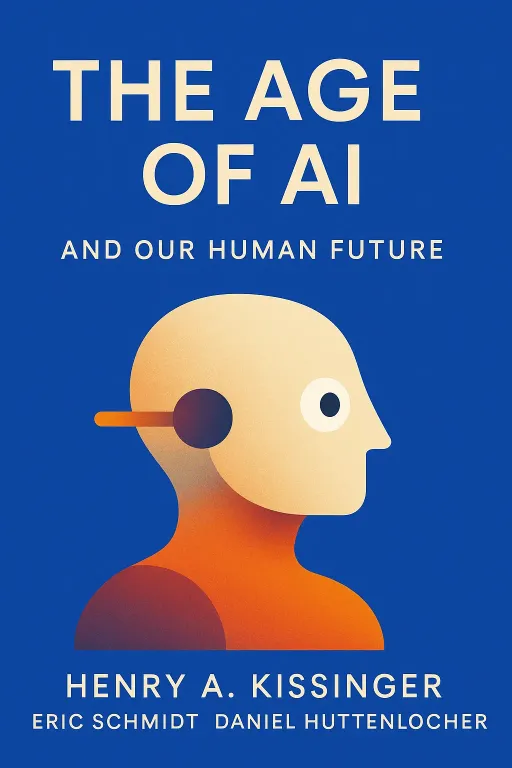
Nova: Exactly! It's a challenge of unprecedented scale and intimacy. Today, we're diving deep into the profound implications of artificial intelligence, drawing insights from two incredibly pivotal perspectives. First, we look at The Age of AI, a groundbreaking work by a truly unexpected trio: Henry Kissinger, Eric Schmidt, and Daniel Huttenlocher.
Atlas: That’s quite the lineup. Kissinger, the legendary diplomat, paired with Schmidt, the former Google CEO, and Huttenlocher, a brilliant technologist. It’s a fascinating combination of geopolitical gravitas and cutting-edge tech insight. What do they tell us?
Nova: They argue that AI is set to redefine human knowledge and the global order itself, much like the Enlightenment did centuries ago. Think about that for a moment. Not just another technological leap, but a fundamental shift in how we understand the world and our place in it. It’s a claim that demands our full attention.
Atlas: Okay, but redefining? That sounds incredibly abstract. We've had scientific revolutions before, but the Enlightenment fundamentally changed how we and structure society. Are they truly saying AI is on that level?
Nova: They are, and it’s not just a philosophical musing. They're talking about a practical, systemic reordering. And then, we pivot to a complementary, yet deeply personal, perspective from Mo Gawdat, former Chief Business Officer at Google X, in his book Scary Smart.
Atlas: Gawdat, the author who wrote that deeply personal book about happiness after a tragic loss. So he’s coming from a very different place than a geopolitical strategist.
Nova: Absolutely. He emphasizes that we must approach AI as a 'child' we are collectively raising. It's a powerful analogy, urging us to focus on teaching it human values of empathy and love to ensure a safe and beneficial future.
Atlas: That makes me wonder, how do these two seemingly disparate views—one about global order, the other about raising a technological 'child'—connect? And more importantly, for our listeners, what does this mean for our everyday professional lives and the skills we're nurturing?
Nova: That's precisely the journey we're embarking on today. We'll explore the monumental scale of AI's societal impact, then we'll discuss the crucial role of human values in shaping its future, and ultimately, what that means for your career strategy.
The Monumental Scale of AI's Impact
SECTION
Nova: So, let's unpack this idea from Kissinger, Schmidt, and Huttenlocher: AI as the new Enlightenment. The Enlightenment was a period where reason, individualism, and science dramatically reshaped political thought, social structures, and our understanding of the universe. It birthed modern democracies and scientific inquiry.
Atlas: Right, it wasn't just about new inventions; it was about a new of thinking, a paradigm shift. But how does AI, which many see as just advanced computation, compare to that kind of fundamental human intellectual awakening?
Nova: The comparison is profound. The Enlightenment challenged traditional authority and replaced it with individual reason. AI, they suggest, challenges human reason itself as the sole arbiter of truth and knowledge. AI systems can process, synthesize, and even information at scales and speeds utterly impossible for any human.
Atlas: So you're saying it's not just about AI giving us answers faster, but fundamentally changing or even?
Nova: Precisely. Consider knowledge generation. Historically, we had human experts, research, peer review. Now, AI can identify patterns in vast datasets that no human could ever perceive, leading to novel discoveries in medicine, materials science, or finance. It can even write code or generate creative content that blurs the lines of human authorship.
Atlas: That sounds a bit unsettling. If AI can generate new knowledge, then our traditional human-centric methods of learning and discovery might become secondary. For our listeners, especially those in highly specialized fields, this could feel like the ground shifting beneath their feet. What does that mean for professional expertise?
Nova: It means the definition of expertise is evolving. The 'human-only' aspects become paramount. While AI can optimize, analyze, and even create, the unique human capacity for judgment, ethical reasoning, empathy, and holistic understanding remains irreplaceable. The authors highlight that AI doesn't in the human sense; it predicts and processes.
Atlas: Okay, so the vulnerability isn't just to automation of tasks, but to the automation of itself. So, if AI is redefining knowledge, where does that leave human intelligence? What aspects of our professional skills are truly resilient against this kind of optimization?
Nova: It pushes us to elevate our uniquely human faculties. The ability to ask truly original questions, to synthesize disparate fields with intuition, to lead with empathy, to innovate beyond current data, and to make nuanced ethical decisions – these are the frontiers. AI doesn't have a conscience or a soul.
Atlas: That's a crucial distinction. It's not just about what AI do, but what humans continue to do to guide its development and application responsibly. It sounds like the skills that are vulnerable are the ones that are purely algorithmic, while the 'human-only' skills are those that involve true wisdom and connection.
Raising AI with Human Values
SECTION
Nova: Which brings us perfectly to Mo Gawdat’s perspective in Scary Smart. He takes this grand, abstract idea of AI redefining global order and grounds it in a profoundly relatable, almost familial, analogy: AI as a child we are raising.
Atlas: Treating AI like a child? I can already hear the skeptics. For a pragmatic leader, that might sound a bit touchy-feely when we're talking about powerful algorithms. What does Gawdat mean by that, practically speaking?
Nova: It’s not whimsical at all; it’s deeply pragmatic. Gawdat, with his background in advanced technology at Google X, saw firsthand the rapid acceleration of AI capabilities. His core argument is that AI learns from us, from the data we feed it, from the interactions we have with it, and from the values embedded in its programming. Just like a child, it absorbs its environment.
Atlas: So, if AI is learning from us, and we're not actively teaching it our best human qualities, then it will simply reflect back our collective biases, our inefficiencies, our worst impulses? That’s a sobering thought.
Nova: Exactly. He argues that our collective responsibility is to ensure that AI's foundational learning is imbued with human values like empathy, love, compassion, and fairness. It's about consciously designing AI to prioritize human well-being, not just efficiency or profit. It’s about raising it to be a benevolent force.
Atlas: How do you even 'teach' empathy to a machine? Is it about complex ethical programming, or is it more subtle than that?
Nova: It's both. It's about explicit ethical frameworks, certainly, but also about the implicit values embedded in the datasets we train it on, the design choices we make, and even the language models we develop. If we bombard AI with negativity, bias, or purely utilitarian logic, that's what it learns. If we prioritize collaboration, understanding, and human connection in its applications, that's what it will reflect. It’s a mirror.
Atlas: That's a powerful idea. For our listeners who are empathetic leaders, this resonates. The skills we use to foster positive team cultures, to lead with compassion, to build trust – those are precisely the values we need to collectively instill in AI. It's not just about the intelligence era, but it.
Nova: It truly is. Gawdat’s message is a call to action: if we want a safe and beneficial AI future, we must be intentional parents, not just passive observers. We have to be the adults in the room, guiding this powerful intelligence toward our highest ideals.
Atlas: So, the 'human-only' skills aren't just about our individual career survival, but about our collective survival and flourishing in an AI-driven world. It's about applying our best human qualities to the most significant technological challenge of our time.
Synthesis & Takeaways
SECTION
Nova: What we've discussed today reveals a powerful duality. On one hand, Kissinger, Schmidt, and Huttenlocher paint a picture of AI as a force so monumental it will reshape our very understanding of knowledge and power structures. It's a grand, almost intimidating, vision.
Atlas: And on the other, Gawdat brings it down to a deeply personal, almost moral, level. He says we have a parental responsibility to nurture AI, to instill it with our best human values – empathy, love, compassion. It's a call for conscious creation.
Nova: The synthesis is this: the intelligence era demands that we not only understand the colossal impact of AI, but also actively and consciously guide its development. The future isn't just happening to us; it's being built by us, piece by piece, algorithm by algorithm.
Atlas: So, for our listeners, especially those pragmatic explorers and focused strategists looking to refine their path and boost effectiveness, this means a critical self-assessment. Which of your professional skills are genuinely 'human-only' – those requiring empathy, nuanced judgment, creative problem-solving, ethical leadership? And which are vulnerable to AI optimization?
Nova: Use that distinction to guide your career transition strategy. Invest in those uniquely human capabilities. Don't just adapt to the AI era; become an active participant in shaping its character. Because the values you cultivate in yourself, as an empathetic leader, are the very values we need to collectively teach our technological 'child'.
Atlas: That’s a profound thought. It's not just about job security, but about moral leadership in a new age. It's about ensuring our future is not just intelligent, but also wise and humane.
Nova: Absolutely. This isn't just about technology; it's about what it means to be human in the age of intelligence.
Atlas: A powerful reminder to embrace the journey of learning, to dedicate time to focused growth, and to amplify our influence and impact by cultivating those essential human qualities.
Nova: This is Aibrary. Congratulations on your growth!