

Scaling Up
How a Few Companies Make It… and Why the Rest Don’t
Introduction
Nova: Did you know that out of the roughly 28 million firms in the United States, only about 4 percent ever make it past one million dollars in revenue? And even more shocking, only about 0.4 percent ever reach ten million. Most businesses don't just stop growing because they run out of ideas; they stop because they hit a ceiling they don't know how to break through. This is the scaling gap, and today we're diving into the blueprint specifically designed to bridge it.
Nova: That is exactly the metaphor Verne Harnish uses in his landmark book, Scaling Up. He calls these moments the valleys of death. Every time a company grows by an order of magnitude, the rules of the game change. Harnish spent decades working with what he calls gazelles, those high-growth companies that are actually responsible for almost all the job creation in the economy, to find out what the 0.4 percent are doing differently.
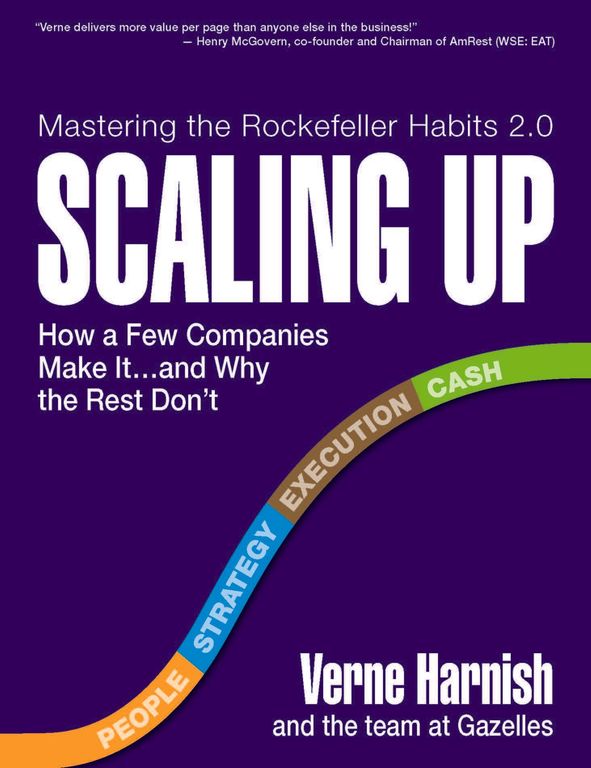
Nova: It's actually much more fundamental. Harnish argues that scaling a business comes down to mastering four key decisions: People, Strategy, Execution, and Cash. If you fail to get even one of these right, your growth will eventually stall or, worse, blow the company apart. Today, we're going to break down those four pillars and look at the actual tools Harnish provides, like the famous One-Page Strategic Plan, to help any business owner stop spinning their wheels and start scaling up.
Key Insight 1
The People Decision
Nova: Let's start with the first pillar, which is People. Harnish says that if you don't have the right people in the right seats, every other part of the business becomes ten times harder. He often asks a provocative question to CEOs: Would you enthusiastically rehire everyone on your team today?
Nova: That's the trap. Scaling Up introduces the concept of the A-Player. These aren't just people who are good at their jobs; they are people who fit your core values perfectly and are in the top 10 percent of the talent available for that specific role. Harnish's point is that one A-Player can often do the work of three B-Players, and they require significantly less management.
Nova: That's where a tool called the FACe comes in, the Functional Accountability Chart. Unlike a traditional org chart that just shows who reports to whom, the FACe chart identifies the key functions of the business, like sales, operations, or even things like the website or the bank relationship. Each function can only have one person's name next to it. If two people are responsible, no one is responsible.
Nova: Core values are the guardrails. Harnish insists that you have to hire, fire, and reward based on those values. If you have a high-performer who is a toxic influence and goes against your values, you have to let them go. He calls them C-Players disguised as A-Players. They might hit their numbers, but they destroy the team's energy and make scaling impossible.
Nova: It is. Scaling is uncomfortable. It requires a shift from being a doer to being a leader. You have to stop doing the work and start building the machine that does the work. And that machine is built out of people. If you're spending all your time putting out fires, it's usually a sign that you have a People problem, not a fire problem.
Nova: You've got the engine, but you still need a map. That brings us to the second decision: Strategy. Without a clear strategy, your talented team will just be running very fast in different directions.
Key Insight 2
The Strategy Decision
Nova: Strategy is where most companies get confused. They think a strategy is a goal, like we want to increase revenue by twenty percent. But Harnish is very clear: a goal is where you want to go; strategy is how you are going to get there in a way that makes you unique.
Nova: Actually, Harnish would say that's a recipe for disaster. If you're trying to be everything to everyone, you end up being nothing to anyone. He uses a framework called the 7 Strata of Strategy. It's about finding that one thing you can be the best at, your core competency, and then building a moat around it. One of the most important parts of this is the Brand Promise.
Nova: No, more like a measurable guarantee. For example, if you're a shipping company, your brand promise might be on-time delivery. But here's the kicker: if you fail to deliver on that promise, it has to hurt you. There has to be a catalyst, like a refund or a penalty. That pain is what keeps the organization aligned and focused on what actually matters to the customer.
Nova: That is exactly why Harnish created the One-Page Strategic Plan, or the OPSP. It is the holy grail of the Scaling Up methodology. It forces you to condense your entire strategy onto a single sheet of paper. Your core values, your purpose, your 10-year goal, which he calls the BHAG, or Big Hairy Audacious Goal, and your one-year and quarterly targets.
Nova: That's the point. If you can't fit it on one page, it's too complicated for your team to remember. Harnish says that for a strategy to work, every single person in the company, from the CEO to the person answering the phones, should be able to look at that page and understand how their work today connects to the company's goals ten years from now.
Nova: Precisely. You've hit on the third decision: Execution. This is where most strategies go to die. Harnish says that if People and Strategy are the brain and heart of the company, Execution is the nervous system.
Key Insight 3
The Execution Decision
Nova: Execution in the Scaling Up world is all about habits. In fact, the original name for the methodology was the Rockefeller Habits, named after John D. Rockefeller, who was legendary for his disciplined approach to business. Harnish argues that there are three key habits: Priorities, Data, and Rhythm.
Nova: I hear you, but Harnish's version of meetings is totally different. He advocates for the Daily Huddle. It's a fifteen-minute, standing-up meeting. No chairs allowed. You go over what's happening in the next twenty-four hours, look at the key metrics, and identify any roadblocks.
Nova: Because you're not solving problems in the huddle; you're just surfacing them. If a problem needs a deeper dive, you schedule a separate time for the people involved. The daily huddle is about synchronization. It's like a sports team quickly checking in before the next play. It keeps the communication loops tight. When you scale, communication usually breaks down, and these huddles are the fix for that.
Nova: That's why Harnish insists on having a Critical Number. At any given time, there should be one or two metrics that are the most important for the health of the company. Everyone should know what those numbers are and whether they are green, yellow, or red. It creates a sense of accountability. If the numbers are down, the team knows they need to pivot before it's too late.
Nova: Priorities are about focus. Harnish says you should never have more than three to five priorities for the year or the quarter. And within those, you should have one Top Priority. If everything is a priority, nothing is. Scaling requires a ruthless focus on the things that will actually move the needle.
Nova: Exactly. And that discipline pays off because it leads to the fourth and final decision, which is often the most overlooked by growing companies: Cash. Because here's a hard truth from the book: growth sucks cash.
Key Insight 4
The Cash Decision
Nova: Most entrepreneurs think that if they're growing and profitable, they're doing great. But Harnish points out that you can literally grow yourself into bankruptcy. When you scale, you have to spend money on people, inventory, and space before you ever see the revenue from those investments. If you don't manage your cash flow, your growth becomes your undoing.
Nova: That's a perfect analogy. Harnish introduces a concept called the Cash Conversion Cycle, or CCC. It's the amount of time it takes from the moment you spend a dollar on rent or payroll until that dollar comes back into your pocket from a customer. The goal of scaling is to make that cycle as short as possible, or even better, negative.
Nova: Exactly. Think about a company like Dell in its early days. You'd order a computer, pay for it, and then they'd use your money to buy the parts and build it. They were essentially using their customers to fund their growth. Harnish provides seven levers to improve your cash flow, like shortening your payment terms or increasing your prices.
Nova: But Harnish argues that if you have a strong strategy and a unique brand promise, you have the power to charge what you're worth. A small increase in price can have a massive impact on your bottom line and your cash reserves. He wants companies to have at least six months of operating expenses in the bank. That's what gives you the confidence to make bold moves.
Nova: And it allows you to take advantage of opportunities that your competitors can't. When a recession hits or a competitor falters, the company with the cash is the one that wins. Cash isn't just about survival; it's about agility. It's the fuel that allows you to accelerate when everyone else is hitting the brakes.
Conclusion
Nova: We've covered a lot today. We looked at how scaling requires the right people in the right seats, a strategy that sets you apart from the crowd, a disciplined execution rhythm with clear data, and a ruthless focus on managing your cash. It's a comprehensive framework, but it all starts with that one-page strategic plan.
Nova: If you're a business owner or a leader, the takeaway is simple: pick one of these areas to focus on this quarter. Maybe it's implementing a daily huddle, or maybe it's finally getting your core values down on paper. Don't try to do it all at once. Scaling is a marathon, not a sprint.
Nova: Verne Harnish's Scaling Up is more than just a book; it's a operating system for growth. If you're feeling stuck in one of those valleys of death, this might be exactly what you need to break through. Thank you for joining us on this deep dive into the world of high-growth business.
Nova: This is Aibrary. Congratulations on your growth!