The Hidden Math of Life, Cities, and Companies: Unlocking the Laws of Scale
Golden Hook & Introduction
SECTION
Nova: Imagine a tiny shrew, its heart beating a thousand times a minute, living for just two years. Now, picture a massive blue whale, gliding through the ocean with a slow, steady pulse, living for a century. On the surface, they couldn't be more different. But if you count their total heartbeats over a lifetime, they both get roughly one and a half billion. Why does life keep such a strict mathematical ledger? Welcome to the show, everyone! I am Nova, and today we are diving into the mind-bending world of complexity, networks, and universal laws. Joining me is the wonderfully analytical and ever-curious Dana Coleen Pineda. Dana, when you first hear that heartbeat stat, what goes through your mind?
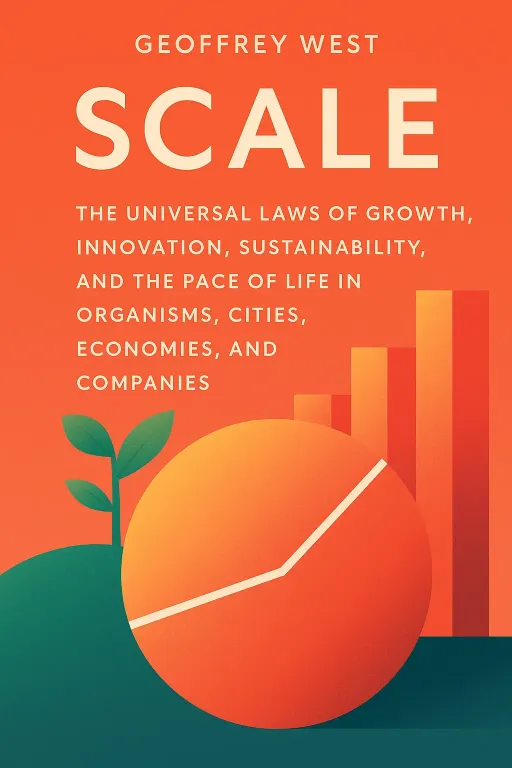
Dana Coleen Pineda: Oh, it immediately sparks this intense curiosity, Nova! It tells me that beneath the messy, beautiful chaos of biology, there is an underlying order. It is as if nature is operating on a hidden blueprint. And that is exactly what physicist Geoffrey West set out to prove in his book,. He shows us that whether we are looking at the cells in our bodies, the infrastructure of our cities, or the balance sheets of Fortune 500 companies, they are all governed by the exact same mathematical scaling laws.
Nova: It is absolutely wild! Today, we are going to tackle this book from two fascinating angles. First, we will explore how nature uses fractal networks to optimize life and why ignoring these scaling laws can be downright fatal. Then, we will shift our lens to human systems, comparing the explosive, open-ended growth of cities with the surprisingly biological mortality of companies. Ready to crack the code, Dana?
Dana Coleen Pineda: I am so ready, Nova. Let's do it.
Deep Dive into Core Topic 1
SECTION
Nova: Awesome. Let's start with a story from the book that is both tragic and a massive warning sign about how we think. Back in 1962, a group of researchers at the University of Oklahoma decided to study the effects of LSD on elephants. They wanted to see if it would trigger a condition called musth, which is this period of high aggression. They chose a bull elephant named Tusko. Now, to figure out the dosage, they looked at what was safe for a cat. A cat weighs about three kilograms, and a safe dose is about point-one milligrams. Tusko weighed three thousand kilograms. So, they did some quick, simple math. Tusko is one thousand times heavier than a cat, so he should get one thousand times the dose, right? They injected him with nearly three hundred milligrams of LSD.
Dana Coleen Pineda: Oh, no. I can see where this is going, and it is a classic, devastating example of the linear thinking trap.
Nova: Exactly! It was a disaster. Tusko collapsed almost immediately and died an hour and forty minutes later. The researchers assumed elephants were just incredibly sensitive to the drug. But as Geoffrey West points out, the real culprit was bad math. They assumed a linear relationship between body mass and drug dosage.
Dana Coleen Pineda: Right, they assumed that if you double the mass, you double the dose. But biology does not work that way. It is non-linear. In fact, metabolic rate—the speed at which an organism processes energy and clears chemicals—scales sublinearly. Specifically, it follows what we call Kleiber's Law, which has a scaling exponent of three-quarters, or point-seven-five. This means that as an organism grows larger, it actually becomes more efficient. If you double the size of an animal, its metabolic rate doesn't double; it only increases by about seventy-five percent. So, Tusko's metabolism was running much slower than a cat's relative to his weight. He was massively, tragically overdosed because the researchers ignored the laws of scale.
Nova: It is a heartbreaking lesson, but it perfectly illustrates why size really matters. And this three-quarters exponent—this "magic number four" as West calls it—shows up everywhere in biology. Why is that, Dana? Why does life scale in quarters rather than nice, neat halves or thirds?
Dana Coleen Pineda: It all comes down to the geometry of the networks that keep us alive. Think about your circulatory system. It has to do three things. First, it has to be space-filling, meaning it must reach every single cell in your body. Second, the terminal units—the capillaries where oxygen is actually delivered—have to be the same size, whether you are a mouse or a whale. A whale's cells aren't giant; they are the same size as ours, he just has way more of them. And third, the network has to be optimized to minimize the energy required to pump blood. When you translate those three physical constraints into mathematics, the equations naturally spit out quarter-power scaling.
Nova: Wow. So, our blood vessels are essentially optimized fractal branching networks. Because they are fractals—meaning they look self-similar whether you zoom in or out—they maximize surface area within a three-dimensional space.
Dana Coleen Pineda: Exactly! By maximizing that exchange surface, fractal geometry effectively gives life an extra dimension. It is as if we are operating in a four-dimensional biological space, even though we live in a three-dimensional physical world. That is why the number four is baked into our very physiology. It is how nature solves the problem of getting energy to trillions of cells without the heart having to work itself to death.
Nova: That is mind-blowing. It also explains why we don't see land animals the size of Godzilla. I mean, I love a good monster movie, but Galileo actually figured out why Godzilla is physically impossible centuries ago, right?
Dana Coleen Pineda: Yes! Galileo's scaling argument is so elegant. He pointed out that as you scale up an object, its volume and weight grow much faster than its surface area or cross-sectional area. Weight scales with the cube of length, while the strength of your bones only scales with the square of their cross-sectional area. So, if you scale a lizard up to the size of Godzilla, its weight increases by a factor of millions, but its leg bones only get thousands of times stronger. Godzilla's legs would have to be so thick to support his weight that he would essentially be all leg, and even then, his bones would instantly shatter under his own gravity.
Nova: I guess Godzilla won't be joining us for a cardiovascular checkup anytime soon! But it is fascinating how these physical constraints set hard limits on both the minimum and maximum size of life. A mammal can't be smaller than the Etruscan shrew, which weighs only two grams, because its heart would have to beat so fast to keep up with heat loss that it would literally burn out. And a land mammal can't be much bigger than an elephant because of gravity and oxygen diffusion limits. Nature has optimized us to a razor's edge.
Dana Coleen Pineda: It really has. And what I find so beautiful about this, Nova, is that it shows how individual variations—what we call individuality—are just minor deviations around these massive, universal scaling laws. We are all variations on a single, mathematically optimized theme.
Deep Dive into Core Topic 2
SECTION
Nova: That is a perfect transition to our next big topic. Because as humans, we didn't just stop at biological evolution. We started building cities and companies. And Geoffrey West asks this incredibly provocative question: Are cities and companies just giant, scaled-up organisms?
Dana Coleen Pineda: It is a brilliant question. On the surface, we use biological language all the time, right? We talk about the "heart" of the city, the "brain" of a company, or a business "growing" and "dying." But when West looked at the data, he found a massive, fundamental difference in how they scale. And this difference explains why cities seem almost immortal, while companies are incredibly fragile.
Nova: Let's talk about that urban immortality first. It is actually really hard to kill a city. Think about Hiroshima and Nagasaki. Seventy years ago, they were devastated by atomic bombs. Yet, just thirty years later, they were thriving, bustling cities again. Why are cities so resilient?
Dana Coleen Pineda: It is because of how they scale. In biology, as we discussed, scaling is sublinear—the exponent is less than one. This means growth eventually slows down and stops. But in cities, socioeconomic metrics—things like wages, wealth, patents, creative ideas, and even negative things like crime and disease—scale. The exponent is approximately one-point-one-five.
Nova: One-point-one-five! So, that means if you double the size of a city, you don't just get double the innovation or double the wealth. You get a fifteen percent systematic increase!
Dana Coleen Pineda: Exactly! It is the ultimate economy of scale, but with an added bonus of increasing returns. The bigger the city, the more the average individual systematically owns, produces, and consumes. And this happens because cities are, at their core, social networks. They are physical incubators for human interaction. When you pack more people together, the number of potential interactions doesn't grow linearly; it explodes. That connectivity drives innovation, creativity, and wealth creation. It is why cities are the engines of civilization.
Nova: And at the same time, the physical infrastructure of the city—the length of roads, water pipes, electrical cables, the number of gas stations—actually scales, with an exponent of about point-eight-five. So, you get a fifteen percent savings on infrastructure every time a city doubles in size, while getting a fifteen percent boost in socioeconomic activity. Talk about a win-win!
Dana Coleen Pineda: It is incredibly efficient. But here is the catch, and this is where the analytical side of my brain gets a bit worried. Superlinear growth is exponential. It leads to what mathematicians call a "finite-time singularity." Basically, the system requires infinite resources and infinite growth in a finite amount of time to avoid collapse.
Nova: That sounds terrifying. How do we avoid that collapse?
Dana Coleen Pineda: Historically, we have avoided it through major paradigm shifts—innovations that reset the clock. Think of the transition from stone to bronze, the Industrial Revolution, the invention of the computer, the internet. Each of these resets the growth curve. But because the growth is superlinear, the time between these necessary innovations has to get shorter and shorter. We are on an accelerating treadmill. We have to innovate faster and faster just to stay in the same place.
Nova: It is like that scene in where the Red Queen says you have to run as fast as you can just to stay in the same place! But now, let's contrast this with companies. If cities have this superlinear, immortal growth, why do companies die? I mean, think about the corporate landscape. Where are the companies from a hundred years ago? Most of them are gone.
Dana Coleen Pineda: Yes, the mortality rate of companies is shockingly high, and their growth curves look almost exactly like biological organisms. Unlike cities, companies scale when it comes to assets, income, and sales relative to their number of employees. Their scaling exponent is around point-nine.
Nova: Point-nine! So, as a company gets bigger, it actually becomes efficient per employee, not more. It behaves like a mammal, not a city. Why does that happen?
Dana Coleen Pineda: It is a fascinating organizational shift. When a company starts out, it is highly innovative, dynamic, and driven by social networks—much like a young city. But as it grows, it has to establish structure, rules, and bureaucracy to survive. The leadership starts focusing on efficiency, risk minimization, and administration. The corporate "circulatory system" becomes rigid. They stop fostering the open-ended social interactions that drive innovation.
Nova: Ah, so they trade their creative, superlinear social networks for rigid, sublinear administrative networks. They become bureaucratic dinosaurs.
Dana Coleen Pineda: Precisely. They become so focused on maintaining the status quo and servicing their internal bureaucracy that they lose their ability to adapt to changing environments. And because they scale sublinearly, their growth eventually stagnates, just like an animal reaching maturity. Once they stop growing, any major market perturbation—like a new technology or a financial crisis—can easily kill them. They have bounded lifespans.
Nova: It is a wild paradox. The very things we build to be stable and structured—companies—are the ones that die. While the messy, chaotic, unstructured things—cities—are the ones that live forever. It really makes you rethink what "good management" actually looks like.
Dana Coleen Pineda: It really does. It suggests that if a company wants to survive, it has to find ways to keep its internal social networks open, messy, and collaborative. It has to allow for "emergent" behavior, rather than trying to control everything from the top down.
Synthesis & Takeaways
SECTION
Nova: This has been such an incredible journey through the laws of scale, Dana. We have gone from the heartbeat of a shrew to the tragic story of Tusko, all the way to the accelerating treadmill of our modern megacities and the fragile lifespans of corporations. If you had to synthesize the core lesson of Geoffrey West's work for our listeners, what would it be?
Dana Coleen Pineda: I think the most powerful takeaway is the danger of linear thinking in a non-linear world. We naturally want to believe that if we double the input, we will double the output. But whether we are designing public health policies, managing a business, or planning our cities, we have to understand the network constraints at play. We need to shift our focus from raw, unchecked growth to sustainable, network-optimized development.
Nova: That is so beautifully put. We have to respect the networks that sustain us. And for our listeners out there, here is a thought-provoking question to carry with you today: In your own life, your projects, or your organization, are you building rigid, bureaucratic structures that limit your growth, or are you fostering the open, collaborative social networks that spark true innovation?
Dana Coleen Pineda: That is the ultimate question, Nova. If we want to thrive on this rapidly urbanizing planet, we have to learn to design for complexity, not just simplicity.
Nova: Absolutely. Thank you so much, Dana, for bringing your brilliant analytical mind to this conversation today. It has been an absolute blast.
Dana Coleen Pineda: Thank you, Nova! I loved every minute of it.
Nova: And to all our listeners, thank you for tuning in. Keep asking questions, keep looking for those hidden connections, and we will see you next time!