Personalized Podcast
Golden Hook & Introduction
SECTION
Dr. Celeste Vega: Did you know that from a tiny, hyperactive shrew to a massive, slow-gliding blue whale, almost every single mammal gets roughly one and a half billion heartbeats in a lifetime? It sounds like a myth, right? But it is a real, documented biological pattern. The shrew just burns through its billion and a half heartbeats in a couple of frantic, high-speed years, while the whale stretches them out over a century.
Nishat Tasnime: That is absolutely mind-blowing, Celeste. It is like nature has this hidden, universal budget bookkeeper, ticking off the seconds. As someone who spends all day looking at market trends and consumer behavior, I am always searching for patterns, but this is on a whole different level. It makes you realize that beneath the chaotic surface of life, there are these rigid, mathematical rules running the show.
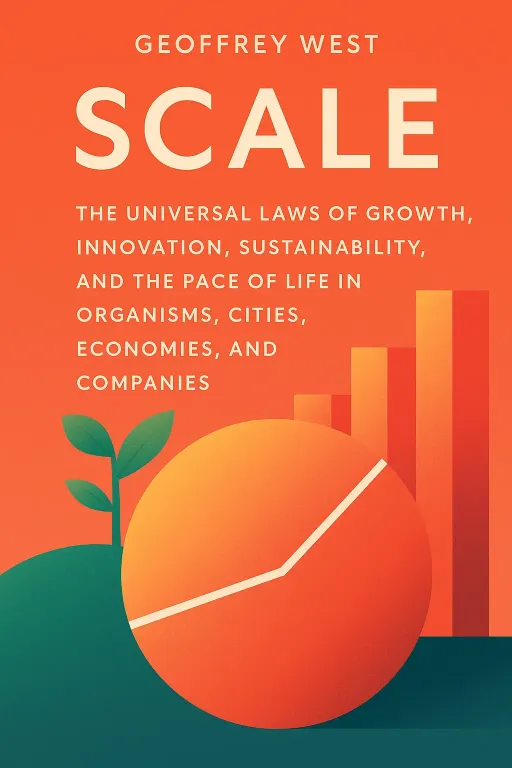
Dr. Celeste Vega: Exactly! And those rules are what physicist Geoffrey West calls the laws of scaling. Today, we are diving deep into his seminal book,. We are going to tackle this mind-expanding book from two distinct angles. First, we will look at sublinear scaling, basically, how nature uses networks to save energy as things get bigger, and the tragic consequences when humans ignore this math. Then, we will shift to the socioeconomic world to explore why companies are structurally destined to die like animals, while cities manage to achieve a kind of immortality.
Nishat Tasnime: I love that roadmap. It is a perfect bridge between the natural world and the systems we build as humans. I can already see how this applies to how we scale brands and organizations. Let us start with the biology. How does a whale actually manage to be so much more energy-efficient than a shrew?
Deep Dive into Core Topic 1
SECTION
Dr. Celeste Vega: It all comes down to what is called sublinear scaling, or more simply, economies of scale. You might think that if an organism is twice as heavy as another, it needs twice as much food and energy to stay alive, right? That seems like common sense. But it is completely wrong. In biology, metabolic rate scales to the three-quarter power of mass. This is known as Kleiber's Law. If you double the size of an animal, you only need about seventy-five percent more energy, not one hundred percent.
Nishat Tasnime: Wow, so the larger you get, the more efficient you become on a per-cell basis. It is like a massive bulk discount on energy. But why? What is the physical mechanism behind this discount?
Dr. Celeste Vega: It is all about the plumbing, Nishat. Whether you are a tree or a human, you have to distribute resources, like oxygen, water, and nutrients, to every single cell. To do this, life evolved hierarchical, branching networks. Think of your blood vessels. You start with one massive pipe, the aorta, which branches into smaller arteries, which branch again and again, all the way down to microscopic capillaries. West and his colleagues discovered that these networks are optimized by natural selection to minimize the energy required to pump fluid. Because the terminal units, the capillaries, are basically the same size whether you are a mouse or an elephant, the larger network becomes mathematically more efficient at distributing resources.
Nishat Tasnime: That is fascinating. So the infrastructure of the network itself creates the efficiency. But you mentioned tragic consequences when humans ignore this math. What happens when we apply linear thinking to a nonlinear world?
Dr. Celeste Vega: Oh, there is a devastating historical example of this from 1962. A group of researchers wanted to study the effects of LSD on elephants. They decided to test it on a prized bull elephant named Tusko at the Oklahoma City zoo. Now, to figure out the dosage, they used simple, linear proportionality. They knew a safe dose for a cat was about zero point one milligrams per kilogram. So, they literally just multiplied that ratio by Tusko's weight, which was about three thousand kilograms. They injected him with nearly three hundred milligrams of LSD.
Nishat Tasnime: Oh no. Let me guess. An elephant's metabolism does not scale linearly with a cat's.
Dr. Celeste Vega: Exactly. They fell straight into the seductive trap of linear thinking. Because of sublinear scaling, Tusko's metabolic rate and drug-processing capacity were vastly lower than a simple weight ratio would suggest. His system was completely overwhelmed. Tragically, Tusko collapsed and died a little over an hour later. If they had scaled the dosage based on metabolic rate and network transport, which scales to the three-quarter power, they would have given him a tiny fraction of that amount.
Nishat Tasnime: That is a heartbreaking story, but it is such a powerful lesson. In marketing, we see this all the time. People assume that if you double your ad spend, or double the size of your target audience, you will get double the results. But networks do not work that way. There is a saturation point, a drag, and a change in the internal dynamics of how information spreads. If you do not understand the underlying network structure of your market, you are essentially injecting your budget with a lethal dose of linear assumptions.
Dr. Celeste Vega: That is a brilliant connection, Nishat! We treat systems as if they are just collections of independent parts, but they are actually defined by their connections. And that brings us to the physical limits of these networks. Why can't we have a mammal the size of Godzilla? Or why aren't there mammals the size of ants?
Nishat Tasnime: Right, Galileo actually wrote about this, didn't he? The idea that you can't just scale up a structure indefinitely because its weight increases faster than its strength.
Dr. Celeste Vega: Yes! Galileo's scaling argument is beautiful. Weight is proportional to volume, which is three-dimensional, while the strength of a bone or a column is proportional to its cross-sectional area, which is only two-dimensional. If you scale up Godzilla to be a hundred meters tall, his weight increases by a factor of millions, but his leg bones only get thousands of times stronger. He would literally collapse under his own weight the moment he tried to take a step.
Nishat Tasnime: So biology has these hard physical boundaries. You can only optimize a branching network so much before the physics of gravity and fluid dynamics say, "No more." But what happens when we transition from biological networks to social networks? Because that is where things get really wild.
Deep Dive into Core Topic 2
SECTION
Dr. Celeste Vega: This is where we pivot to the "Urbanocene," our modern, city-dominated world. And this is where the math completely flips. While biology scales sublinearly, meaning bigger equals slower and more efficient, socioeconomic quantities in cities scale superlinearly. The exponent is typically around one point one five.
Nishat Tasnime: Wait, superlinearly? So, as a city grows, it actually gets faster and more productive per capita?
Dr. Celeste Vega: Precisely! If you double the size of a city, you don't just get double the economic output. You get a fifteen percent systematic increase per capita in wages, wealth, patents, and creative ideas. But, because the universe is fair and thermodynamics is undefeated, you also get a fifteen percent increase per capita in crime, traffic, and infectious diseases.
Nishat Tasnime: That is incredible. So, a person living in a city of eight million is systematically more productive, more innovative, but also more exposed to crime than that exact same person living in a city of one million. Why does this happen?
Dr. Celeste Vega: Because cities are ultimately social networks. Unlike biological networks, which are designed to distribute physical resources to fixed locations, urban networks are designed to facilitate human interaction. They are social incubators. As more people pack into a dense space, the number of potential interactions doesn't just grow linearly; it explodes. This density creates a positive feedback loop of ideas, collaboration, and innovation. It is what we call "increasing returns to scale."
Nishat Tasnime: This makes total sense from a marketing and cultural perspective. It is why creative industries cluster in places like New York, London, or Silicon Valley. The physical infrastructure of the city, the roads, the transit, the water pipes, actually scales sublinearly, saving the city fifteen percent on infrastructure costs per capita. But the social interactions scale superlinearly. It is the ultimate double win: you save on costs, and you multiply on output. But what about companies? Because companies are also collections of people, right? Do they scale like cities?
Dr. Celeste Vega: You would think so, but this is one of Geoffrey West's most surprising findings. Companies do not scale like cities. They scale like organisms. Their assets, income, and productivity scale sublinearly with their number of employees, with an exponent of around point nine.
Nishat Tasnime: Wow. So as a company gets bigger, it actually becomes less innovative and more efficient in a stagnant, bureaucratic way, rather than more creative?
Dr. Celeste Vega: Exactly. As a company grows, it has to establish strict administrative structures, rules, and protocols to keep from descending into chaos. The leadership starts focusing more on minimizing risk, optimizing efficiency, and maintaining the status quo. In doing so, they strangle the very social networks that foster innovation. The company transitions from being a dynamic, superlinear social network to a rigid, sublinear distribution network. It becomes a biological beast. And because it scales like an organism, it eventually stops growing, stagnates, and dies.
Nishat Tasnime: That is a profound insight for anyone in business. It explains the classic corporate lifecycle. Startups are like mini-cities, chaotic, highly connected, superlinear, and bursting with ideas. But as they scale, they implement HR policies, silos, and middle management. They transition into organisms. They trade their creative chaos for predictable efficiency, but in doing so, they sign their own death warrant.
Dr. Celeste Vega: Yes! And the data back this up. West analyzed thousands of publicly traded US companies and found that the probability of a company dying is remarkably constant, regardless of its age. Most companies don't make it past fifty years. Yet, cities are incredibly resilient. Think about it: it is almost impossible to kill a city. Hiroshima and Nagasaki were devastated by atomic bombs, and yet, thirty years later, they were thriving metropolises again. But when a major corporation like Lehman Brothers or Enron takes a hit, they vanish overnight.
Nishat Tasnime: That contrast is stunning. A city is decentralized and adaptive; its citizens can self-organize and pivot when a crisis hits. But a company is centralized and top-down. If the brain of the organism fails, or if the rigid distribution network gets blocked, the whole system collapses. It shows that diversity and open-ended connectivity are the keys to long-term resilience.
Synthesis & Takeaways
SECTION
Dr. Celeste Vega: Absolutely. To wrap things up, Geoffrey West's shows us that whether we are looking at the capillaries in our lungs, the streets of Tokyo, or the organizational chart of a Fortune 500 company, we are looking at the mathematics of networks. Nature uses sublinear scaling to conserve energy and sustain life, but this limits maximum size. Human social networks in cities use superlinear scaling to drive open-ended growth and innovation, but this creates an accelerating pace of life that puts immense stress on our planet's resources.
Nishat Tasnime: It really forces us to confront the sustainability of our current model. If cities require continuous, accelerating innovation to avoid a systemic collapse, we are on a treadmill that keeps moving faster and faster. For me, the big takeaway is that we need to design our organizations and our marketing strategies to mimic cities rather than rigid organisms. We must foster open, decentralized networks, embrace a bit of creative chaos, and prioritize resilience over mere, short-term linear efficiency.
Dr. Celeste Vega: Well said, Nishat. And for our listeners, we leave you with this question to ponder: In your own life, your career, or your business, are you building a rigid, vulnerable organism, or are you cultivating a dynamic, resilient city?
Nishat Tasnime: Thank you, Celeste. This has been an incredibly eye-opening conversation.
Dr. Celeste Vega: Thank you, Nishat, and thanks to everyone for listening. Until next time, keep looking for the patterns beneath the noise.