The Sapiens Blueprint: Deconstructing History to Build Your Future
10 minGolden Hook & Introduction
SECTION
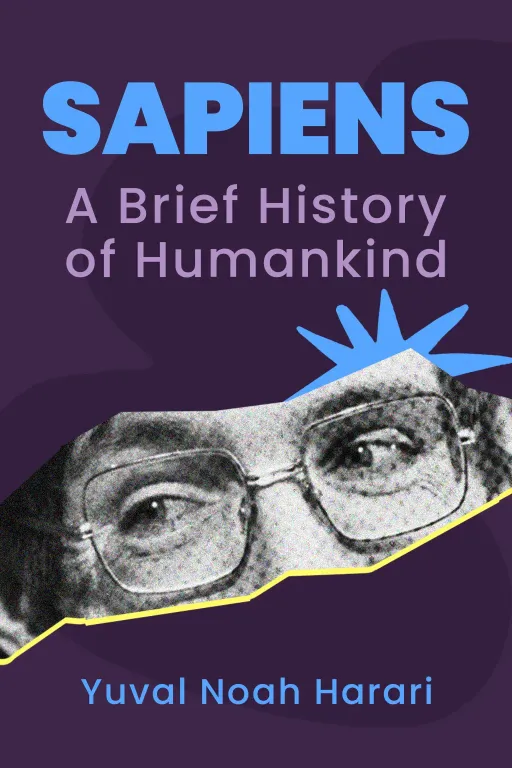
Dr. Celeste Vega: What if I told you that the most powerful tool for shaping your future—for building a career, for innovating, for understanding yourself—isn't a new piece of tech or a productivity hack, but a secret hidden 70,000 years in our past? We're talking about the moment our ancestors,, went from being insignificant animals to the rulers of the planet. Today, with my guest Muluken, a curious and analytical thinker from the world of media, we're diving into Yuval Noah Harari's masterpiece,. We're not just recapping history; we're looking for the source code of human power and anxiety.
Dr. Celeste Vega: Today we'll dive deep into this from two powerful perspectives from. First, we'll explore the 'software upgrade' that made us who we are—our ability to create shared realities. Then, we'll discuss the psychological price of our rapid success, and what Harari calls our 'banana republic dictator' complex. Muluken, welcome. Are you ready to deconstruct history to build a better future?
Muluken: Absolutely, Celeste. Thanks for having me. As someone in my early 20s thinking about creativity and leadership, the idea that our success is built on storytelling is fascinating. It feels like the ultimate lesson in branding and influence, and I can't wait to get into it.
Deep Dive into Core Topic 1: The Software Upgrade
SECTION
Dr. Celeste Vega: Exactly! And that's our first big idea: the Cognitive Revolution. Harari argues it wasn't bigger brains or sharper tools that gave us the ultimate edge over all other species, including other humans like the Neanderthals. It was a change in our minds, a kind of cognitive mutation that allowed for what he calls 'fictive language.'
Muluken: Fictive language. So, you mean like fiction? Like telling stories?
Dr. Celeste Vega: Precisely. But not just telling stories for entertainment. It's the ability to speak about, and more importantly,, things that don't have a physical reality. A lion can't do that. A chimp can signal, 'Danger! Eagle!' But it can't say, 'The great eagle spirit is the guardian of our tribe.' That second sentence, that fiction, is what changes everything.
Muluken: How so? What does believing in a 'great eagle spirit' actually accomplish?
Dr. Celeste Vega: It allows for large-scale, flexible cooperation. Harari paints this vivid picture. Imagine a valley 50,000 years ago. There's a band of strong, intelligent Neanderthals. They can cooperate, but only in small numbers, maybe 30 to 50 individuals, based on intimate, personal knowledge of each other. Then, a group of arrives. They aren't necessarily stronger individually. But they share a common myth—a belief in a tribal ancestor, a spirit, a god. That shared story allows 150 of them to trust each other, even if they're strangers. They can coordinate a massive hunt, defend a large territory, and develop complex social rules. In the long run, who do you think wins the valley?
Muluken: The group of 150, every time. Their numbers and coordination would be an overwhelming advantage. That's incredible. So a corporation, like the ones Bill Gates or Steve Jobs built, is just a highly evolved version of that tribal myth? It's really just a legal concept, a piece of paper, but it's a fiction that allows thousands of strangers all over the world to cooperate towards a single goal.
Dr. Celeste Vega: You've hit the nail on the head. That's the core of the argument. A company like Microsoft or Apple isn't a physical thing. You can't point to it. It's a legal fiction that we all agree to treat as real. The 'great lion spirit' is now the company's mission statement or its brand identity. And Harari argues that money is the most successful fiction ever created. It's just paper or digital code with no intrinsic value, but because billions of us believe in it, it can turn a piece of fruit in one country into a medical device in another.
Muluken: Wow. You know, that really changes how I see my field. For someone in media or publishing, it means our job isn't just to report on objective reality. We're actively participating in the creation and maintenance of these fictions—the stories that define our culture, our economy, our politics.
Dr. Celeste Vega: It's a huge responsibility, isn't it? Harari would say we live in a dual reality. There's the objective reality of rivers, trees, and lions. And then there's the imagined, or 'inter-subjective,' reality of nations, human rights, laws, and Google. The second reality, the one made of stories, is now more powerful than the first.
Muluken: That's a profound thought. It's an incredible source of power and creativity. The people I admire, the great innovators, they weren't just good at making things. They were master storytellers. Steve Jobs didn't just sell a phone; he sold a story about rebellion, creativity, and thinking differently. He created a fiction that people wanted to be a part of.
Dr. Celeste Vega: Exactly. He was tapping into that 70,000-year-old software in our brains.
Deep Dive into Core Topic 2: The Anxious Apex Predator
SECTION
Dr. Celeste Vega: It is a huge power. But that naturally leads us to the second, and much darker, idea from. What happens when an animal gets that much power, that fast? Harari has this chilling analogy that has always stuck with me.
Muluken: I'm almost afraid to ask.
Dr. Celeste Vega: He says, and I'm quoting here, "Sapiens by contrast is more like a banana republic dictator. Having so recently been one of the underdogs of the savannah, we are full of fears and anxieties over our position, which makes us doubly cruel and dangerous."
Muluken: A banana republic dictator... that's a heavy comparison. What does he mean by that?
Dr. Celeste Vega: Well, think about the food chain. For millions of years, humans were somewhere in the middle. We hunted small animals, but we were also hunted by big ones. We were prey. We were anxious. Then, in what is a geological blink of an eye, the Cognitive Revolution and the later mastery of fire catapulted us to the very top. We went from being terrified of lions to being able to wipe them out. Harari's point is that we never had time to evolve the confidence and calm temperament of a true apex predator, like a shark or a lion, which spent eons at the top.
Muluken: So we're the new boss, but we're deeply insecure about it. That feels so true, even on a personal level. It sounds like a recipe for a kind of collective impostor syndrome. We're running the planet, but we're constantly looking over our shoulder, terrified it's all going to fall apart.
Dr. Celeste Vega: That's a perfect way to put it! Collective impostor syndrome. And Harari suggests this is the root of our most destructive tendencies. A lion kills when it's hungry. It's calm in its power. Humans, on the other hand, have committed genocides, driven countless species to extinction, and destroyed ecosystems, often out of fear—fear of the 'other', fear of scarcity, fear of losing our top spot. We hoard resources and lash out at perceived threats because we have a deep, instinctual memory of being the underdog.
Muluken: Does he connect this to our modern psychology? I'm thinking about things like anxiety, our constant pursuit of more, our difficulty with contentment.
Dr. Celeste Vega: He absolutely does. He suggests that our anxieties, our endless wars, and our unsustainable consumption are all symptoms of this deep-seated insecurity. We are the anxious apes who suddenly found themselves with the power of gods, and we haven't learned how to handle it. We're still acting like we might be attacked at any moment, even though we're in the driver's seat.
Muluken: You know, this reframes so much for me. When I think about my own self-doubt or the anxiety I see in my peers, maybe it's not just a 'me' problem, or a generational problem. Maybe it's a 'human' problem, an echo of our evolutionary journey. That doesn't excuse bad behavior, of course, but it's an explanation that could foster a lot more empathy—for ourselves and for others.
Dr. Celeste Vega: I think that's one of the most powerful takeaways from the book. It's a call for self-awareness on a species-wide level. Understanding our psychological baggage is the first step toward managing it.
Synthesis & Takeaways
SECTION
Dr. Celeste Vega: And that really brings us to the beautiful, terrifying paradox that Harari leaves us with. We are story-telling gods trapped in the bodies of anxious apes. Our greatest strength—the ability to create and believe in shared fictions—is the very thing that gave us the power we were psychologically unready for.
Muluken: So, for someone in their 20s trying to figure out how to live, the lesson from isn't just to learn the rules of the game—the fictions of money, careers, and success. It's to understand that we are the ones writing those fictions, for ourselves and for others. And at the same time, we have to be mindful of that 'anxious ape' inside us, that 'banana republic dictator', and actively cultivate the self-awareness and empathy to make sure our evolutionary baggage doesn't drive us to destructive ends.
Dr. Celeste Vega: That's perfectly put, Muluken. It’s about wielding the power of storytelling responsibly, starting with the stories we tell ourselves.
Muluken: It's about being a conscious creator of your reality, not just a passive consumer of the fictions handed to you.
Dr. Celeste Vega: Exactly. So the question we want to leave our listeners with today is this: As you build your life and career, what are the foundational stories you're choosing to believe in? Are they about competition or collaboration? Scarcity or abundance? And more importantly, what stories are you choosing to? Because as shows us, those stories create worlds.
Muluken: A powerful question to end on. Thanks so much, Celeste. This has been incredibly insightful.
Dr. Celeste Vega: Thank you, Muluken. It was a pleasure.