Unpacking Our Cultural Narratives: Beyond the Surface
6 minGolden Hook & Introduction
SECTION
Nova: What if everything you thought you knew about how societies are built, how humans cooperate, and even how progress happens... was fundamentally wrong?
Atlas: Whoa, fundamentally wrong? That's a bold claim, Nova. Are we talking about a glitch in the matrix or something even bigger?
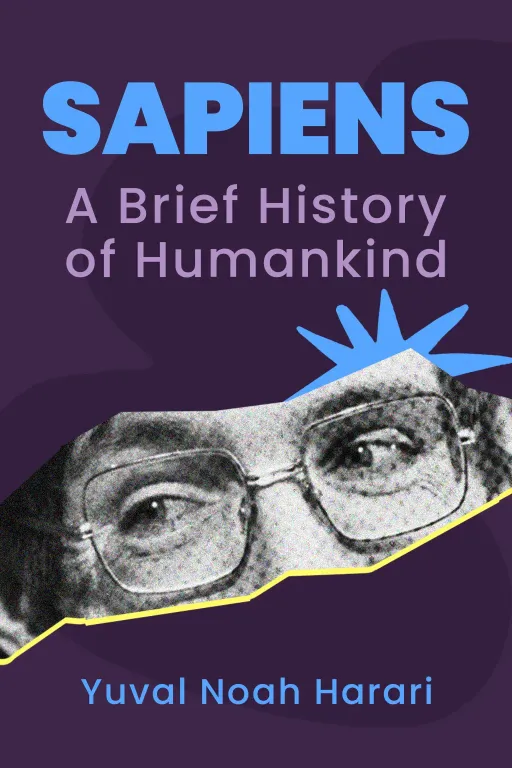
Nova: Something much bigger, Atlas. Today, we're diving into an intellectual earthquake, brought to us by two groundbreaking books: by Yuval Noah Harari, and by David Graeber and David Wengrow. They both challenge our deepest assumptions about progress and civilization.
Atlas: Harari, now he's a fascinating figure. I remember reading that he actually started his academic career specializing in medieval history, which honestly makes his jump to a sweeping history of humankind even more remarkable. So, how do these books help us see past this 'blind spot' you mentioned? Are they just tearing down our beliefs, or are they building something new?
The Illusion of Inevitability & Shared Fictions
SECTION
Nova: They're absolutely building something new, Atlas. They help us understand what we call 'The Blind Spot.' We often look at our current societal structures—our governments, our economies, even our daily routines—as inevitable. Like a river that's carved its path through a canyon over millennia; we forget it started as a tiny trickle, making countless small choices about which way to flow. We tend to see our world as a natural progression, rather than a series of deliberate choices.
Atlas: So, you're saying our modern world isn't just... the way it had to be? That's a huge idea. But isn't believing in things like money or nations just practical? How is that a 'fiction' in a way that truly changes our perspective? I mean, money buys food, nations have borders. These feel very real.
Nova: They real, and that's precisely their power. Harari argues in that our unique ability as humans to create and believe in 'shared fictions' is what allows for large-scale cooperation. Think about it: a lion can't convince another lion to trust a piece of paper in exchange for a gazelle. But we can. A corporation, for instance, is a legal fiction; it has rights and responsibilities, but you can't touch it or see it. Yet, it organizes millions of people and trillions of dollars. It's not a lie, but a collective agreement, a story we all tell each other. That's why, despite being rooted in academic history, became a global phenomenon, selling tens of millions of copies. It made people question the very fabric of their reality.
Atlas: Right, I see. So if these shared fictions allow for cooperation and build our societies, what happens when we realize they're not 'natural' laws, but stories we've collectively agreed upon? Does that make them fragile? Or does it open up new possibilities?
Diverse Realities & The Dawn of Everything
SECTION
Nova: That question, Atlas, is precisely where steps in, almost as a dialogue partner to Harari. Graeber and Wengrow challenge the conventional 'progress narrative' we've all been taught: that humans inevitably progressed from simple hunter-gatherers, to settled agriculture, to complex hierarchical states. They argue that this linear view is far too simplistic and, frankly, wrong.
Atlas: Wait, so is it saying there wasn't a 'natural' progression? That we didn't just 'evolve' into kings and states? Can you give an example of how these early societies were so... from what we're usually taught? Because I was definitely taught that it was a clear path from simple to complex, and complex means hierarchy.
Nova: Absolutely. They present incredible evidence from archaeological and anthropological research, showing that early human societies were incredibly diverse and experimental. For example, some indigenous groups in North America, like the Wendat, would switch between highly hierarchical structures in winter, when they needed strong leadership for hunting, and much more egalitarian, consensus-based governance in summer. They their societal structure based on need, rather than being locked into one. Or consider the city of Çatalhöyük, one of the earliest urban centers, which thrived for thousands of years without any obvious signs of a ruling elite or central authority. People lived in closely packed homes, but there were no grand palaces, no clear signs of a king or even a permanent bureaucracy. It suggests that complex, large-scale living didn't automatically mean top-down rule. This book, a posthumous work for the brilliant anthropologist David Graeber, left a profound legacy by forcing us to re-evaluate history's 'givens.'
Atlas: That's fascinating! I imagine a lot of our listeners, especially those who feel stuck in current systems, would find that incredibly liberating – the idea that things don't to be this way. It's not just about understanding the past, but about realizing the potential for different futures.
Synthesis & Takeaways
SECTION
Nova: Exactly. Both and deliver this powerful 'shift.' They reveal that our cultural foundations are not set in stone, but are products of choices, of shared fictions, and of countless historical experiments. Our current world isn't an inevitable endpoint; it's just one of many possible outcomes. And realizing that offers immense hope for intentional change.
Atlas: It makes you wonder, then. For our listeners, what foundational belief about our society, if proven to be a collective fiction, would most profoundly change perspective? It's about trusting your instincts for profound engagement, as our listener profile suggests. Documenting those reflections can be incredibly powerful.
Nova: Indeed. The power to imagine different futures stems from understanding that our past wasn't a straight line. It was a sprawling, experimental landscape of human possibility.
Atlas: And that's a thought that truly inspires.
Nova: This is Aibrary. Congratulations on your growth!