Uncovering Hidden Histories: How to See the Past's Unseen Threads
9 minGolden Hook & Introduction
SECTION
Nova: What if everything you thought you knew about the history of civilization was... well, mostly wrong? Not just a little off, but fundamentally misremembered, or even deliberately obscured?
Atlas: Whoa, Nova, that's a bold claim right out of the gate! Are we talking about ancient aliens again, or something even more mind-bending?
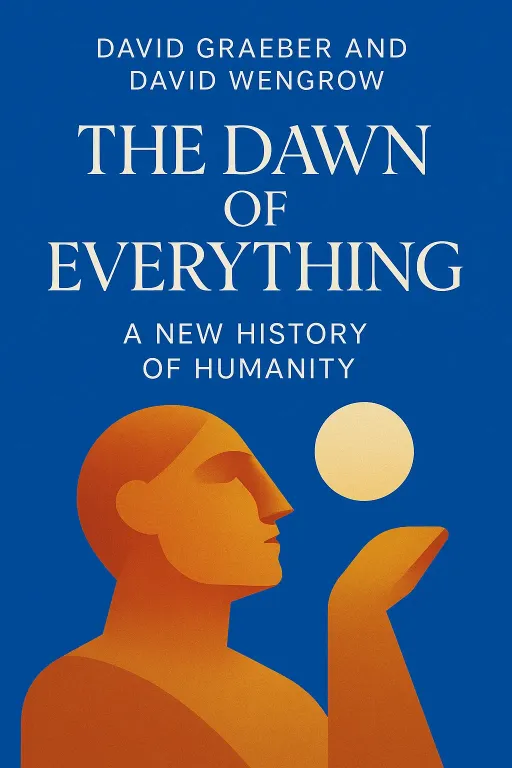
Nova: Even more mind-bending, Atlas. We're talking about the very foundations of how we understand human progress, governance, and even our own potential. Today, we're diving into two revolutionary books: "The Dawn of Everything" by the late, brilliant anthropologist David Graeber and archaeologist David Wengrow, and "Sapiens" by the global phenomenon Yuval Noah Harari.
Atlas: Okay, "revolutionary" and "global phenomenon." That sounds like exactly what our listeners, especially those in high-stakes strategic roles, are always looking for – a way to break free from conventional thinking. So, where do we start unraveling this grand historical illusion?
Nova: We start with what Graeber and Wengrow call "The Blind Spot" – our ingrained assumption that history is a linear march towards progress, from simple hunter-gatherers to complex, unequal states. It's a story we've been told for centuries, and it limits our imagination for what's possible today.
The Myth of Linear Progress and Early Human Diversity
SECTION
Nova: Their core argument, meticulously researched over years by Graeber, a renowned anarchist thinker and Wengrow, a leading archaeologist, is that early human societies were far more varied and complex than we ever dared to imagine. We've been fed this narrative of a "primitive" past, where humans were either noble savages or brutal brutes, inevitably leading to farming, cities, and states.
Atlas: Wait, so are you saying our Stone Age ancestors weren't just grunting and clubbing each other? That they actually had... social experiments?
Nova: Exactly! For millennia, people experimented with incredible social diversity. Imagine societies that deliberately switched between hierarchical and egalitarian structures depending on the season. They built monumental cities without kings or centralized administration. They experimented with different forms of governance and freedom for thousands of years.
Atlas: That's incredible. I mean, for anyone managing complex teams or navigating market volatility, the idea of adapting structures seasonally sounds almost utopian. How does this challenge our fundamental assumptions about human nature?
Nova: It fundamentally broadens them. The book argues that many of our current social ills – inequality, bureaucracy, constant warfare – aren't the "natural" end-state of human development. They are or taken, often quite recently in human history. This perspective, which some critics initially found highly provocative but ultimately compelling, offers a profound sense of human agency. It suggests we're not trapped by some predetermined historical trajectory.
Atlas: So, the takeaway here for a strategic leader isn't just a fun historical fact, it's a fundamental challenge to the "this is just how things are" mindset. If ancient humans were so adaptable, what does that say about our perceived 'inevitability' of current systems, like corporate hierarchies or nation-states?
Nova: It's a direct challenge. Consider the indigenous North American societies, like the Haudenosaunee Confederacy. Their sophisticated democratic structures, with checks and balances and a focus on consensus, actually influenced Enlightenment thinkers like Benjamin Franklin. They weren't primitive; they were a vibrant, complex civilization operating on entirely different principles than European monarchies.
Atlas: Fascinating. So, this historical "blind spot" has actually been limiting our strategic options by making us think certain structures are the only way?
Nova: Precisely. It frees us from conventional historical narratives and expands our understanding of human potential. It allows us to ask, "If they could experiment so radically, why can't we?"
The Power and Peril of Shared Fictions
SECTION
Nova: That line of thinking leads us beautifully into our second big idea, from Yuval Noah Harari's "Sapiens." While Graeber and Wengrow show us the of human social structures, Harari reveals we build them, and how we got to our current, often rigid, state. His core insight is the power of what he calls "shared fictions" or "inter-subjective realities."
Atlas: Okay, "shared fictions." That sounds like a fancy way of saying "lies we all agree on." What kind of fictions are we talking about here, and how do they impact our strategic thinking?
Nova: Exactly that, but in the most profound sense. Harari argues that what truly sets Homo Sapiens apart isn't just language, but our unique ability to believe in and cooperate around things that exist only in our collective imagination. Money, nations, corporations, human rights, gods – these aren't physical realities; they're powerful stories we tell each other. And because we believe them, they become immensely real and govern our lives.
Atlas: So, the dollar bill in my wallet isn't inherently valuable; it's valuable because millions of us agree it is. And the company I work for? It's a legal fiction that allows thousands of people to cooperate towards a common goal, even if they've never met.
Nova: You've got it. And this capacity, this "cognitive revolution," allowed Sapiens to scale cooperation far beyond what any other animal could achieve. It's why we dominate the planet. Harari's book, which has been widely acclaimed and translated globally, makes you look at everything differently.
Atlas: That's both liberating and terrifying. Liberating because if our realities are constructed, we can deconstruct and reconstruct them. Terrifying because it means we're constantly operating within these invisible frameworks, sometimes without even realizing it. For someone trying to bridge macro trading and impactful leadership, this is huge. It means understanding the "fictions" driving market psychology or organizational culture is key to influence and strategy.
Nova: Absolutely. It's about recognizing that the "rules of the game" – whether in finance, politics, or social dynamics – are often not eternal laws of nature, but agreements. And agreements can be changed. This insight broadens our strategic thinking from simply optimizing within existing frameworks to questioning and potentially reshaping those frameworks themselves.
Atlas: So, if I'm looking at a market trend, I shouldn't just analyze the numbers, but also the underlying "story" or "fiction" that's making people believe in certain valuations or narratives?
Nova: Precisely. It's about seeing beyond the surface phenomena to the foundational principles and shared beliefs that underpin those systems. It makes you a more astute observer, a more flexible leader, and a more innovative strategist because you're not just playing by the rules; you understand how the rules themselves are made and unmade.
Synthesis & Takeaways
SECTION
Nova: So, when we combine the insights from "The Dawn of Everything" – that human societies have always been far more diverse and experimental than we thought – with Harari's "Sapiens" – that our current realities are built on shared, malleable fictions – we get a powerful one-two punch.
Atlas: It's like getting a backstage pass to human history, realizing the stage sets can be reconfigured. This directly speaks to the deep question from our main content: "What assumptions about human nature or society have you held that might be limiting your strategic thinking today?"
Nova: Exactly! These books aren't just about the past; they're about freeing our imagination for the future. They challenge the limiting belief that human nature is inherently greedy or hierarchical, or that our current economic and political systems are the only viable ones. They show us that throughout history, humans have been incredibly inventive with how they organize themselves, constantly adapting and experimenting.
Atlas: So, for our "Strategic Integrator" listeners, the challenge is to identify those "shared fictions" in their own domains – in their industry, their organization, even their own personal beliefs about what's possible – and then ask: "Is this fiction serving us, or is it limiting our potential?" It's about questioning the "inevitable" and seeing the "possible."
Nova: Precisely. It's about embracing the journey of integration, not just of different domains, but of different ways of thinking about reality itself. It's a call to identify one leadership principle you hold dear, and then challenge its historical inevitability. Apply it to your trading decisions, and see if there are assumptions buried within it that are actually holding you back.
Atlas: That's a profound thought, Nova. It's about recognizing that true mastery isn't just about understanding the rules, but understanding that you can rewrite them.
Nova: Indeed. It offers a powerful framework for strategic influence, for understanding market psychology, and for harmonizing dual ambitions by seeing the deeper currents that shape our world.
Atlas: It really does. It's about unlocking a new level of strategic thinking.
Nova: This is Aibrary. Congratulations on your growth!