The Unseen Architect: How Shared Stories Build Our World
10 minGolden Hook & Introduction
SECTION
Nova: You know, Atlas, whenever we talk about human progress, innovation, or even just building a successful team, we often hear about the importance of objective facts, data-driven decisions, and logical blueprints.
Atlas: Absolutely, Nova. It’s the bedrock, right? The cold, hard truth. The numbers don't lie. That's what we're taught to trust, especially when you're trying to build something real, something that lasts.
Nova: But what if I told you that our greatest achievements as a species, from towering skyscrapers to global financial markets, from complex legal systems to even the very idea of a nation, aren't primarily built on objective facts at all? What if they're actually built on something far more ephemeral, yet infinitely more powerful?
Atlas: Whoa. Hold on. So you're saying all those facts, all that data, all that logical planning... it's a distraction? That sounds like a pretty bold claim, especially for anyone trying to navigate the complexities of, say, a startup or even just a busy household. What could possibly be more fundamental than objective reality?
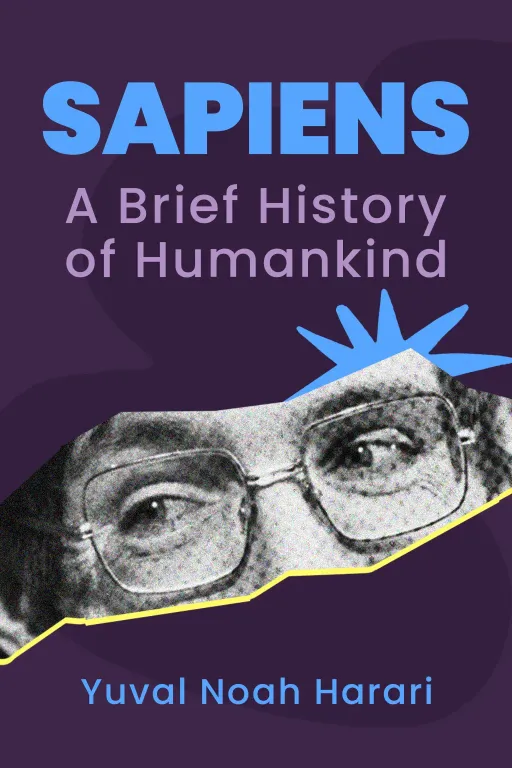
Nova: Well, that's exactly what we're diving into today, inspired by a book that fundamentally shifted how millions of people view human history: by Yuval Noah Harari. What's fascinating about this book, Atlas, is that it started as a university textbook in Hebrew, written by a relatively young Israeli historian, and it unexpectedly became a global phenomenon, translated into dozens of languages. It even earned high praise from figures like Barack Obama and Mark Zuckerberg, not just for its historical sweep, but for its utterly unique perspective.
Atlas: I remember when that book first hit. It felt like everyone was talking about it. So, what’s this core idea Harari puts forward that challenges our reliance on objective facts?
Nova: He argues that it's our unique capacity to believe in shared myths, what he calls "collective fictions," that enabled Homo Sapiens to achieve global dominance and build complex societies. And the "blind spot" we often have is precisely this: we prioritize those objective facts and logical blueprints, forgetting that much of human collaboration, especially large-scale collaboration, is fundamentally built on shared beliefs.
Atlas: That makes me wonder, then, how many leaders, how many founders, are missing this crucial piece? If you're so focused on the metrics, on the market data, are you overlooking the very glue that holds your team or your customer base together?
The Blind Spot: Overlooking Shared Beliefs
SECTION
Nova: Exactly. It’s a profound blind spot. Think about it: a corporation exists. It has a legal identity, it can own property, sign contracts. But if you strip away all the laws, all the shared agreements, all the beliefs in its existence, what is a corporation? It's just a bunch of people, a building, some computers. It's not a physical entity in the way a tree or a rock is. Its power, its very reality, is a collective fiction.
Atlas: So you're saying the company I work for, the one with its mission statement plastered on the wall, the one with its quarterly reports and its stock price... that's a story we all agree to believe in? That’s kind of mind-bending. For someone trying to build systems for people, or drive meaningful impact, that feels like a foundational truth I might have been missing.
Nova: It is. And overlooking this power of collective stories limits our ability to lead and inspire. If you're a founder, an architect of systems, or someone driven by impact, you might be meticulously crafting your product, refining your processes, optimizing your analytics. All crucial. But if you haven't also crafted a compelling that binds your team, your customers, your investors – a shared belief system – then your logical blueprint, however sound, might lack the power to truly mobilize.
Atlas: That gives me chills, honestly. Because I can think of times when a project, even with all the right data, just didn't take off. And maybe it was because the wasn't compelling enough. Or maybe there wasn't a shared understanding of we were doing it, beyond the obvious financial incentives.
Nova: Consider a nation, for instance. What makes a group of millions of strangers willing to pay taxes, obey laws, and even fight for something called "their country"? It's not a biological imperative. It's a shared story, a collective myth of common origin, shared values, and a common destiny. Harari argues that this ability for large groups of Sapiens to believe in the same fictional stories – whether they're religious myths, national narratives, or economic concepts like money – is what gave us an unparalleled advantage over all other species.
Atlas: So, for leaders, then, this isn't just about having a good idea or a solid business model. It's about being a master storyteller, too? Crafting the vision, yes, but making sure that vision taps into something deeper, something everyone can collectively buy into, even if it's not physically tangible. That's a huge responsibility. And a powerful one.
The Power of Collective Fictions
SECTION
Nova: It is. And this naturally leads us to the second key idea, which is the sheer of these collective fictions. Harari’s work, particularly in, details how these fictions—from nations to corporations—shape our understanding of reality and drive our collective progress. He posits that our unique cognitive revolution, our capacity for abstract thought and language, allowed us to create and share these myths. And once enough people believe them, they become real in their consequences.
Atlas: Okay, but 'fiction' sounds like 'not true.' How can something not true be the foundation of our world? That's still a bit of a hurdle for me. I mean, we’re talking about real-world impact here, not fairy tales. What exactly do you mean by 'myth' or 'fiction' in this context?
Nova: That’s a crucial distinction. When Harari says "myth" or "fiction," he's not talking about falsehoods in the sense of lies. He's talking about concepts that exist purely in our collective imagination, not in the objective physical world, but which we. Take money, for example. A twenty-dollar bill is just a piece of paper. Its value isn't inherent in the paper itself; it’s a shared belief, a collective agreement that this piece of paper represents a certain amount of value.
Atlas: That makes sense. I guess we all just tacitly agree that this paper has worth, and because we all agree, it have worth. It’s like a massive, global game of make-believe that actually works because everyone's playing by the same rules.
Nova: Precisely. And this capacity to believe in and cooperate around these fictions is what allowed Sapiens to organize in groups far larger than any other animal. A chimpanzee troop might have 50 members, limited by direct, personal relationships. But a city of millions, or a multinational corporation employing hundreds of thousands across continents? That requires belief in shared fictions like laws, currencies, or human rights. These are not biological realities, but they enable cooperation on an unprecedented scale.
Atlas: Wow. That's actually really inspiring, because if our reality is shaped by these stories, then understanding them, and even crafting them, becomes an incredibly powerful tool. For someone who wants to build an unbreakable team, or create products with deeper empathy, understanding the dominant narratives—and perhaps even challenging or rewriting them—seems absolutely essential. It makes me think about leadership psychology in a whole new light.
Nova: It fundamentally shifts your perspective. Once you understand that these narratives bind us, you gain the ability to craft more compelling visions and foster deeper collective action. It’s about becoming a conscious architect of the stories that guide your work, your team, and your impact. It’s about realizing that the most powerful thing you can build might not be a physical structure, but a shared belief.
Synthesis & Takeaways
SECTION
Nova: So, what Harari really brings home is that while we constantly seek objective truths, the unseen architects of our world are these shared stories. It's the collective belief, the shared fiction, that allows us to cooperate, to build, to dream on a scale no other species can. And for anyone striving to create something meaningful and sustainable, understanding this is paramount.
Atlas: That gives me chills. It’s almost like... we’re all living inside a giant, collective novel, and the most effective leaders are the ones who can write the most compelling chapters. It's not just about what you, but the you tell about what you do, and whether that story resonates deeply enough for people to truly believe in it.
Nova: Exactly. Nova’s take on this is that understanding the narratives that bind us allows you to craft more compelling visions and foster deeper collective action. It encourages us to look beyond the surface, beyond the immediate data, and ask: what are the foundational stories currently shaping your direction, in your work or personal life? And are they still serving your highest purpose?
Atlas: That's a truly profound question. It forces you to reflect, not just on your actions, but on the underlying beliefs that drive those actions. For all our listeners out there who are always seeking wisdom, always trying to build something impactful, it's an invitation to examine the invisible forces at play.
Nova: It’s about recognizing that the "truth" we operate under is often a shared agreement, and that gives us immense power to shape our world, not just react to it.
Atlas: So, if you're out there, building, leading, innovating, take a moment this week for reflection. Journal your insights. What stories are you living by? Are they the ones you truly want to tell?
Nova: This is Aibrary. Congratulations on your growth!