The Illusion of Certainty: Why History Isn't a Straight Line
10 minGolden Hook & Introduction
SECTION
Nova: What if everything you thought you knew about human progress, about history always moving forward, was actually a carefully constructed illusion?
Atlas: Whoa, Nova. That's a bold claim right out of the gate. Are you telling me my entire understanding of history class was just one big, beautifully packaged lie? Because, honestly, I'm ready to believe it.
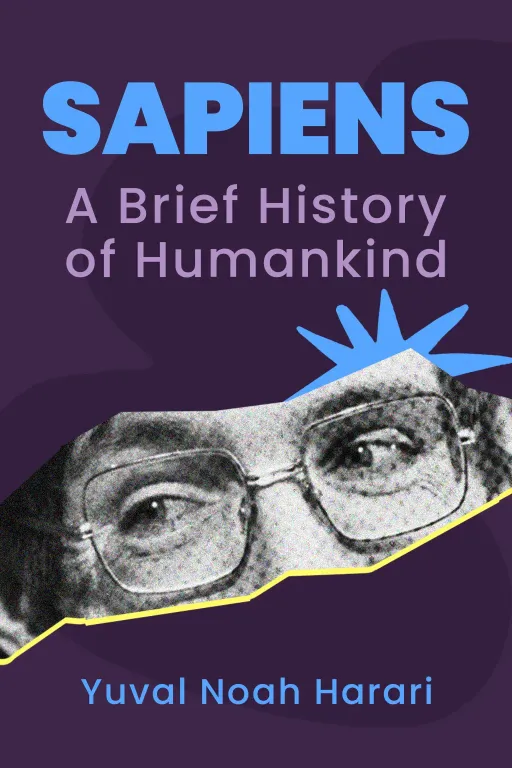
Nova: Well, Atlas, not a lie, but perhaps a very compelling narrative, one that's been deeply ingrained. Today, we're diving into the revolutionary ideas of Yuval Noah Harari’s, a book that exploded onto the global stage and fundamentally changed how millions viewed our past and future. It's truly a landmark work that sparked conversations in every corner of academia and popular culture, offering a lens through which we can see history not as a clear, unbroken chain, but as something far more complex.
Atlas: Ah,. I remember the buzz around that. It definitely made a splash. So, it's not just about facts, but how those facts are chosen and interpreted, right? Because sometimes I feel like history is this massive, unchangeable force, and we're just along for the ride. It’s like feeling trapped by the past, as if our present was always destined.
Nova: Exactly! And that feeling of being trapped, of our present being an inevitable outcome, is precisely the illusion we need to dismantle. Harari, and later, the brilliant minds behind, show us that history is far more contingent, far more a product of choices than we often realize. And there's no better place to start challenging that linear narrative than with what many consider humanity's greatest leap forward: the Agricultural Revolution.
Challenging Linear Progress & The Agricultural Revolution
SECTION
Atlas: Okay, so the Agricultural Revolution. My history books always framed it as this incredible advancement, right? We stopped chasing mammoths, settled down, started farming, and built civilizations. Sounds like a pretty clear win. So, what's the catch? It sounds like a good thing.
Nova: That’s the conventional wisdom, Atlas, and it's a powerful one. But Harari, with that signature wit of his, famously calls the Agricultural Revolution "history's biggest fraud."
Atlas: History's biggest what now? Fraud? That sounds rough, but I'm intrigued. What do you mean?
Nova: Think about it from the perspective of our hunter-gatherer ancestors. They had a varied diet, worked fewer hours, and generally enjoyed a more stimulating and less disease-ridden life. They were essentially the original leisure society, if you will. Then came agriculture. The promise was more food, greater security.
Atlas: Right, more food means more people, right? That’s the classic narrative.
Nova: Precisely. But here’s the brutal reality: that increased food production, primarily from a few staple crops like wheat, often led to a diet for individuals, not better. People became dependent on a single crop, making them vulnerable to famine. They had to work incredibly long, back-breaking hours in the fields. And living in dense, sedentary communities? That was a breeding ground for disease.
Atlas: Wow, so we traded freedom for grains... that's kind of heartbreaking. It’s like, we thought we were leveling up, but we actually just signed up for a much harder, less healthy grind. So, if it was so bad, why did humanity stick with it? Why didn't everyone just say, "This farming thing sucks, let's go back to hunting and gathering?"
Nova: That’s the cunning part of the "fraud." It was a trap, a "golden cage." Once you commit to agriculture, your population explodes. More food means more people, but those people then that increased food supply to survive. There's no going back to the old ways because the land can no longer support a large hunter-gatherer population. It became an irreversible commitment, creating new forms of suffering and inequality that were unimaginable to our nomadic ancestors.
Atlas: I see. It's like getting stuck on a career path you hate because the golden handcuffs are too tight, and you have responsibilities now. You can't just quit and go back to your college dorm life. That makes me wonder, how many of our modern "advancements" are actually just similar traps?
Nova: That’s the deep question, isn't it? Harari forces us to look at progress not as an unalloyed good, but as a series of choices with complex, often negative, consequences. It fundamentally challenges the idea of history as a smooth, upward trajectory.
Dismantling Determinism & Diverse Early Societies
SECTION
Nova: And if that wasn't enough to shatter our historical complacency, another groundbreaking work, by David Graeber and David Wengrow, takes this idea of non-linear history even further. This book has been widely celebrated for its ambitious scope and for thoroughly dismantling established narratives about human social evolution, challenging centuries of assumptions.
Atlas: Okay, so Harari showed us progress isn't always good. What do Graeber and Wengrow add to that? Do they just pile on more historical bad news?
Nova: Far from it! They offer a profoundly hopeful and empowering perspective. While Harari focuses on the pitfalls of what we was progress, Graeber and Wengrow completely upend the "simple story" of human social evolution. You know the one: humans started in small, egalitarian hunter-gatherer bands, then agriculture forced us into larger, more complex, and inevitably hierarchical states, leading to kings, priests, and all the power structures we know today.
Atlas: Oh yeah, the standard narrative. From simple to complex, from free to stratified. It feels... inevitable. Like a natural law.
Nova: And that's precisely what they dismantle. They show that our ancestors were far more politically sophisticated and experimental than we give them credit for. They weren't just passively evolving along a fixed path. For example, take the Nambikwara of Brazil, who would shift their social structures seasonally. During one part of the year, they'd live in small, egalitarian bands; then, for another season, they'd gather in larger, more hierarchical settlements with clear leaders. They their social organization based on their needs.
Atlas: You mean they to be egalitarian, even when they could have been hierarchical? That's mind-blowing. Like they consciously experimented with how to live? That sounds like something out of a sci-fi novel, not ancient history.
Nova: Exactly! Or consider the vast urban settlements in pre-Columbian North America, like Cahokia, or the mega-sites in Ukraine. These were huge, complex centers, but they often lacked the rigid hierarchies we associate with early states. People lived in large, organized communities without being ruled by absolute monarchs or rigid class systems. Graeber and Wengrow argue these were often deliberate choices, experiments in social living. Our ancestors were "political actors," actively shaping their societies, not just passively evolving.
Atlas: I get it. So, the story isn't "hunter-gatherer inevitably leads to agriculture, which inevitably leads to hierarchy and states." It's more like, "hunter-gatherers experimented with a dozen different ways to organize themselves, some of which were complex, some egalitarian, and they often switched back and forth." This contradicts the idea of a fixed, inevitable path that we're still on.
Nova: Absolutely. They show that societies could deliberately choose to hierarchy, or to build complexity without sacrificing freedom. This wasn't some accidental byproduct; it was often a conscious, thoughtful decision. It suggests that the social structures we live with today aren't the only possible ones, nor were they predestined.
Atlas: So, if they had all these options, if history is full of deliberate choices and experiments, what possibilities for societal change are overlooking in our own time? Because if history isn't a fixed path, then maybe our future isn't either.
Synthesis & Takeaways
SECTION
Nova: That's the profound takeaway, Atlas. Both Harari and Graeber and Wengrow, from their different angles, converge on this crucial insight: history is a story of choices and contingencies, not an unbroken, predetermined chain leading inevitably to our present. Understanding this frees us from feeling trapped by the past, or by the idea that "this is just how things are."
Atlas: So the illusion of certainty isn't just about understanding the past; it's about empowering our future. It's about realizing that our current social structures, our ways of organizing work, or even how we define "progress," aren't the only way. They are the result of choices, and often, choices made long ago with unforeseen consequences.
Nova: Precisely. The past doesn't dictate our future. It offers a vast catalog of human experimentation, both successful and disastrous. It shows us that different worlds were, and are, possible. This realization is incredibly liberating, because if our present is not an inevitable outcome, but a result of choices, then we have the agency, the power, to make different choices for the future.
Atlas: This really makes me think about all the things we take for granted as "just the way it is." Maybe those aren't facts of nature, but just historical decisions that we can, if we choose, re-evaluate. It’s a powerful call to critical thinking about our own world.
Nova: It truly is. By challenging the illusion of certainty, we unlock a world of possibilities. We realize that our capacity for social innovation is just as vast as our ancestors'. And that, for an engaged citizen and a deep diver like you, is an incredibly inspiring thought.
Atlas: Absolutely. It makes you want to go out and challenge every "because that's how it's always been" statement you hear.
Nova: That's the spirit! This is Aibrary. Congratulations on your growth!