The 'How-To' Twist: How to Understand Civilizations Without Getting Lost in Dates.
7 minGolden Hook & Introduction
SECTION
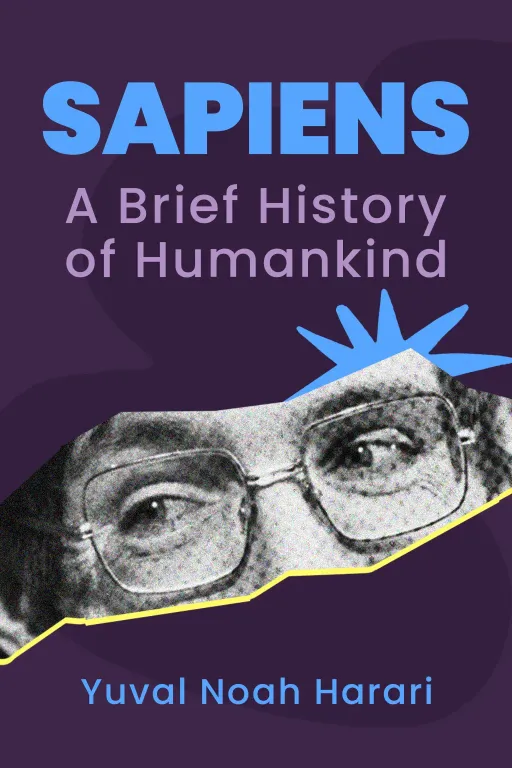
Nova: Alright, Atlas, quick game: give me your five-word review of Yuval Noah Harari's. No pressure.
Atlas: Oh, that's a tough one! Hmm. "Mind-bending, uncomfortable truth, utterly essential." How's that for five?
Nova: Perfect! "Mind-bending." I think that captures it beautifully. And today we're actually unpacking not just by Yuval Noah Harari, but also by Jared Diamond. What's fascinating about Harari is how he, a medieval historian, managed to synthesize millennia of human history into a narrative that utterly changed how millions view our species. It blew people's minds.
Atlas: Absolutely. And Diamond, a physiologist and geographer, bridging science and history, is just as audacious. He didn't just tell us happened, but. Their combined insights are a potent cocktail for anyone trying to understand the 'why' behind civilization, not just the 'what'. This is about really seeing the larger patterns.
The Power of Shared Fictions: How Stories Shape Civilizations
SECTION
Nova: And that's where we dive into our first big idea: the incredible power of shared fictions. Harari argues that what truly sets apart, what allowed us to dominate the planet, isn’t our individual intelligence. It’s our unique ability to create and believe in collective myths, in shared fictions.
Atlas: Shared fictions? So, are you saying our entire economic system, our legal codes, nations, even corporations, are just… stories? That sounds almost too simplistic, or maybe a bit cynical.
Nova: It's not cynical, it's profoundly insightful. Think about money. A piece of paper, or now just a digital number in a bank account, has immense value. Why? Because billions of people it does. It's a shared fiction that allows strangers to cooperate on a massive scale, to trade, to build economies. Without that shared belief, that story, it's just paper.
Atlas: Huh. That makes sense. It's like a collective hallucination we all agree to participate in. But what does that mean for someone trying to build a sustainable business or lead a team today? If everything is a 'fiction,' how do you build something real, something with lasting impact?
Nova: That's the strategic twist. Recognizing these fictions doesn’t make them less real in their effects; it makes you a more strategic player. As a leader, you're not just managing tasks or data; you're often managing or creating shared fictions. Whether it's a company culture, a brand identity, or a strategic vision, you're crafting a story that motivates people to cooperate towards a common goal.
Atlas: So, for the strategic storyteller, it's about understanding the narratives people already believe, and then either leveraging them or, perhaps, creating new, more compelling ones?
Nova: Exactly. Think about how a founder inspires early employees to work tirelessly for equity that might be worthless. It's a powerful shared fiction about a future vision. Or how nations rally citizens around a flag or an anthem. These are not tangible things you can touch, but their power to unite and mobilize is immense.
Atlas: That gives me chills, actually. The idea that we're all operating within these invisible frameworks of belief. It makes you question everything, in a good way.
Beyond Dates: Interconnected Systems & Underlying Forces
SECTION
Nova: And that questioning leads us directly into our second big idea, which often acts as a counterpoint or a deeper layer to what we just discussed. It's the concept of history not as a series of isolated events, but as interconnected systems governed by underlying forces. This is where Jared Diamond’s work in really shines.
Atlas: So, it's not just about the stories we tell, but the very stage upon which those stories play out?
Nova: Precisely. Diamond argues that geographical and environmental factors—the availability of domesticable plants and animals, the orientation of continents, access to resources—provided different starting points for societies. These weren't minor details; they were fundamental determinants. For example, Eurasia's east-west axis allowed for the rapid spread of crops, animals, and innovations because climates were similar across vast distances.
Atlas: Wait, so are you saying human ingenuity and effort are secondary to just… good geography? That sounds a bit out there. Does it mean we’re just pawns of our environment?
Nova: Not at all. It means the environment sets the stage and provides the initial conditions, but human innovation and those shared fictions then interact with those conditions. Think of it like this: Eurasia had a massive head start due to its geography, which led to denser populations, the development of writing, advanced technologies, and unfortunately, a greater resistance to diseases. When Europeans encountered the Americas, it wasn't because they were inherently superior, but because they had accumulated a vast array of advantages over millennia due to their initial geographical luck.
Atlas: Wow. That's a powerful reframing. It connects the dots between climate, agriculture, population, technology, and even disease. So it's a systems view, where everything is linked. How does that help someone in a leadership position, an 'Analytical Architect' who's trying to build something resilient, especially in today's fast-changing world?
Nova: It provides a profound analytical lens. Leaders often get caught up in immediate problems or surface-level trends. But understanding history as interconnected systems means you look for the deeper, often hidden, causes. It’s about asking: what are the environmental, social, or even ideological 'geographies' that are shaping my organization, my market, or my industry? What are the underlying forces creating the conditions we operate in?
Atlas: So, instead of just reacting to symptoms, it's about diagnosing the systemic issues and recognizing the foundational 'geographies' that either enable or constrain us. That sounds like a powerful tool for strategic pattern recognition. It's not about being deterministic, but about being deeply informed.
Synthesis & Takeaways
SECTION
Nova: Exactly. When you combine these two insights—Harari's shared fictions and Diamond's interconnected systems—you get an incredibly powerful framework. You realize that civilizations, and by extension, organizations or even personal trajectories, are shaped by both the stories we collectively believe and the material conditions we operate within.
Atlas: That’s actually really inspiring. It means strategic leaders aren't just managing the visible; they're also influencing the invisible, the shared beliefs, and understanding the deep currents of the systems they're a part of. It transforms how you approach building and leading.
Nova: It does. It moves you from just seeing historical dates or market fluctuations to recognizing the profound, interconnected forces at play. It empowers you to ask: what are the 'fictions' we live by today in our teams, our companies, our society? Are they serving us, or are they limiting our potential? And how can understanding the underlying systems help us craft better fictions, better strategies, and ultimately, build more resilient futures?
Atlas: That makes me wonder, for anyone listening, what 'fictions' are you living by right now that might be shaping your reality in ways you don't even realize? And what fundamental systems are at play in your world that you might be overlooking?
Nova: Food for thought indeed. This is Aibrary. Congratulations on your growth!