The Historian's Edge: Unmasking the Cycles of Economic Change
11 minGolden Hook & Introduction
SECTION
Nova: History's cycles: see the future.
Atlas: Dalio's patterns, human nature revealed.
Nova: Welcome back to Aibrary, where we're always looking for that intellectual edge. Today, we're diving into what we're calling "The Historian's Edge: Unmasking the Cycles of Economic Change." It's a title that immediately makes you think about the grand sweep of time and the big picture.
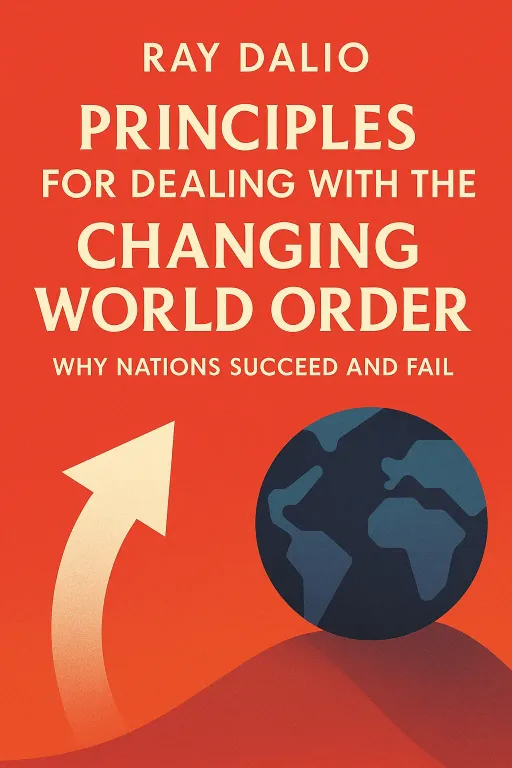
Atlas: Absolutely. And it draws heavily from two foundational works that really complement each other: Ray Dalio's "Principles for Dealing with the Changing World Order" and Yuval Noah Harari's "Sapiens: A Brief History of Humankind." Dalio, of course, is the legendary investor who founded Bridgewater Associates, one of the world's largest hedge funds. His unique approach to understanding history to predict markets is what makes his work so compelling, especially given his incredible track record.
Nova: Exactly. He's not just an economist; he's a historian of economic systems, which gives his insights a rare depth. He spent years meticulously analyzing 500 years of data to find these patterns. And Harari, well, his work is a global phenomenon, giving us that sweeping context for human systems evolve the way they do, which is crucial for truly understanding Dalio.
Atlas: That makes sense. It's like one gives you the detailed map of the road, and the other explains why the road exists in the first place.
Nova: Precisely. And what both these works fundamentally challenge is what we call "The Blind Spot." It's the human tendency to view current economic events as entirely unique, as unprecedented challenges, when history often offers profound rhymes.
The Blind Spot – Why We Misinterpret Economic Cycles
SECTION
Atlas: But wait, why do we keep falling for this? Isn't human memory better than that? For our listeners who are constantly bombarded with "unprecedented" news headlines, it feels like we're always in uncharted territory.
Nova: It’s a fascinating cognitive bias, isn't it? We get so caught up in the specifics of the moment—the new technology, the specific political drama, the latest market fluctuation—that we miss the underlying structural forces at play. We focus on the "what" and the "who," but not the "how" or "why" these patterns keep emerging across centuries.
Atlas: Can you give an example of this "blind spot" in action? Something that felt unique but actually wasn't?
Nova: Think about the 2008 global financial crisis. At the time, it felt like this monumental, once-in-a-lifetime collapse. Pundits and politicians alike described it as a "black swan" event, completely unforeseen. Yet, when you look at history, the patterns of excessive debt, speculative bubbles, and liquidity crises are undeniably similar across different eras.
Atlas: So you're saying the change—like subprime mortgages instead of tulip bulbs—but the are constant? Like different actors, same play?
Nova: Exactly. In 2008, the cause was a housing bubble fueled by subprime mortgages, leading to systemic risk as complex financial instruments collapsed. The process involved widespread bank failures, a credit crunch, and ultimately a deep global recession, forcing massive government interventions. Now, compare that to the South Sea Bubble in 1720, or even the Panic of 1907. Different assets, different technologies, but the human behaviors—greed, fear, herd mentality, speculative fever—and the structural weaknesses of over-leveraged systems? They rhyme powerfully.
Atlas: That’s a great way to put it. So, for our listeners who are trying to navigate today's economic turbulence, whether it's inflation or market volatility, the first step is to recognize that this isn't necessarily unprecedented. It's just a new iteration of an old story.
Nova: Precisely. And without understanding those grand cycles of empires and markets, we risk misinterpreting the present and making reactive decisions based on a false sense of uniqueness. We effectively blind ourselves to potent lessons from the past.
Unmasking the Cycles – Dalio's Framework for Understanding Economic Change
SECTION
Nova: And that naturally leads us to someone who's made a career out of seeing these patterns: Ray Dalio. His work doesn't just point out the blind spot; it provides an incredibly powerful blueprint for understanding these cycles and anticipating what might come next.
Atlas: Okay, so what are the big levers in Dalio's 500-year cycle? What's the core of his 'changing world order' framework? Break it down for us.
Nova: Dalio identifies three primary drivers that interact to shape the rise and fall of great powers and their reserve currencies over centuries. First, there's the: how countries borrow, spend, and eventually face the consequences of too much debt. Then, there's the: the strength of a country's unity, its political stability, and wealth gaps. And finally, the: a nation's ability to invent, adapt, and compete economically.
Atlas: Can you give us a vivid historical example of these in action? Something that really brings it to life.
Nova: Think about the Dutch Empire. In the 17th century, they were the world's leading power, driven by incredible innovation in shipping, finance—they invented the stock market, for crying out loud!—and trade. Their internal order was relatively stable, and their currency, the Dutch Guilder, was the world's reserve currency. This was a nation building immense wealth through productivity and global reach.
Atlas: So they were hitting all three of Dalio's points: innovation, internal order, and a strong currency.
Nova: Exactly. But over time, as often happens, they started to accumulate more debt. Internal divisions began to surface. Other powers, like the British, innovated and started to catch up. The Dutch, burdened by debt and internal strife, eventually saw their preeminence wane, and the British Pound slowly replaced the Guilder as the dominant global currency. It wasn't a sudden collapse but a gradual, cyclical shift driven by these forces.
Atlas: But wait, for someone in, say, the tech industry or finance, how is a 500-year cycle relevant? We're talking about quarterly earnings, not centuries! How does this translate to modern-day decision-making?
Nova: That’s a crucial question. The speed of the cycle might vary, and the technologies are different, but the apply. Take the US's current position as a global power with the dollar as the world's reserve currency. Dalio points out that we are seeing patterns of rising national debt, increasing internal political and wealth division, and a formidable challenger on the innovation front. It's not about predicting the exact year of a shift, but about anticipating the at play and positioning oneself accordingly. It’s seeing the long arc.
Atlas: I guess that makes sense. So, it's about understanding the current phase of the cycle we're in, rather than getting lost in the daily noise. Looking at a chart of the dollar's strength against other currencies or a graph of national debt suddenly takes on a much deeper meaning.
Nova: Exactly. You start to see the echoes, the "rhymes," that suggest where things might be heading. It’s about developing a strategic perspective, not a tactical one.
The Long Game – Harari's Human Context for Economic Evolution
SECTION
Atlas: That makes sense. But what about Harari? How does "Sapiens," a book about human history and our evolution, fit into these economic cycles? It seems like a much broader lens.
Nova: It’s the perfect complement. Dalio gives us the mechanics of the cycles, the and. Harari gives us the profound. He explains that what fundamentally allows humans to build complex economic systems, to create money, nations, and corporations, is our unique capacity for collective fiction and cooperation.
Atlas: So you're saying economic systems, like the ones Dalio describes, are built on shared beliefs? Like, the value of a dollar or the existence of a company is a story we all agree to believe?
Nova: Precisely. Harari argues that unlike other animals, humans can cooperate flexibly in large numbers because we can believe in "inter-subjective realities"—shared myths or stories that exist only in our collective imagination. Money, human rights, nations, corporations—these aren't physical realities, but incredibly powerful fictions we've created. When we all believe in them, they become real in their consequences.
Atlas: Wow, that’s kind of heartbreaking and inspiring at the same time. So Dalio's cycles are the of these underlying human tendencies to cooperate, organize, and create complex systems, which Harari describes at a much deeper, evolutionary level?
Nova: You’ve hit the nail on the head. Harari shows us that the very concept of a reserve currency, for example, isn't just about economic strength; it's about the and that underpins that currency. When those collective fictions, those shared beliefs, start to fray due to the pressures of debt or internal conflict, that's when Dalio's cycles kick in, leading to shifts in power and currency dominance.
Atlas: That’s actually really inspiring. So the resilience of human cooperation and our ability to create these shared fictions is the ultimate underlying force?
Nova: It's our greatest strength and our greatest vulnerability. Our ability to cooperate on a massive scale through these shared fictions has allowed us to build civilizations, but when those fictions are strained—by massive debt, by internal divisions, by a loss of faith in institutions—they can also lead to conflict, disorder, and ultimately, the kind of decline Dalio outlines. It’s a constant dance between creation and destruction, all driven by these deep human patterns.
Synthesis & Takeaways
SECTION
Nova: So, what we learn from "The Historian's Edge" is that by combining Dalio's cyclical economic patterns with Harari's deep human history, we don't just get a clearer picture of the past; we shift our perspective from short-term market noise to the long, deep currents of historical evolution.
Atlas: What's the big takeaway for our listeners who are trying to make sense of, say, inflation or geopolitical tensions today? How do they actually gain this 'historian's edge' in their daily lives or industries?
Nova: It's about cultivating a particular mindset. It’s about embracing nuance, allowing for complexity, and actively connecting past to present. Don't just react to the headlines; ask what historical pattern this 'rhymes' with. Is it a debt bubble, a shift in global power, or a breakdown of internal order? It’s about developing an informed perspective and engaging in respectful debate to test that understanding, rather than just accepting a simple narrative.
Atlas: And for anyone feeling overwhelmed by the constant churn of news, this perspective offers a kind of clarity. It's not about predicting the future perfectly, but about understanding the at play, the underlying currents that shape events. It makes the world less chaotic, I imagine.
Nova: Precisely. It's about seeing the chessboard, not just the current move. It's understanding that while the pieces and players might change, the fundamental rules of the game often remain surprisingly consistent across centuries. It allows you to anticipate, rather than just react.
Atlas: That’s a profound way to look at it, and incredibly valuable. This is Aibrary. Congratulations on your growth!