

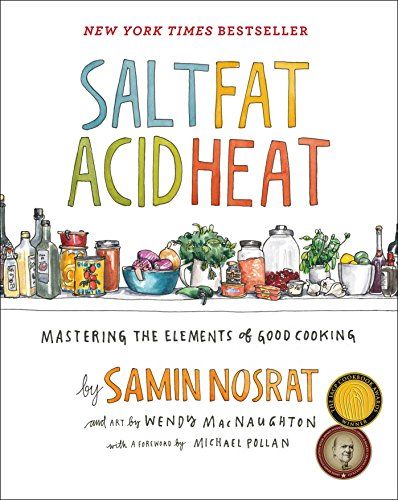
Salt, Fat, Acid, Heat
Mastering the Elements of Good Cooking
Introduction
Nova: Imagine you are standing in a kitchen, looking at a counter full of ingredients, and for the first time in your life, you do not need a recipe. You do not need to check your phone for measurements or worry if you have the exact type of vinegar the instructions called for. You just know what to do because you understand the fundamental laws of flavor.
Nova: Well, that is exactly what Samin Nosrat wanted to change when she wrote Salt, Fat, Acid, Heat. It is not just a cookbook; it is a manifesto. Samin argues that every single delicious thing you have ever eaten, from a five-star steak to a simple bowl of popcorn, relies on just four basic elements. If you master those four, you can cook anything.
Nova: Not quite, but you are closer than you think. Samin’s journey actually started at the legendary restaurant Chez Panisse, where she realized that even the most complex dishes were built on these pillars. She eventually became the person who taught Michael Pollan, the famous food writer, how to cook. Today, we are going to break down her philosophy and show you how these four elements work together to transform your cooking from a guessing game into an art form.
Key Insight 1
The Power of Salt
Nova: Let us start with the first pillar, and arguably the most important one: Salt. Most people think of salt as a flavor, like spicy or sweet. But Samin explains that salt’s primary job is actually to act as a magnifying glass for other flavors.
Nova: Exactly. Salt is the only ingredient that can physically change the structure of food. It works through osmosis. When you salt meat, for example, the salt draws moisture out, dissolves into a brine, and then that brine gets reabsorbed into the muscle fibers. This seasons the meat from the inside out and actually makes it more tender.
Nova: According to Samin, it is one of the biggest mistakes home cooks make. She advocates for salting meat as early as possible—sometimes twenty-four hours in advance. This gives the salt time to travel to the center. If you salt right before cooking, the surface is salty but the middle is bland. It is the difference between a seasoned dish and a salty dish.
Nova: No, vegetables are different. Salt draws moisture out of vegetables and can make them limp if they sit too long. For something like a sauté, you salt as you go. But here is a pro tip from the book: when you are boiling pasta or vegetables, the water should taste like the sea. Samin says that if the water is not salty enough, the food will never be properly seasoned, no matter how much salt you shake on it at the table.
Nova: That is a common fear, but Samin points out that most of the salt in the water stays in the water; only a fraction goes into the food. The goal is to enhance the natural sweetness of the ingredient. Salt actually suppresses bitterness, which is why a tiny pinch of salt in a bitter cup of coffee can actually make it taste smoother. It is all about balance.
Key Insight 2
Fat and the Carrier of Flavor
Nova: She does, because fat is the ultimate carrier of flavor. Many of the aromatic compounds in herbs and spices are fat-soluble, meaning they won't release their full potential unless they are dissolved in oil or butter. Think about garlic sizzling in olive oil—that smell is the fat doing its job.
Nova: Absolutely. Fat creates the two most desirable textures in cooking: creaminess and crispiness. Whether it is the flaky layers of a croissant or the crunch of a fried potato, fat is the magic ingredient. Samin breaks fats down into different categories based on their source and their smoke point.
Nova: It is the temperature at which a fat starts to break down and burn. If you try to sear a steak in extra virgin olive oil, it will smoke and taste bitter because olive oil has a low smoke point. For high heat, you want something like avocado oil or ghee. But for finishing a dish, a drizzle of high-quality olive oil adds a peppery, fresh dimension that butter just can't match.
Nova: Right. Fat is the soul of a cuisine. Olive oil says Mediterranean; lard or corn oil says Mexican; sesame oil or peanut oil says East Asian. By choosing your fat wisely, you are setting the entire stage for the dish. And Samin’s big takeaway is that you should use more fat than you think you need during the cooking process to get that perfect texture, but you can always blot away the excess later.
Key Insight 3
The Brightness of Acid
Nova: Acid is the secret weapon of professional chefs. If a dish tastes heavy, dull, or just a bit flat, nine times out of ten, it is missing acid. Acid provides contrast. It cuts through the richness of fat and the heaviness of starch. It makes your mouth water, which literally makes the flavors pop.
Nova: That is a perfect analogy. Acid brightens everything. But it is not just lemons and vinegar. Samin points out that acid is everywhere: in yogurt, sour cream, tomatoes, wine, and even fermented things like pickles or soy sauce. If you are making a heavy beef stew, a splash of red wine or a spoonful of tomato paste provides the acid needed to keep the dish from feeling like a lead weight in your stomach.
Nova: Precisely. Samin teaches a technique called tasting for balance. You take a bite, and you ask yourself: Is it bright enough? Does it make my tongue tingle? If not, add a drop of vinegar or a squeeze of lime. But be careful—acid can also cook things. Think of ceviche, where the lime juice physically changes the proteins in the fish.
Nova: Exactly. Acid is often the final touch, the thing that wakes up the entire plate right before it hits the table. It is the counterpoint to the salt and the fat. Without it, the meal is a monologue; with it, the meal is a conversation.
Key Insight 4
Mastering the Element of Heat
Nova: You would think so, but heat is actually the most complex element because it is about the transformation of matter. Samin explains that heat is what turns raw, inedible ingredients into something delicious through chemical reactions. The most famous one is the Maillard reaction.
Nova: It is the reaction between amino acids and reducing sugars that gives browned food its distinctive flavor. It is why the crust of a loaf of bread tastes different from the middle, and why a seared steak tastes better than a boiled one. Heat is what creates those hundreds of different flavor compounds.
Nova: That is the challenge of heat management. Samin talks about the three ways heat moves: conduction, convection, and radiation. Conduction is the direct contact of the pan to the food. Convection is the movement of hot air or liquid, like in an oven or a deep fryer. Radiation is like the glowing coals of a grill.
Nova: Yes, and you need to understand carry-over cooking. This is a huge tip from the book: food continues to cook after you take it off the heat. A steak’s internal temperature can rise by five or ten degrees while it rests. If you wait until it looks perfect in the pan, it will be overcooked by the time you eat it.
Nova: You are doing it a favor by letting the juices redistribute, but you have to pull it off the heat early. Samin also emphasizes the importance of the environment. If you put a cold steak into a cold pan, you won't get that Maillard reaction. You need the energy of the heat to be ready and waiting for the food. It is all about controlling the rate of change.
Key Insight 5
The Cooking Compass
Nova: She gives us something better: a compass. In the book, there is a beautiful illustration of a flavor compass. It shows how these four elements interact. If a dish is too salty, you might add fat or acid to mask it. If it is too fatty, you definitely need acid to cut through it.
Nova: That is the core of her philosophy. She wants to move people away from the rigid, often intimidating world of recipes and toward a more intuitive way of cooking. She encourages people to taste their food at every single stage. Taste the water, taste the sauce, taste the raw ingredients. If you don't know what it tastes like halfway through, you can't possibly know what it needs.
Nova: Exactly. And she does this with so much joy. If you have seen the Netflix series or read the book, her enthusiasm is infectious. She isn't a stern chef yelling about technique; she is a friend who wants you to experience the same magic she found at Chez Panisse. She believes that good cooking is accessible to everyone, regardless of their background or budget.
Nova: That is the Samin effect! Once you start seeing the world through the lens of Salt, Fat, Acid, and Heat, you can never go back to just following a recipe. You start to understand the why behind the how, and that is when the real fun begins.
Conclusion
Nova: We have covered a lot today, from the molecular magic of salt to the balancing act of acid and the transformative power of heat. Samin Nosrat’s Salt, Fat, Acid, Heat is more than just a guide to cooking; it is a guide to understanding the world through our senses.
Nova: If there is one takeaway for our listeners, it is this: next time you are in the kitchen, put the phone away for a moment. Taste your food. Ask yourself if it needs more brightness, more richness, or a bit more time under the flame. You have all the tools you need right there in your kitchen and in your own senses.
Nova: We hope this inspires you to go out and experiment. Cooking is a lifelong journey of discovery, and there is no better guide than the four pillars of flavor. Thank you for joining us on this deep dive into the culinary world.