Thriving Amidst Strategic Volatility
Golden Hook & Introduction
SECTION
Nova: You know that old saying, Atlas, "What doesn't kill you makes you stronger"? It's practically etched into every motivational poster out there.
Atlas: Oh, absolutely. The mantra of every startup founder who’s pulled an all-nighter, every team hitting a tight deadline. It’s the battle cry of resilience.
Nova: Well, what if I told you, sometimes, what doesn't kill you just... makes you weaker, slower, and slightly traumatized?
Atlas: Whoa. That's a gut punch for every 'resilient' business plan I've ever seen. Are we debunking resilience today? This sounds juicy.
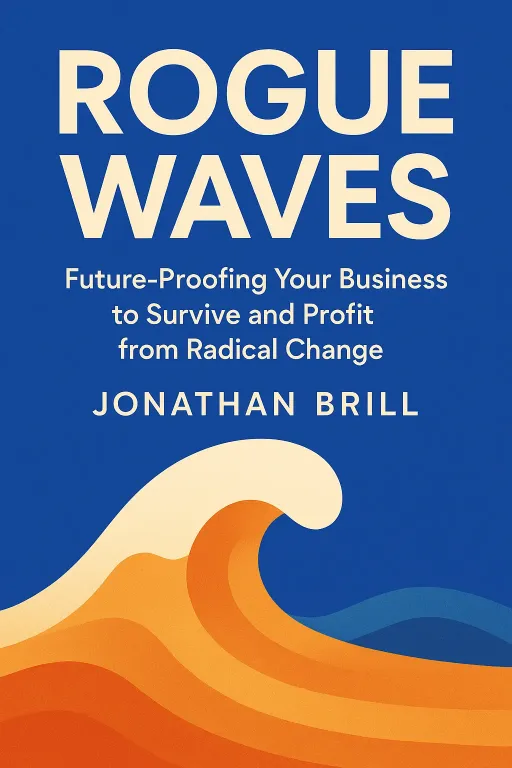
Nova: We're not debunking it, Atlas, we're evolving it. Because today, we're diving into a fascinating convergence of ideas from two brilliant minds: Jonathan Brill’s "Rogue Waves" and Nassim Taleb’s groundbreaking "Antifragile." Brill, with his practical background advising Fortune 500s on future-proofing, helps us spot the storms. And Taleb, the contrarian philosopher and former options trader from his influential "Incerto" series, gives us the radical blueprint for not just surviving them, but getting exponentially better because of them.
Atlas: So, we're not just talking about surviving the storm, but actually building a better, stronger ship the storm hit? That speaks directly to anyone trying to build scalable success.
Nova: Exactly. And the first step in that transformation is seeing the storm coming, or understanding how these 'rogue waves' even form.
Rogue Waves: Spotting the Strategic Shifts
SECTION
Nova: Brill's core idea in "Rogue Waves" is that massive industry shifts aren't usually single, sudden events. They're the result of economic and technological trends in unexpected ways. Think of it like multiple smaller currents gathering force beneath the surface, unnoticed, until they form an overwhelming, destructive wave.
Atlas: So, for someone analyzing market entry or designing new business models, it's not enough to see a new technology, like AI, in isolation. It's about seeing how AI with, say, changing labor markets, new data privacy regulations, and shifting consumer expectations about personalization? That's a lot to track.
Nova: Precisely. Take the classic Blockbuster versus Netflix story. Blockbuster saw DVDs. They even saw the potential of mail-order. But they missed the of declining physical media sales, the rapid rise of high-speed internet, and the emerging convenience economy that prioritized instant gratification and subscription models. They saw individual trends, but didn't grasp how they were funneling into one enormous, industry-redefining current.
Atlas: That makes perfect sense. They were optimizing for the old system, not preparing for the new one that was forming beneath their feet. It reminds me of companies today who are hyper-focused on quarterly earnings, but might be missing the fundamental shifts in how value is created or exchanged.
Nova: And that's the danger. Brill argues that these rogue waves aren't just big; they fundamentally alter the architecture of an industry. They create entirely new competitive landscapes. The key is to look for those non-linear effects, where 1+1+1 doesn't equal 3, but 100.
Atlas: That sounds like a lot of noise to sift through. How do you distinguish a genuine 'rogue wave' from just... a really big ripple, or a temporary market fluctuation? For a strategist, resource allocation is everything.
Nova: That's where the analytical mind comes in. You look for trends that are and that challenge fundamental assumptions about your industry's value chain or customer behavior. Are people changing they consume, not just they consume? Is a new technology enabling a business model that was previously impossible? It’s about asking if the very rules of the game are changing, not just the players.
Antifragility: Thriving on Disorder
SECTION
Nova: And that brings us beautifully to Nassim Taleb and his revolutionary idea of "antifragility." Because even if you spot the rogue wave, what do you do when it hits? Most companies try to be 'robust,' right? Build stronger walls, bigger buffers, hoping to withstand the impact.
Atlas: Exactly. That's the builder's instinct: create solid, stable systems. Minimize risks, optimize for predictability.
Nova: And that's often the downfall. Robust systems resist stress up to a point, then break. Fragile systems break easily. But antifragile systems... they stress. They actively get stronger, more efficient, and even thrive when exposed to volatility, randomness, and disorder.
Atlas: So it's like a muscle. If you never lift weights, it atrophies. But if you constantly push it, expose it to beneficial stress, it gets stronger, more defined. How does a business for that? Are we talking about planned chaos, or something else entirely?
Nova: Not planned chaos, but planned to beneficial stressors. Think about an immune system. It needs to be exposed to pathogens to learn and grow stronger. Or, in business, a startup that constantly launches small, low-risk experiments, collecting rapid feedback, and pivoting based on market signals. Each "failure" or unexpected market shift isn't a setback; it's data, an opportunity to refine, to become more aligned with what the market truly needs.
Atlas: That sounds incredibly counter-intuitive to the 'efficiency at all costs' mindset many builders and strategists strive for. Redundancy costs money, small experiments take time. How do you sell that to stakeholders looking for predictable, scalable success?
Nova: That's the core challenge, and it requires a fundamental shift in mindset. It’s about understanding that true long-term growth and scalable success aren't achieved by optimizing for stability, but by optimizing for adaptability and learning. Taleb would argue that what looks like "inefficiency" in a stable world—like having redundant systems or exploring multiple small bets—is actually the ultimate efficiency in a volatile world. It’s the difference between a single, perfectly optimized, but fragile pathway, and a distributed, adaptable network.
Atlas: So, instead of trying to predict the future and build a rigid plan, you build a system that from the unpredictable nature of the future. That’s a powerful distinction.
Synthesis & Takeaways
SECTION
Nova: So, we've got Brill showing us how to identify the gathering storm clouds, the 'rogue waves,' by recognizing converging trends. And then Taleb gives us the radical blueprint for not just weathering those storms, but for actively gaining strength and efficiency from them. The real magic happens when you combine these two ideas.
Atlas: Turning a threat into an innovation driver. It's like seeing a market disruption not as a problem to be survived, but as a blank canvas for a new business model, a new market entry strategy. For someone driven by business model innovation, that's incredibly inspiring.
Nova: Precisely. The ultimate takeaway isn't to avoid volatility. It's to embrace it as a core design principle. It's about building systems, strategies, and even organizations that stress, uncertainty, and shocks to reveal their best, most innovative form. Think about how many truly groundbreaking companies emerged from recessions, market shifts, or technological upheavals. They didn't just survive; they redefined their industries.
Atlas: It sounds like the ultimate competitive advantage in a world that feels increasingly unpredictable. You're not just playing defense; you're using the opponent's unpredictable moves to power your own offense, to fuel your own growth.
Nova: Exactly. It's about designing a strategy that doesn't just withstand volatility, but actively treats it as the primary driver for innovation, for that exponential and sustainable growth your stakeholders are looking for.
Atlas: So, for our listeners, the challenge isn't to predict the next big thing perfectly, but to build an organization that gets better, stronger, and more innovative, no matter what the next big thing is. That's a powerful shift in perspective.
Nova: It really is. It reframes our entire relationship with uncertainty. Instead of fearing it, we invite it in, knowing it's the crucible for our next level of strength and creativity.
Atlas: And it's a constant process, isn't it? Not a one-and-done solution, but an iterative learning journey, just like building any truly resilient and antifragile system.
Nova: Absolutely. It's a mindset shift that allows for continuous growth. So, for our listeners who are deep in strategic challenges, perhaps schedule that 30 minutes this week not just to a problem, but to identify where a little 'beneficial stress' might reveal a breakthrough solution, or how converging trends might unlock your next big innovation.
Atlas: That's a fantastic challenge. Instead of shying away from the chaos, lean into it, learn from it, and let it fuel your next big innovation. Because the future isn't about avoiding the waves; it's about learning to surf them better than anyone else.
Nova: Indeed. Because the world isn't getting less volatile, so our strategies need to get more... well, antifragile.
Atlas: A truly insightful discussion, Nova. Thanks for helping us navigate those rogue waves and build stronger.
Nova: My pleasure, Atlas. And to all our listeners, keep building, keep growing.
Nova: This is Aibrary. Congratulations on your growth!