

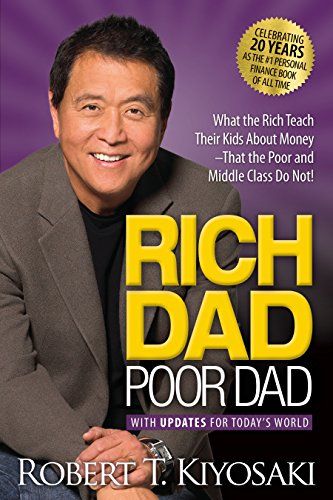
Rich Dad, Poor Dad
What the Rich Teach Their Kids About Money That the Poor and Middle Class Do Not!
Introduction: The House That Costs You Money
Introduction: The House That Costs You Money
Nova: Welcome back to Aibrary. Today, we are diving into a book that has arguably done more to shift the financial mindset of the average person than any other in the last three decades: Robert Kiyosaki’s “Rich Dad Poor Dad.”
Nova: : That book is everywhere. I feel like everyone who has ever tried to start a side hustle has read it. But Nova, what’s the one thing that makes it so explosive?
Nova: It’s the premise, right? It’s the radical redefinition of what we think money is. Imagine this: Kiyosaki tells us that the family home—the symbol of middle-class success—is often not an asset at all, but a liability. That statement alone stops people in their tracks.
Nova: : A liability? My mortgage is a liability? That feels like heresy to the traditional financial advice I grew up with. My Poor Dad, the highly educated government employee, would have had an aneurysm hearing that.
Nova: Exactly! That’s the core tension of the book. Kiyosaki contrasts two father figures: his biological father, the highly educated but financially struggling 'Poor Dad,' and his best friend's father, the high school dropout who became a self-made millionaire, the 'Rich Dad.'
Nova: : So, we’re not just talking about saving money. We’re talking about a complete philosophical break from conventional wisdom. Why does this book, published over 25 years ago, still resonate so strongly today?
Nova: Because it speaks directly to the feeling that the traditional path—go to school, get a good job, save—isn't working for everyone anymore. It’s a call to arms for financial literacy, arguing that school teaches you how to be a great employee, but not how to be a great owner or investor.
Nova: : It’s about learning the language of money, not just earning it. I’m ready to audit my own cash flow statement. Let’s break down the foundational rule that Kiyosaki hammers home: the difference between assets and liabilities.
Nova: Absolutely. Let's move into our first core insight, because understanding this one concept is the entire foundation of the Rich Dad philosophy.
Key Insight 1: Redefining Ownership
The Golden Rule: Assets Put Money In, Liabilities Take Money Out
Nova: The single most important takeaway, which many sources confirm, is Kiyosaki’s definition of assets and liabilities. It’s deceptively simple: An asset puts money in your pocket. A liability takes money out of your pocket.
Nova: : That’s so much more useful than the accounting definition of what you own versus what you owe. If I own a rental property that generates $500 a month after expenses, that’s an asset. If I own a brand new luxury car that costs me $800 a month in payments, insurance, and depreciation, that’s a liability.
Nova: Precisely. And this is where the controversy around the family home kicks in. Kiyosaki argues that for most people, their primary residence is a liability because you are constantly paying the mortgage, property taxes, insurance, and maintenance. It’s a massive cash drain, even if its market value goes up.
Nova: : But wait, if the market value goes up, isn't that wealth building? Traditional finance says equity accumulation is key.
Nova: Rich Dad says that equity is trapped wealth. It’s not cash flow. You can’t pay your bills with equity. You can only realize that gain when you sell, and if you sell, you have to buy another house, restarting the liability cycle. The Rich Dad focuses on assets that generate —income that arrives whether you show up for work or not.
Nova: : So, the Poor Dad’s column looks like this: Salary minus Taxes, minus Mortgage, minus Car Payment, minus Groceries. He’s stuck in the middle, perpetually working to cover the outflows created by his liabilities.
Nova: And the Rich Dad’s column looks completely different. His income column is dominated by cash flow from businesses, real estate, and paper assets. His personal expenses are covered by that flow, and he uses his earned income—if he even has any—to buy assets. He’s building the asset column faster than the liability column grows.
Nova: : I read one source mentioning that Kiyosaki emphasizes the importance of understanding the balance sheet. It’s not about your paycheck; it’s about what’s happening on that statement.
Nova: It is. He’s teaching people to read financial statements, which is a form of financial literacy that schools rarely teach. He wants you to look at your monthly cash flow and ask: Is the arrow pointing toward my asset column or my liability column?
Nova: : It’s a powerful mental shift. It forces you to scrutinize every purchase. That $10,000 TV? It’s not an asset. It’s a liability that depreciates instantly. It’s a drain on the capital that could have bought you a share in a profitable business.
Nova: And the Rich Dad’s goal isn't just to be rich; it’s to be financially independent, which Kiyosaki defines as having enough passive income to cover your living expenses indefinitely. That’s the finish line.
Nova: : So, the first step isn't earning more; it’s stopping the bleeding caused by poorly classified liabilities. It’s about controlling the outflow before you even worry about the inflow.
Nova: Exactly. It’s about discipline in classification. Let’s transition now to the second major theme: why the Rich Dad encouraged working differently than the Poor Dad. This leads us to the concept of working to learn, not just for money.
Key Insight 2: The Employee vs. The Owner
Working to Learn, Not for Money
Nova: The Poor Dad, the academic, always told Kiyosaki, "Go to school, get good grades, find a safe, secure job with benefits." This is the path of the employee, the specialist.
Nova: : And the Rich Dad countered that by saying, "Go to school to learn how to run a business, how to manage money, and how to negotiate." He saw the employee path as a trap, a form of self-imposed servitude.
Nova: Kiyosaki explicitly states that the rich don't work for money; money works for the rich. This is the crucial difference between earned income and passive income. Earned income is trading time for dollars, which is inherently limited.
Nova: : It’s the classic trade-off. If I stop working, my earned income stops. But if I own a successful laundromat or a portfolio of dividend stocks, that income stream continues. The Rich Dad was focused on building those streams.
Nova: And to build those streams, Kiyosaki suggests you need diverse skills, not just deep specialization in one area. He advocates for working in different departments—sales, marketing, accounting—even if you’re an employee, just to learn the mechanics of how money moves in a business.
Nova: : That’s a fascinating angle. It reframes the job search. Instead of asking, “How much does this pay?” you should be asking, “What skills will I acquire here that I can later leverage into an asset?”
Nova: It’s about acquiring skills that make you valuable as an owner, not just as a cog. Think about the three types of income Kiyosaki often discusses: Earned, Passive, and Portfolio. The Poor Dad only focuses on Earned.
Nova: : The Passive income stream, like rental income or royalties, is the holy grail for Kiyosaki. It requires upfront work or capital to set up, but then it flows consistently. And then there's Portfolio income, which comes from selling assets, like stocks or real estate, for a profit.
Nova: The goal is to shift your entire life so that the majority of your income comes from the Passive and Portfolio columns. This is what creates true freedom. He famously said, "Work to learn, don't work for money." If you’re only working for money, you’re just feeding the liability column.
Nova: : I can see how this philosophy would appeal to entrepreneurs, but what about the average person who needs a steady paycheck right now? Is there a middle ground, or is it all or nothing?
Nova: That’s where the criticism often lands, because Kiyosaki tends to present things in stark, black-and-white terms. However, the underlying principle—that you must allocate a portion of your earned income to building assets—is sound. Even if you’re an employee, you can dedicate 10% of your paycheck to buying REITs or fractional shares, starting that passive engine.
Nova: : It’s about conscious allocation. If my car payment is $600, and I could have used that $600 to buy a small piece of a business that pays me $50 monthly, I’m choosing to fund a liability over funding an asset.
Nova: Exactly. You are choosing to fund someone else’s asset column—the bank’s or the car manufacturer’s—instead of building your own. The Rich Dad perspective is that you must become financially intelligent enough to spot those opportunities and have the courage to act on them, often using debt wisely.
Nova: : Ah, debt. That brings up another huge point. The Poor Dad fears debt, but the Rich Dad seems to embrace it, provided it’s used to acquire income-producing assets. That’s a dangerous tightrope walk for a novice.
Nova: It absolutely is. And that leads us perfectly into our next chapter, where we need to discuss the inherent risks and the real-world controversies surrounding this revolutionary, yet sometimes reckless, advice.
Deep Dive: Credibility and Risk
The Shadow Side: Controversy and Real-World Application
Nova: We’ve established the powerful framework: Assets in, Liabilities out. But let’s address the elephant in the room, which many critics point out: the story itself. Is the Rich Dad real?
Nova: : Research shows that Kiyosaki admits the 'Rich Dad' is largely a composite character, based on his best friend's father, but the stories are heavily fictionalized or allegorical. Some critics call this misleading, even fraudulent, especially given the book's massive sales.
Nova: It’s a fair critique. When a book is sold as autobiographical truth, and key elements are later revealed to be narrative devices, it damages credibility. Furthermore, Kiyosaki’s own business history has faced scrutiny, including past bankruptcies and lawsuits, which some find hypocritical given the advice he sells.
Nova: : And then there’s the promotion of specific business models. Kiyosaki is a known proponent of Multi-Level Marketing, or MLMs. I saw mentions that for some readers, the book served as mandatory reading for joining an MLM structure.
Nova: That’s a significant red flag for many financial experts. While the core concept of building a network or business system is valid, pushing readers directly into specific, often high-risk, sales structures can be problematic. It suggests the book is sometimes used as a recruitment tool rather than purely educational material.
Nova: : So, if we strip away the narrative and the controversies, what remains that is genuinely useful for someone today? Because millions still credit this book with changing their lives for the better.
Nova: What remains is the mindset shift. The book’s lasting impact, as noted in several analyses, is its success in popularizing the of financial literacy. It made conversations about cash flow, assets, and investing mainstream for people who previously only discussed salary and retirement funds.
Nova: : It’s like a gateway drug to personal finance. It might not give you the perfect investment strategy, but it forces you to look at your bank statement and realize you might be playing defense when you should be playing offense.
Nova: Precisely. It teaches you to be skeptical of the status quo. Kiyosaki argues that the traditional system is designed to keep the middle class busy working for the system, not owning it. That rebellious, anti-establishment tone is incredibly potent.
Nova: : But that rebellion needs to be tempered with practical knowledge. Kiyosaki’s advice on using debt, for instance, is often criticized as being too aggressive for the average person who doesn't have the Rich Dad's business acumen to back up massive leverage.
Nova: Absolutely. A financial advisor reacting to the book might say, 'Yes, use debt for assets, but only if you understand the underlying risk, have a massive emergency fund, and can service that debt even if the asset temporarily underperforms.' Kiyosaki often glosses over those crucial risk management steps.
Nova: : It seems the book is best viewed as a motivational manifesto that introduces vocabulary, rather than a comprehensive, step-by-step financial manual. It opens the door, but you need other books to walk through it safely.
Nova: That’s the perfect summary. It’s a powerful awakening, but it requires the reader to seek out the practical 'how-to' elsewhere. It gives you the 'why,' but you have to find the 'how' responsibly. Now, let’s wrap this up by synthesizing these powerful lessons into actionable takeaways for our listeners.
Conclusion: Auditing Your Financial Future
Conclusion: Auditing Your Financial Future
Nova: We’ve traveled from the shocking claim that your home is a liability to the philosophical divide between the two dads. What is the ultimate message we should carry forward from this cultural phenomenon?
Nova: : The ultimate message is that financial education is not optional; it is survival. Whether you agree with Kiyosaki’s specific examples or not, the concept that you must understand the language of money—assets versus liabilities—is non-negotiable for building true wealth.
Nova: And the actionable takeaway must be to stop working money and start making money work you. This means consciously redirecting capital away from consumption liabilities and toward income-producing assets. It’s about shifting your focus from your paycheck to your cash flow statement.
Nova: : I think the best thing listeners can do right now is to take a piece of paper—or open a spreadsheet—and draw Kiyosaki’s simple diagram. List everything that puts money in your pocket on one side, and everything that takes money out on the other. Be brutally honest about your primary residence and your car.
Nova: That exercise forces you to confront reality. If your liability column is crushing your income column, you’re on the Poor Dad’s treadmill, regardless of how high your salary is. The Rich Dad’s path demands you actively build systems that pay you while you sleep.
Nova: : It’s a book about courage—the courage to question conventional wisdom, the courage to learn new skills outside of your primary profession, and the courage to take calculated risks by using debt intelligently to acquire income streams.
Nova: It’s a powerful, if sometimes flawed, catalyst. It doesn't guarantee success, but it guarantees you’ll start asking better questions about your money. It’s a mindset shift that can unlock decades of financial growth.
Nova: : A perfect summary, Nova. It’s a book that inspires action, even if we need to fact-check the anecdotes along the way. It’s about moving from being a consumer to being an owner.
Nova: Indeed. The journey to financial freedom starts with understanding the rules of the game. Keep learning, keep questioning, and keep building that asset column.
Nova: : This is Aibrary. Congratulations on your growth!