

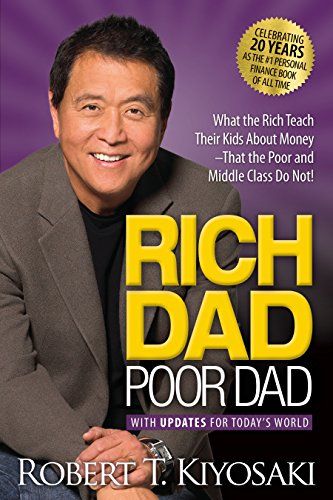
Breaking the Paycheck-to-Paycheck Cycle: A Marketer's Guide to Rich Dad's Secrets
Golden Hook & Introduction
SECTION
Dr. Celeste Vega: You just landed your first real job. You're seeing those paychecks hit your account, and it feels great. But then you look at your budget—rent, a car payment, student loans, daily expenses—and you realize you're running on a treadmill. You're working just to pay the bills, and the cycle is already starting. What if there was a way to think about money that could break you out of that cycle before it even truly begins?
Tina: That’s a feeling I think everyone understands, whether they're one year into their career or twenty. It’s that little bit of anxiety under the surface of the excitement.
Dr. Celeste Vega: Exactly. And that is the promise of the controversial but massively influential classic, by Robert Kiyosaki. Today we'll dive deep into this from two perspectives. First, we'll challenge everything you thought you knew about assets and liabilities. Then, we'll lay out the practical blueprint for escaping that 'rat race' by learning to mind your own business.
Dr. Celeste Vega: And I'm so thrilled to have Tina here with us today. Tina, you're in such a unique position for this conversation. You're a marketing manager in the finance industry and you're just starting your professional journey. You're seeing how the financial world works from the inside, right at the moment these ideas are most critical.
Tina: Thanks for having me, Celeste. Yes, it feels like I have a front-row seat to the very systems this book questions. I'm really curious to dig in.
Deep Dive into Core Topic 1: The Great Redefinition: Assets vs. Liabilities
SECTION
Dr. Celeste Vega: Let's start with the absolute foundation of the book. Tina, when you hear the word 'asset,' what's the first thing that comes to mind for most people? What are we taught to believe are our greatest assets?
Tina: Oh, that's easy. It's what we talk about in our marketing all the time. Your home. Your car, maybe. Your 401. It’s the big-ticket stuff that you own, the things that make up your personal net worth. We frame it as 'your biggest investment.'
Dr. Celeste Vega: Precisely. And Kiyosaki comes in like a wrecking ball and says, 'That's all wrong.' Or at least, it's the 'Poor Dad' way of thinking. In the book, he tells the story of his two dads. His real father, who he calls his 'Poor Dad,' was a brilliant, highly educated man who was the head of education for the state of Hawaii. He had a great job, a great salary, but he struggled with money his whole life.
Tina: He sounds like the model of success we're all told to follow. Go to school, get a good, secure job.
Dr. Celeste Vega: Exactly. Then there was his 'Rich Dad,' who was his best friend's father. He was an eighth-grade dropout who became one of the wealthiest men in Hawaii. And the core difference in their thinking came down to one simple definition. Poor Dad said, "My house is my biggest asset." Rich Dad said, "My house is my biggest liability."
Tina: Okay, so that’s a direct contradiction. How did Rich Dad explain that?
Dr. Celeste Vega: With a definition so simple it's almost shocking. He taught the boys: "An asset is something that puts money your pocket. A liability is something that takes money of your pocket." That's it. It's not about ownership or net worth. It's purely about cash flow.
Tina: Wow.
Dr. Celeste Vega: He would draw these simple diagrams. Imagine two boxes: an income statement at the top and a balance sheet at the bottom. For most people, their paycheck comes into the income box, and then immediately flows out to pay for expenses. When they buy a house, they add a mortgage to their liability column. So every month, money flows from their income, through their expense column, and out the door to pay for the mortgage, property taxes, insurance, repairs... The house is constantly taking money of their pocket.
Tina: This is blowing my mind a little, Celeste. Because my entire job in finance marketing is built on the 'Poor Dad' definition. We market mortgages by selling the dream of homeownership as a primary asset. We use phrases like 'building equity' and 'the American Dream.' Kiyosaki's definition completely flips that.
Dr. Celeste Vega: Go on, that's a fascinating insight.
Tina: He's saying the house is an asset, but it's an asset for the. The mortgage is a piece of paper in the bank's asset column, because my payment every month puts money into pocket. My liability is their asset.
Dr. Celeste Vega: You just summarized the entire first half of the book in three sentences. That is the fundamental mindset shift. The rich acquire assets—things that generate income. The poor and middle class acquire liabilities that they are assets. A new car, a boat, the latest tech... it all just increases the flow of money of your pockets.
Tina: It's a bit chilling, honestly. It makes you look at every marketing message, including the ones I help create, in a totally different light. We're selling a story about security and investment, but through Kiyosaki's lens, we're often selling a cage. A very comfortable, well-decorated cage.
Dr. Celeste Vega: A cage with great curb appeal. And that cage has a name in the book. It's called 'The Rat Race.'
Deep Dive into Core Topic 2: The Blueprint for Escape: Minding Your Own Business
SECTION
Dr. Celeste Vega: And once you understand that distinction between assets and liabilities, the next step becomes clear. It's not just about earning more money. Kiyosaki describes this as the 'Rat Race.' Tina, does that term resonate with you, even this early in your career?
Tina: Absolutely. You get the job, you get the salary. You upgrade your apartment. You get a nicer car to go with the new job title. Your expenses rise to meet your income, or even exceed it. Then you need a raise just to maintain your new lifestyle. I see it happening with colleagues already. It's a quiet, creeping pressure.
Dr. Celeste Vega: That's the trap. You're working for everyone else but yourself. You work to pay your landlord, to pay the government in taxes, to pay the bank for your car loan. The escape, Kiyosaki says, is to "mind your own business."
Tina: Which sounds like he's saying, "Quit your job and become an entrepreneur." That's a terrifying prospect for most people, especially someone just starting out.
Dr. Celeste Vega: And that's the brilliant misunderstanding he clarifies. 'Minding your own business' does mean quitting your job. Your profession is not your business. Your profession is what pays the bills. Your is your asset column. The strategy is to use your 9-to-5 job as a source of capital to buy or build true assets—the kind that generate their own income.
Tina: So you keep your day job, but you have a second focus.
Dr. Celeste Vega: Exactly. And he gives a perfect example from his own life. After leaving the military, he took a job at the Xerox corporation. Now, his Poor Dad, the academic, was horrified. He had a college degree, why was he taking a low-status, commission-only job selling photocopiers? He thought it was a step down.
Tina: But Rich Dad probably had a different take.
Dr. Celeste Vega: Rich Dad was ecstatic. He congratulated him. Because Robert wasn't there for the paycheck. He was shy and hated rejection, and he knew that the single most important skill for building a business was the ability to sell. He took the Xerox job specifically to conquer his fear and learn how to sell. He stayed until he was one of their top salesmen. The sales skill itself became a powerful, invisible asset that he used to build his real estate and other businesses later.
Tina: Okay, that makes so much sense. It reframes the purpose of a job. So my job as a marketing manager isn't my 'business.' It's my source of capital and, more importantly, my training ground.
Dr. Celeste Vega: Tell me more. What's the 'asset' you're building right now?
Tina: The skills. I'm learning how to communicate complex financial ideas simply. I'm learning data analytics to understand a target audience. I'm learning project management. According to this logic, are the assets I'm acquiring. My 'business' would be what I with my salary and those skills outside of my 9-to-5.
Dr. Celeste Vega: Nailed it. Your job becomes a gym where you're getting paid to build your financial and intellectual muscles.
Tina: So what are some simple, first-step assets someone like me could acquire? The book talks about real estate and starting companies, which feel huge and intimidating when you're just starting out with a small salary.
Dr. Celeste Vega: That's the key question. And Kiyosaki's answer is broad. An asset can be a dividend-paying stock. It can be a small rental property. It could be intellectual property, like writing a book or creating a course using the marketing skills you're learning. It could even be a simple, automated online business that generates a few hundred dollars a month. The amount doesn't matter at first. What matters is the mental shift of buying something that.
Synthesis & Takeaways
SECTION
Dr. Celeste Vega: So, as we wrap up, it feels like we have two incredibly powerful, and frankly, life-altering ideas on the table. First, we have to redefine assets and liabilities based on pure, simple cash flow, not on social convention.
Tina: Right. Does it put money in my pocket, or take it out? It's a simple, analytical question, which really appeals to the logical side of my brain. No emotion, just math.
Dr. Celeste Vega: And second, we need to use our job not as the end-goal, but as a tool to build our business—our asset column.
Tina: The job is the launchpad, not the destination. I love that. For me, the biggest takeaway is about clarity and data. It's so easy to get caught up in the emotions of money—fear, greed, keeping up with others. This book cuts through all of that.
Dr. Celeste Vega: So if someone listening is feeling that spark and wants to take a first step, what would you recommend?
Tina: I think the most powerful and least intimidating first step is one Kiyosaki suggests. For the next thirty days, just track your finances. Don't judge it, don't try to change it yet, just be an inspector of your own money. Every dollar that comes in, every dollar that goes out. At the end of the month, draw your own little cash flow diagram like he does in the book. See where your money is going. Are you using your salary to acquire assets, or are you just paying for liabilities? That knowledge alone is the real first asset.
Dr. Celeste Vega: That is a perfect, actionable piece of advice. It's about becoming financially literate about your own life first. Tina, this has been incredibly insightful. Thank you. And for everyone listening, I'll leave you with one question to ponder, inspired by our conversation: What is one skill you can master at your current job that could become the foundation for your first true asset?
Tina: A great question to think about. Thanks so much for having me, Celeste.