

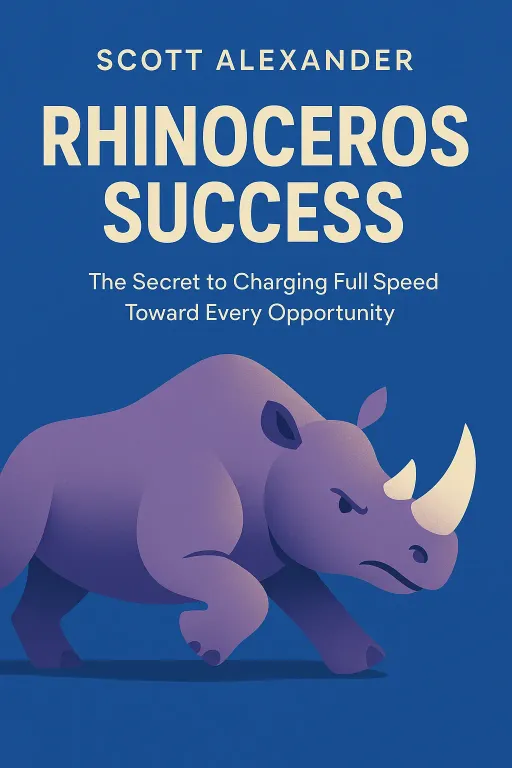
Charging the Roadmap: A Product Manager's Guide to Rhino Success
Golden Hook & Introduction
SECTION
Nova: In the world of product management, we live by roadmaps, sprints, and data-driven decisions. It's a world of careful planning. But what if the secret to staying competitive isn't more planning, but more charging? Like a three-ton rhinoceros, full speed, at every single opportunity. That's the wild premise of Scott Alexander's book, 'Rhinoceros Success.' And today, we're here with veteran Product Manager Simonsoiu to see if this audacious philosophy is crazy, or crazy brilliant.
Nova: Welcome, Simonsoiu! With over 15 years in tech and a recent Master's to keep your skills sharp, you seem like the perfect person to help us tackle this.
Simonsoiu: Thanks for having me, Nova. It's a fascinating premise. The tech world is definitely a jungle, so maybe thinking like a rhino isn't so far-fetched.
Nova: I love that! Well, today we'll dive deep into this from two perspectives. First, we'll explore what it means to stop grazing like a 'cow' and start 'charging'—transforming passive plans into massive action. Then, we'll discuss how to build the Rhino's armor, developing the thick skin needed to handle the inevitable problems and setbacks that come with any ambitious project.
Deep Dive into Core Topic 1: The Rhino's Charge: From Passive Planning to Massive Action
SECTION
Nova: So, Simonsoiu, let's start with this central image. The book paints a picture of two animals: the lazy, complacent 'Cow' in the pasture, just waiting for things to happen, and the energetic, unstoppable 'Rhinoceros' in the jungle, who makes things happen. As a Product Manager, does that metaphor immediately resonate with you?
Simonsoiu: It absolutely does. You see 'cow' behavior all the time in large organizations. It's the tendency to have meetings about the meetings, to get stuck in 'analysis paralysis,' or to be so afraid of launching an imperfect V1 that you never launch at all. You're just... grazing. Waiting for the perfect conditions that never arrive.
Nova: Exactly! And the book's answer to that is to become a rhino and just... charge! There's a great little story in the first chapter. The author, Scott Alexander, was trying to figure out the secret to success. He was reading all the books, trying to follow all the rules. Then he observed this thirty-year-old millionaire who seemed to break all of them. He didn't have neatly written goals, his office was a mess, he wasn't a teetotaler.
Simonsoiu: Sounds familiar.
Nova: Right? But the author realized the man's secret was that he was a 'full-time charging rhinoceros.' He was always in motion, always pursuing an opportunity with massive energy. He didn't wait for permission; he just charged. The book says we need to get 'charging mad' about our goals. So, my question for you is, how does a Product Manager get a team of engineers, designers, and marketers 'charging mad' about a new product?
Simonsoiu: That's the million-dollar question. You can't just stand up in a sprint planning meeting and yell 'Charge!' and expect it to work. The charge has to be something. The PM's job is to be the storyteller-in-chief. You have to paint such a vivid, compelling picture of the target—the customer problem we're solving, the impact we're going to make—that the team feels that urgency and excitement themselves. The 'singleness of purpose' the book talks about? That's your product vision. It's the North Star that focuses the charge.
Nova: So the charge isn't chaos, it's focused energy.
Simonsoiu: Precisely. It's the difference between a mob and a cavalry charge. Both have energy, but only one has direction. But, you know, there's a risk here that I think is important to mention.
Nova: Oh, I'm intrigued. What's the risk?
Simonsoiu: The book paints the rhino as this unstoppable force, which is great for motivation. But a rhino that just charges blindly without sensing the environment might run right off a cliff. In product management, that's the classic mistake of building a beautiful, powerful product that nobody actually wants or needs. So the 'charge' has to be paired with listening. You charge, you gather feedback, you adjust your course, and you charge again. It's an iterative charge.
Nova: An agile rhino! I love it. You're not just charging, you're charging, learning, and re-charging. That's a brilliant adaptation of the concept.
Simonsoiu: It has to be. The jungle—the market—is constantly changing. A successful rhino has to be both powerful and perceptive.
Deep Dive into Core Topic 2: The Rhino's Armor: Building Resilience for Inevitable Setbacks
SECTION
Nova: That's a perfect point, Simonsoiu, because charging inevitably means you're going to hit things. And that brings us to our second big idea: the Rhino's armor. The book says you need a 'two-inch-thick skin' because you're going to get hit by 'torpedoes.'
Simonsoiu: 'Torpedoes' feels like an accurate term for some of the things that can happen on a project, yes.
Nova: It really does! And the book has this wonderful way of reframing problems. It says problems are actually a good sign. If you don't have any problems, you're probably standing still. Problems are 'landmarks of progress.' And it uses this great little analogy for small problems—it calls them 'gnats.'
Simonsoiu: Gnats. Okay.
Nova: Imagine a rhino. When it's standing still, the gnats are buzzing all around its head, driving it crazy. But the moment it starts charging, the wind from its own momentum blows them all away. The small problems disappear when you're focused on moving forward.
Simonsoiu: That is an incredibly useful mental model for a Product Manager. We are constantly swarmed by 'gnats'—a minor UI inconsistency someone found, a stakeholder asking for a tiny change to a button color, a low-priority bug. If you stop to swat every single gnat, you'll never move. The key is teaching the team to differentiate between a gnat, which you log and deal with later, and a 'torpedo,' which you have to tackle head-on.
Nova: So in your 15+ years, you've surely faced some torpedoes—a competitor's surprise launch, a critical bug right after a release. How does a PM with that 'rhino skin' handle that pressure differently from one who doesn't?
Simonsoiu: Oh, absolutely. I remember a time we launched a major new feature, and within hours, a critical third-party API we relied on went down completely. The 'cow' reaction in that situation is panic, finger-pointing, and despair. The team's morale just craters.
Nova: I can picture it.
Simonsoiu: The 'rhino' reaction is different. You take a deep breath. You acknowledge the hit—you don't pretend it didn't happen. Then you huddle the team, not to assign blame, but to define the new target: the solution. You say, 'Okay, we've been hit. Here's the plan to get back on track.' The problem isn't the end of the story; it's just the next obstacle to run over. That's what rhino skin gives you: the ability to absorb a hit, stay on your feet, and keep the team charging forward.
Nova: That's so powerful. It's about being unstoppable, not untouchable. And I have to wonder, as an ISFP, 'The Artist,' does this idea of treating problems as part of the 'adventure' of the jungle appeal to that creative, experience-seeking side of you?
Simonsoiu: It really does. It reframes problem-solving from a chore into a creative challenge. How do we get around this? What's the elegant solution here? It turns a potential disaster into a memorable war story that bonds the team. It makes the journey more interesting. The best products aren't built on a smooth, easy road; they're forged in the fire of solving hard problems. That's the adventure.
Synthesis & Takeaways
SECTION
Nova: I just love that perspective. So, as we wrap up, it feels like the real lesson from 'Rhinoceros Success' isn't just about blind aggression. It's about a focused, massive charge fueled by a clear vision...
Simonsoiu: ... combined with the resilient armor to handle the inevitable collisions along the way. It's about being unstoppable, not untouchable. The vision directs the charge, and the thick skin ensures you get back up after you're knocked down.
Nova: Perfectly said. So for everyone listening, especially those in demanding roles like Simonsoiu, here's the challenge for the week. Simonsoiu, can you give us our call to action?
Simonsoiu: With pleasure. Look at your week ahead. Identify one 'cow' activity on your to-do list—maybe it's delaying a tough conversation with a stakeholder, or over-analyzing a small, reversible decision. And I want you to replace it with one 'rhino' action. Make the call. Ship the small update. Make a decision and commit to it. Just take one decisive step forward and feel that momentum. That's how you start charging.
Nova: A fantastic, practical takeaway. Simonsoiu, thank you so much for helping us translate the wild wisdom of the rhino into a real-world strategy.
Simonsoiu: It was my pleasure, Nova. Now, if you'll excuse me, I think I have a roadmap to go charge at.









