

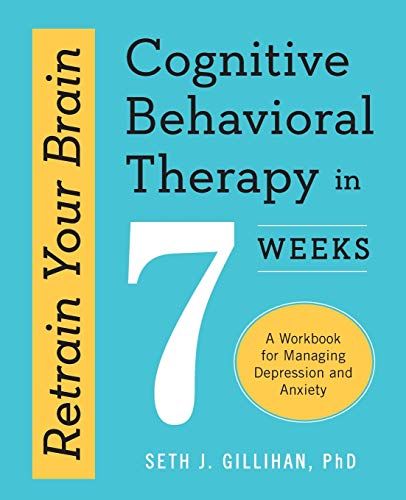
Retrain Your Brain : Cognitive Behavioral Therapy in 7 Weeks
Cognitive Behavioral Therapy in 7 Weeks
Introduction
Nova: Have you ever felt like your brain is just stuck on a loop? Like you are playing the same negative soundtrack over and over, and no matter how hard you try to hit pause, the volume just keeps going up?
Nova: It really is. But what if I told you that you could actually fire that roommate? Or at least, retrain them to be a bit more supportive? That is the core promise of the book we are diving into today: Retrain Your Brain: Cognitive Behavioral Therapy in 7 Weeks by Dr. Seth Gillihan.
Nova: It is actually grounded in some very heavy-duty science. Dr. Gillihan is a clinical psychologist who specializes in CBT, or Cognitive Behavioral Therapy. The book is not just a read; it is a workbook. It is designed to be a manual for your own mind, taking these high-level clinical techniques and making them accessible for anyone sitting on their couch.
Nova: Well, the research shows that for mild to moderate anxiety and depression, bibliotherapy—which is just a fancy word for using books as therapy—can be incredibly effective. Today, we are going to break down exactly how those seven weeks work and why this specific approach has become a lifeline for so many people.
Key Insight 1
The Cognitive Triangle
Nova: Before we get into the week-by-week breakdown, we have to talk about the foundation of everything Dr. Gillihan teaches. It is called the Cognitive Triangle.
Nova: It is much simpler than a secret society, but just as powerful. The three points are Thoughts, Feelings, and Behaviors. The central idea of CBT is that these three things are constantly influencing each other in a loop.
Nova: Exactly. Imagine you are at a party and you see a friend across the room. You wave, but they do not wave back. That is the event. Now, your thought might be, they are ignoring me because they do not like me anymore.
Nova: And then the behavior follows. You leave the party early or you avoid that friend for the next month. That behavior then reinforces the thought that the friendship is over, and the cycle continues.
Nova: CBT says that while we cannot always control our feelings directly—you cannot just command yourself to stop feeling sad—you can intervene at the other two points: your thoughts and your behaviors. If you change what you think or what you do, the feelings eventually have to follow.
Nova: Precisely. Dr. Gillihan spends the first week of the program just helping you identify these patterns. You start by tracking your mood and your activities. It is about becoming an observer of your own life rather than just a victim of your emotions.
Nova: It is definitely an investment. But Gillihan argues that you cannot fix what you cannot see. Most of us are walking around with these automatic negative thoughts—he calls them ANTs—and we do not even realize they are there. Week one is about turning the lights on so you can see where the ants are hiding.
Key Insight 2
Behavioral Activation
Nova: Now, here is where the book gets counterintuitive. In Week 2, Gillihan does not start with your thoughts. He starts with your actions. This is called Behavioral Activation.
Nova: You would think so, right? But when people are depressed or anxious, they often wait until they feel better before they do things. They say, I will go for a walk when I have more energy, or I will call my mom when I am in a better mood.
Nova: The problem is that the motivation never comes because you are not doing anything! Behavioral Activation flips the script. It says: do the thing first, and the mood will follow. It is an outside-in approach.
Nova: Yes, but Gillihan is very realistic about it. He does not ask you to run a marathon in Week 2. He asks you to identify small, manageable activities that give you either a sense of pleasure or a sense of mastery.
Nova: More like washing the dishes or answering one email. Mastery just means the feeling of accomplishment. When you are in a dark place, even small tasks feel like climbing Everest. By checking off a small task, you get a tiny hit of dopamine that starts to nudge the needle on your mood.
Nova: That is a perfect analogy. He has you schedule these activities and then rate how you felt afterward. Often, people find that they actually enjoyed the walk more than they thought they would, which provides the evidence needed to keep going.
Key Insight 3
The Thought Detective
Nova: Once you have some momentum with your behaviors, Weeks 3 and 4 dive into the cognitive part—the thoughts. This is where you become a thought detective.
Nova: Exactly. Gillihan introduces the concept of cognitive distortions. These are basically the ways our brains lie to us. Common ones include catastrophizing, where you assume the absolute worst will happen, or all-or-nothing thinking, where if you are not perfect, you are a total failure.
Nova: That is a classic distortion! In Week 4, the book teaches you how to use a Thought Record. When you have a strong negative emotion, you stop and write down the situation, the feeling, and the automatic thought. Then—and this is the crucial part—you look for evidence for and against that thought.
Nova: You are the judge, the jury, and the defense attorney. You ask yourself: Is there another way to look at this? What would I tell a friend in this situation? Usually, when you look at the evidence objectively, you realize the thought is either totally false or at least a massive exaggeration.
Nova: It is a skill, like a muscle. At first, you have to write it down and it takes forever. But eventually, you start doing it automatically in your head. You catch the thought, you check it against reality, and you change it. Gillihan calls this the Three Cs: Catch, Check, Change.
Nova: Exactly. And by the time you hit Week 4, you are starting to realize that you are not your thoughts. You are the person observing the thoughts. That shift in perspective is where the real healing begins.
Key Insight 4
Mindfulness and Core Beliefs
Nova: As we move into Weeks 5 and 6, the book adds a layer of mindfulness. Dr. Gillihan is a big proponent of mindful CBT, which is about being present in the moment without judgment.
Nova: Think of it as the grease for the gears. CBT can sometimes feel very analytical, which can lead to overthinking. Mindfulness helps you just sit with a feeling without needing to fix it immediately. It is about saying, Okay, I am feeling anxious right now. That is a sensation in my body. It is not a disaster; it is just a feeling.
Nova: Exactly. And that leads into Week 6, which is the deep dive into Core Beliefs. These are the underlying assumptions we have about ourselves and the world that drive all those automatic thoughts.
Nova: Precisely. Those are the roots. If the automatic thoughts are the weeds, the core beliefs are the seeds they grow from. Gillihan helps you identify these deep-seated beliefs and start to plant new, more balanced ones.
Nova: You are right, and Gillihan is honest about that. Week 6 is about starting the process. It is about recognizing that these beliefs are just stories we have told ourselves for a long time, often based on childhood experiences or past traumas. They are not objective truths.
Nova: I love that. And by Week 7, it is all about integration. You look back at how far you have come and you create a plan for the next seven weeks and beyond. Because the retraining never really stops; it just gets easier.
Conclusion
Nova: We have covered a lot of ground today. From the Cognitive Triangle to the Three Cs of Catch, Check, and Change, Dr. Seth Gillihan's Retrain Your Brain offers a very clear, structured path out of the fog of anxiety and depression.
Nova: That is the biggest takeaway. You have more agency over your mental state than you think. By intervening in your behaviors and challenging your thoughts, you can literally change the physical pathways in your brain. It is neuroplasticity in action.
Nova: If you are listening and you feel stuck, remember the Three Cs. Catch that negative thought, Check it against the evidence, and Change it to something more balanced. You do not have to believe everything your brain tells you.
Nova: That is the spirit! Small steps lead to big changes. Thank you for joining us on this deep dive into retraining your mind.
Nova: This is Aibrary. Congratulations on your growth!