

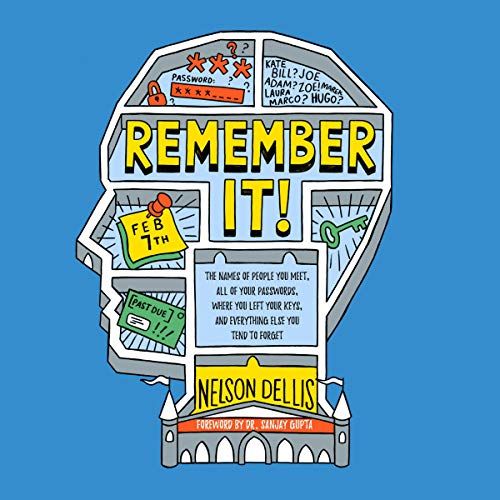
Remember it!
Introduction
Nova: Picture this. You're at a networking event, someone walks up to you, shakes your hand, and says their name. Two seconds later, it's gone. Vanished. You spend the next ten minutes avoiding using their name entirely because you simply cannot retrieve it. Sound familiar?
Nova: You are not alone, Sage. And here's the wild part: according to Nelson Dellis, a five-time USA Memory Champion, that is not a memory problem. It's an attention problem. His book "Remember It!" argues that most of us don't actually have bad memories. We have bad—well—looking.
Nova: It means we never actually encoded the information in the first place. We hear a name and we're already thinking about what we're going to say next. Dellis says the first step to an amazing memory isn't some complicated mental trick. It's simply paying attention. Really seeing what's in front of you.
Nova: Exactly. Dellis wrote "Remember It!" specifically for the rest of us. The subtitle says it all: "The Names of People You Meet, All of Your Passwords, Where You Left Your Keys, and Everything Else You Tend to Forget." He takes the techniques that made him a champion and translates them into daily life. Today we're diving into his system and how it can genuinely transform the way your brain works.
The Core Memory System
The SEE-LINK-GO Framework
Nova: Alright, let's start with the backbone of the entire book. Dellis organizes his memory method around three steps: SEE, LINK, and GO. It's deceptively simple, but each step is packed with nuance.
Nova: SEE is all about attention. Dellis argues this is where ninety percent of memory failures actually happen. If you don't truly observe something, you can't remember it. He teaches readers to pause, take a mental snapshot, and consciously register what they're looking at. For a name, that means really looking at the person's face. For your keys, that means noticing exactly where you're placing them and even saying it out loud: "I am putting my keys on the kitchen counter next to the fruit bowl."
Nova: We absolutely do. Dellis calls it "autopilot mode," and it's the enemy of memory. The book includes exercises where you practice simply observing a scene for thirty seconds and then writing down everything you saw. Most people are shocked at how little they actually notice.
Nova: LINK is where the creativity kicks in. Once you've really seen something, you need to connect it to something you already know. Dellis says the brain remembers things by association, not by brute force. So if you meet someone named Lily, you don't just repeat "Lily, Lily, Lily" in your head. You picture a giant lily flower sprouting out of her hair. The more bizarre, colorful, and emotionally charged the image, the stickier it becomes.
Nova: That's a huge part of it. Dellis emphasizes that the brain is wired to remember the unusual. You don't remember your commute last Tuesday because nothing surprising happened. But if a flamingo walked across the road, you'd remember every detail. So he teaches you to deliberately inject that flamingo-level weirdness into everything you want to remember.
Nova: GO is about placing that linked image somewhere in your mind where you can retrieve it later. For practical purposes, this often means using your environment. You attach the image to a specific location, like a room in your house or a landmark on your commute. Later, when you mentally walk through that space, the image is waiting for you. This is the foundation of the memory palace technique, which we'll get into.
Nova: That's the skeleton. The rest of the book puts flesh on those bones with specific applications for names, numbers, passwords, to-do lists, and even where you parked your car.
Deep Dive
The Memory Palace and Your Everyday Life
Nova: Let's talk about the memory palace, because it sounds intimidating but it's actually one of the most practical tools in the book. Also called the Method of Loci, it dates back to ancient Greece. The idea is that you take a physical space you know intimately, like your home, and you mentally place the things you want to remember at specific locations throughout that space.
Nova: He absolutely does. He has readers build their first memory palace using their childhood home or current apartment. You mentally walk through the front door, and every piece of furniture becomes a "memory station." The couch, the TV, the dining table, the bathroom mirror. Each station holds one vivid image linked to what you want to remember.
Nova: Perfect. Using your apartment as a palace, you'd walk through the front door and picture the couch overflowing with gallons of milk, squirting everywhere. A ridiculous, exaggerated scene. Then at the TV station, you picture a giant tooth with a phone receiver, screaming into it. Finally, at the dining table, you picture your boss sitting there typing furiously on a laptop with your report glowing on the screen. When you mentally walk through later, each image triggers the task.
Nova: Exactly. Dellis calls this the "bizarre effect." The brain remembers the weird. He also emphasizes making images interactive, multisensory, and emotionally charged. Don't just see the milk. Feel the cold splash, smell the dairy, hear the squelch. The more senses you engage, the stronger the memory.
Nova: Dellis says a typical home with ten to twenty rooms can easily hold dozens of items. But he also teaches readers to build multiple palaces for different purposes. You might have one for your work presentations, another for your kids' schedules, and a third just for grocery lists. And the beauty is, once you learn to build them, it becomes second nature.
Nova: Yes. Your commute to work, your jogging route, the layout of your favorite coffee shop. Any space with a clear sequence of locations works. Dellis recommends starting with your body. Literally, ten memory stations: your feet, knees, thighs, hips, stomach, chest, shoulders, neck, face, and top of your head. You have a memory palace with you at all times.
Nova: That's the spirit.
Real-World Application
Never Forget a Name Again
Nova: Now let's get to the part of the book that probably resonates with everyone: names and faces. Dellis dedicates a huge chunk of "Remember It!" to this because it's the number one memory complaint people have.
Nova: He breaks it into a simple sequence. Step one: when you meet someone, actually look at their face. Notice one distinctive feature. Big ears, a pronounced nose, striking eyebrows, a beauty mark. This is the SEE step in action. Most of us give a quick glance and move on. Dellis says to take two full seconds to study the face.
Nova: It does, and that's exactly why we fail. We rush. Step two: turn their name into a vivid image. If they're named Mike, picture a microphone. If they're named Daisy, picture the flower. This is where Dellis provides a fantastic resource: he includes a massive list of common names and suggested images in the back of the book.
Nova: There is, and it's worth the price alone. Hundreds of names with suggested visual associations. But he also teaches you to create your own. The key is to pick the first concrete thing that pops into your head. For abstract-sounding names, break them into syllables. "Jennifer" becomes "chin" plus "fur." Picture a furry chin.
Nova: Step three: you take that image and you attach it to the distinctive facial feature you noticed. If Mike has big ears, you picture a giant microphone lodged in his left ear. If Daisy has striking eyebrows, you picture daisies sprouting from her eyebrows. You've just used the LINK and GO steps in one motion.
Nova: Precisely. Dellis calls this the "face-name association chain." He also recommends using the person's name immediately in conversation, which reinforces the connection. And here's a pro tip from the book: after the conversation ends, mentally review the image. Dellis says a thirty-second review can cement the name for years.
Nova: It works because it's based on how the brain naturally operates. The brain evolved to remember locations, faces, and surprising sensory experiences. It did not evolve to remember abstract sound sequences like "Jennifer from accounting." The trick is translating the abstract into the concrete and visual.
Nova: Dellis has a great story in the book about attending a conference and meeting over a hundred people in two days. Using this method, he recalled nearly every single name. He also shares stories of people who went from being chronically name-blind to becoming the person everyone is impressed by at parties. The transformation is genuinely achievable.
Practical Memory for Modern Life
Numbers, Passwords, and Where You Left Your Keys
Nova: Beyond names, Dellis tackles the other great nemeses of modern memory: numbers, passwords, and misplaced objects. His approach to each is surprisingly creative.
Nova: You and millions of others. Dellis introduces what he calls the "Person-Action-Object" system, or PAO. Instead of memorizing random strings of characters, you convert each element into a vivid scene. Numbers become people, actions, and objects using a phonetic code. For example, the number 23 might be "Michael Jordan dunking a basketball," and 47 might be "a chef whisking eggs."
Nova: It sounds like it, but once you have your personal PAO system established, every number or password becomes a quick, memorable mini-story. And Dellis walks readers through building their own system step by step. He also teaches the Major System, a centuries-old technique where each digit from zero to nine is assigned a consonant sound. You turn numbers into words by inserting vowels between the consonants.
Nova: Exactly, though you'd pick more memorable words. The Major System turns your phone number into a sentence, your credit card into a story, and your PIN into an image. Dellis claims that with practice, you can memorize a fifty-digit number in minutes. He's done it in competition in seconds.
Nova: This goes back to the SEE step. Dellis says the fix is embarrassingly simple: when you put something down, pause for one second and say out loud, "I am placing my keys on the bookshelf." The combination of focused attention, auditory reinforcement, and spatial awareness creates a stronger memory trace. He also recomends designating a "home" for frequently lost items and never deviating from it.
Nova: Mindfulnes with a practical framework. Dellis isn't asking you to meditate for twenty minutes. He's asking for one second of deliberate attention per object placement. The book includes a whole chapter on what he calls "prospective memory" remembering to remember. Setting visual cues, creating bizarre mental reminders, and building routines that make forgetting nearly impossible.
Nova: Yes. He recommends taking a photo of your parking spot with your phone if you're absolutely stuck, but the better method is the memory palace approach. As you park, link the floor and section to a vivid image placed somewhere on your route into the building. Floor G3, section Blue? Picture a giant blue G-string at the elevator door. When you return, the image is waiting for you.
Why These Techniques Actually Work
The Science Behind the System
Nova: Let's step back and talk about why any of this works, because Dellis doesn't just share techniques. He grounds them in neuroscience, and that's part of what makes the book credible rather than feeling like a collection of party tricks.
Nova: Dellis draws on well-established research about how the brain encodes, stores, and retrieves memories. The hippocampus is central to spatial memory and navigation, which is why the memory palace works. When you mentally walk through a familiar place, you're activating the same neural pathways you use for actual navigation. The brain evolved to remember spaces beautifully. Tapping into that ancient machinery is far more effective than rote repetition.
Nova: That's tied to the amygdala and emotional salience. The brain prioritizes memories that have emotional weight or novelty. When you create a ridiculous, funny, or shocking image, you're tagging it as important. The brain says, "That was weird, I'd better keep that." Dellis also discusses spaced repetition the practice of reviewing information at increasingly longer intervals. He recomends reviewing new names or information after ten minutes, then an hour, then a day, then a week.
Nova: Exactly. Memory formation isn't a single event. It's a process. Dellis compares it to building a path through a forest. The first time you walk through, the path is barely visible. Each time you revisit, the path becomes clearer and easier to follow. Eventually it's a highway.
Nova: He does, and emphatically. Dellis calls sleep the most underrated memory tool in existence. During deep sleep, the brain replays and consolidates the day's experiences, strengthening neural connections. He cites research showing that students who sleep after learning retain significantly more than those who don't. He's very clear: if you care about your memory, protect your sleep.
Nova: Not in the sense of a rigid program, but he does discuss the brain-healthy lifestyle. He's also a mountaineer, so physical fitness is part of his identity. He recommends cardiovascular exercise for increased blood flow to the brain, a Mediterranean-style diet rich in omega-3s, and staying mentally active through puzzles, learning new skills, and social engagement. But he's careful to say these support memory rather than replace technique. You can be the healthiest person alive and still forget names if you aren't paying attention.
Key Insight
The Art of Forgetting and Building a Memory Lifestyle
Nova: One of the more surprising sections of "Remember It!" is dedicated to forgetting. Dellis argues that forgetting is not a bug. It's a feature. Your brain has to forget in order to prioritize what matters.
Nova: Doesn't it? But he makes a compelling case. If you remembered every detail of every day, you'd be overwhelmed. The brain actively prunes irrelevant information. The problem is when it prunes things you actually wanted to keep, like that client's name or your anniversary. So part of his system is being intentional about what you choose to forget and what you choose to encode.
Nova: He describes a technique called "thought substitution." When an unwanted memory or earworm pops up, you don't try to suppress it, which actually strengthens it. Instead, you immediately redirect to a pre-chosen replacement thought. He also discusses the concept of "directed forgetting" where you consciously label certain information as unimportant, reducing the likelihood your brain will waste resources on it.
Nova: That's exactly the mindset shift Dellis wants readers to make. Memory isn't a passive faculty that either works or doesn't. It's an active, trainable skill. He ends the book with a call to build what he calls a "memory lifestyle"—not just using techniques when you're in trouble, but weaving them into how you experience the world.
Nova: It looks like automatically noticing details when you meet people. It looks like mentally placing your grocery list in your kitchen memory palace while you're driving to the store. It looks like converting appointment times into silly images without thinking about it. Dellis says that after a few months of practice, these techniques become as natural as tying your shoes.
Nova: He tells the story beautifully. Dellis started training his memory after his grandmother passed away from Alzheimer's disease. He was in his mid-twenties, with a perfectly ordinary memory. Within a year of dedicated practice using these exact techniques, he won his first USA Memory Championship. He's now won it five times. The point is not that he's a genetic anomaly. The point is that the techniques work for anyone willing to practice.
Nova: It was, and that emotional core runs through the whole book. He's not selling a parlor trick. He's offering a way to hold onto the people, moments, and details that matter most.
Conclusion
Nova: So here's what we've covered from Nelson Dellis's "Remember It!" The core is SEE, LINK, GO: pay attention, make bizarre associations, and place them somewhere you can find them later. The memory palace transforms familiar spaces into mental filing cabinets. Names become unforgettable when you attach vivid images to distinctive facial features. Numbers and passwords become manageable through phonetic systems like the Major System and PAO. And underneath it all is a foundation of solid neuroscience, good sleep, and deliberate practice.
Nova: That's the message he wants readers to take away. You don't have a bad memory. You have an untrained one. The book is essentially a training manual, complete with exercises, quizzes, and that incredible name-to-image dictionary in the back.
Nova: Start with names. The next person you meet, take two full seconds to look at their face. Find one distinctive feature. Turn their name into a concrete image. Attach that image to the feature. Then use their name in conversation. That's it. Five seconds of deliberate effort, and you've just done more for your memory than most people do all day.
Nova: Exactly. One second of attention. "I am placing my keys on the hook by the door." Small changes, massive results. Nelson Dellis proves that a champion-level memory isn't reserved for the naturally gifted. It's available to anyone willing to look a little closer, imagine a little wilder, and care a little more.