

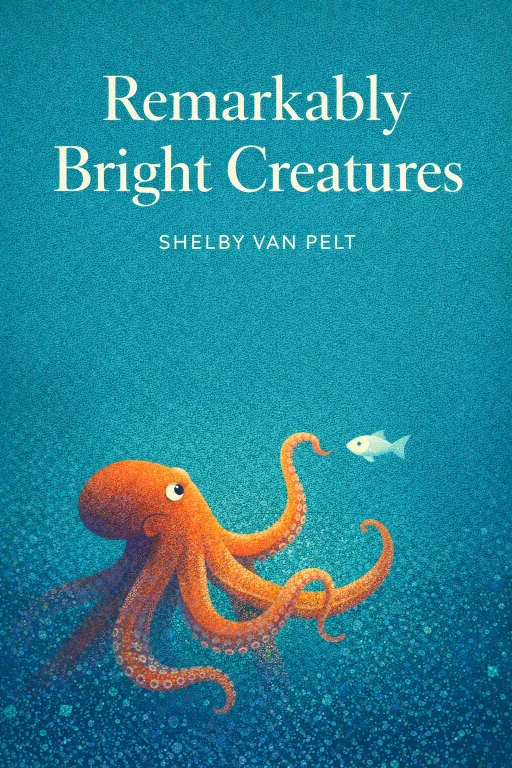
Remarkably Bright Creatures
Introduction
Nova: Imagine you are trapped in a glass box. You are incredibly intelligent, you have three hearts, blue blood, and you can squeeze your entire body through a hole the size of a lemon. But to the humans walking past, you are just a curiosity. A wet, squishy thing behind glass.
Atlas: That sounds like the start of a sci-fi movie, but we are actually talking about one of the most beloved characters in recent fiction. His name is Marcellus, and he is a Giant Pacific Octopus.
Nova: Exactly. Today we are diving into Remarkably Bright Creatures by Shelby Van Pelt. It is a debut novel that took the world by storm, landing on the New York Times bestseller list for over a year and even getting a glowing recommendation from Bill Gates.
Atlas: I have to admit, when I first heard about a book narrated by an octopus, I was skeptical. I thought, is this going to be a children's story? But it is actually a deeply moving exploration of grief, aging, and the unexpected ways we find connection.
Nova: It really is. It centers on Tova Sullivan, a seventy-year-old widow who works the night shift at the Sowell Bay Aquarium, and her unlikely friendship with Marcellus. It is a story about how sometimes, the most 'remarkably bright' creatures are the ones we almost overlook.
Atlas: So, let's get into it. How does a grumpy octopus and a meticulous cleaning lady become the literary duo of the decade?
Key Insight 1
Tova and the Art of Routine
Nova: To understand this book, you have to understand Tova Sullivan. She is seventy years old, living in the fictional town of Sowell Bay, Washington. Her husband, Will, passed away recently, and her only son, Erik, disappeared thirty years ago when he was just eighteen.
Atlas: That is a lot of loss for one person to carry. And Tova’s way of coping is... well, it is very specific. She cleans.
Nova: She doesn't just clean; she polishes. She takes a job as the night cleaner at the local aquarium, not because she needs the money, but because she needs the movement. She finds solace in the repetitive nature of mopping floors and wiping fingerprints off the glass.
Atlas: It is her armor, right? If she keeps the world around her orderly and sparkling, maybe the chaos of her grief won't swallow her whole. She even has this social group called the 7-O'Clock-ers.
Nova: Yes! Mary-Ann, Janice, and Barb. They meet for coffee and knit, and they represent that very real pressure of aging—the idea that once you reach a certain age, you are expected to just... fade into a retirement home and stop being useful.
Atlas: But Tova resists that. She finds her purpose in the quiet of the aquarium at night. And that is where she meets Marcellus. He is in his own kind of retirement, though a much more involuntary one.
Nova: Marcellus is a Giant Pacific Octopus, and he is nearing the end of his life. These creatures only live about four years, and Marcellus knows his days are numbered. He actually counts them. He starts the book telling us he has about 160 days left.
Atlas: He is such a curmudgeon! He looks at the humans visiting the aquarium and thinks they are mostly idiots. He calls them 'remarkably bright creatures' with a heavy dose of sarcasm at first.
Nova: But he notices Tova. He notices that she is different. She talks to him, but she also respects him. And their friendship begins when Tova finds Marcellus tangled in some stray power cords after one of his secret late-night escapes from his tank.
Atlas: Wait, he escapes? Is that actually a thing octopuses do, or is that just for the plot?
Nova: Oh, it is very real. Giant Pacific Octopuses are famous escape artists. They can unscrew jars, solve puzzles, and yes, they have been known to climb out of their tanks at night to scavenge for snacks in other exhibits. Shelby Van Pelt actually researched this heavily. Marcellus’s late-night raids for sea cucumbers are based on real cephalopod behavior.
Key Insight 2
The Invertebrate Detective
Atlas: So we have Tova cleaning and Marcellus escaping. But the book isn't just a slice-of-life story about an aquarium. There is a mystery at the heart of it, right?
Nova: A thirty-year-old cold case. Tova’s son, Erik, went missing from a boat in the Puget Sound in the middle of the night. The police ruled it a suicide, but Tova never believed it. She has lived three decades with this open wound.
Atlas: And this is where the 'octopus narrator' thing goes from quirky to brilliant. Marcellus is a collector. He picks up things that humans drop or lose in the tanks. He calls them his 'souvenirs.'
Nova: Exactly. He has a perspective that no human has. He sees the things we discard. And he happens to have a very specific item that connects to Erik’s disappearance. But because he is an octopus, he can't just tap Tova on the shoulder and tell her.
Atlas: It is agonizing! You are reading these chapters from Marcellus’s POV where he is basically screaming the truth at the characters, but they just see a giant orange blob with suction cups.
Nova: It creates this incredible tension. Marcellus realizes that Tova is lonely and that she needs closure. He starts to use his 'escapes' not just to find food, but to try and communicate with her. He starts leaving her clues.
Atlas: It is a race against time, too. Because as we mentioned, Marcellus is dying. His body is failing him. He is losing his color, his strength. He knows he only has one last 'great escape' left in him to help Tova.
Nova: It is such a beautiful metaphor for the wisdom of the elderly. Both Tova and Marcellus are being written off by society because they are 'old' or 'captive,' yet they are the only ones with the intelligence and the patience to solve a mystery that the 'experts' gave up on years ago.
Atlas: I love how Van Pelt handles the octopus's voice. It doesn't feel like a cartoon. It feels like a very old, very wise soul trapped in a body that is fundamentally alien to us. He has three hearts, and by the end of the book, you feel like all three of them are breaking for Tova.
Key Insight 3
Cameron and the Search for Belonging
Nova: While Tova and Marcellus are bonding, we have a third perspective: Cameron Cassmore. He is a thirty-year-old guy from California who is, frankly, a bit of a mess.
Atlas: A bit of a mess? The guy can't keep a job, he’s living in a trailer, and he’s obsessed with finding the father who abandoned him. He is the polar opposite of Tova’s orderly life.
Nova: He really is. Cameron comes to Sowell Bay because he finds a class ring in his mother’s old belongings. He thinks the ring belongs to a wealthy real estate mogul in town who might be his father. He’s looking for a payday, but what he’s actually looking for is a family.
Atlas: He ends up taking over Tova’s job at the aquarium after she gets injured. And this is where the threads start to weave together. Tova sees something in Cameron—this spark of potential that he doesn't see in himself.
Nova: It is a classic 'found family' trope, but it feels so earned here. Tova treats Cameron with the stern but kind discipline he never had. She teaches him how to clean, how to show up, how to care about something.
Atlas: But Cameron is also the one who almost ruins everything. He is impulsive. He gets angry. At one point, he actually throws away that class ring—the only clue to his past—out of pure frustration.
Nova: And who is there to catch it? Marcellus. This is the moment where the human and animal worlds collide in a major way. Marcellus sees the ring, recognizes its significance to Tova, and risks his life to retrieve it from the bottom of a drain.
Atlas: That scene is intense. An octopus in a drain pipe is not a good situation. But it shows the depth of Marcellus’s empathy. He isn't just a 'bright creature' because he can solve puzzles; he’s bright because he understands human love and loss.
Nova: It also highlights the theme of 'second chances.' Cameron is a guy who has been told his whole life that he is a failure. Tova is a woman who thought her life ended when her husband died. Together, they find a way to start over.
Key Insight 4
The Silver Ring and the Final Truth
Atlas: Okay, we have to talk about the ending. Without spoiling every single beat, how does Marcellus actually bridge the gap? How does he get the truth to Tova?
Nova: It involves a yellow cleaning bucket and a lot of courage. Marcellus manages to get the ring to Tova in a way she can't ignore. When she sees it, everything clicks. She realizes that the ring didn't belong to some random mogul—it was Erik’s ring.
Atlas: And that means... Cameron isn't just some random kid she’s mentoring. He is her grandson. The daughter of the woman Erik was seeing before he died.
Nova: It is a massive revelation. But the book doesn't stop at the 'happy ending' of finding a grandson. It also gives Tova the truth about Erik’s death. Through a series of coincidences and Marcellus’s help, she learns that Erik didn't take his own life. It was a tragic accident on the boat.
Atlas: That is the closure she needed for thirty years. The weight of the 'why' is finally lifted. But it comes at a cost. Marcellus is at the very end of his life cycle.
Nova: The final chapters are some of the most emotional I have ever read. Tova realizes that Marcellus is dying, and she knows he doesn't want to die in a tank. She decides to give him one last gift.
Atlas: She sneaks him out, right? In her cleaning bucket. She wheels this giant, dying octopus down to the Puget Sound and lets him go back to the ocean.
Nova: It is a beautiful reversal. Marcellus spent the whole book trying to 'save' Tova from her grief, and in the end, Tova saves him from his captivity. He gets to spend his final moments in the vast, dark water he came from.
Atlas: It really hits home that 'remarkably bright' isn't just about IQ. It is about the light we bring into each other's lives. Tova stays in her house, she doesn't go to the retirement home, and she starts a new life with Cameron. It is a story about how it is never too late to find your people—or your cephalopods.
Conclusion
Nova: Remarkably Bright Creatures is more than just a 'book about an octopus.' It is a reminder that we are all connected in ways we can't always see. Whether you are a seventy-year-old widow, a lost thirty-year-old, or a giant Pacific octopus, we all share the same need to be seen and understood.
Atlas: It is no wonder this book has become such a phenomenon. It manages to be heartwarming without being cheesy, and it tackles heavy subjects like death and aging with a lightness of touch that is really rare. Plus, I will never look at an octopus the same way again.
Nova: Neither will I. If you haven't read it yet, it is a must-read. And keep an eye out for the movie—Sally Field is set to play Tova, which is just perfect casting.
Atlas: Absolutely. It is a story that stays with you, much like Marcellus’s souvenirs. It reminds us to look a little closer at the world around us, because you never know who might be trying to tell you something important.
Nova: Thank you for joining us for this deep dive into Sowell Bay. We hope it inspired you to find the 'remarkably bright' moments in your own life.
Atlas: This is Aibrary. Congratulations on your growth!