

The Fearful Gift: Finding Strength in History's Shadows
Golden Hook & Introduction
SECTION
Nova: What if the very quality that brought Abraham Lincoln to the brink of suicide was also the source of his greatest strength as a leader? It’s a provocative thought, isn't it?
Sierra: It's completely counterintuitive to how we're taught to think about strength and leadership. It turns the whole idea on its head.
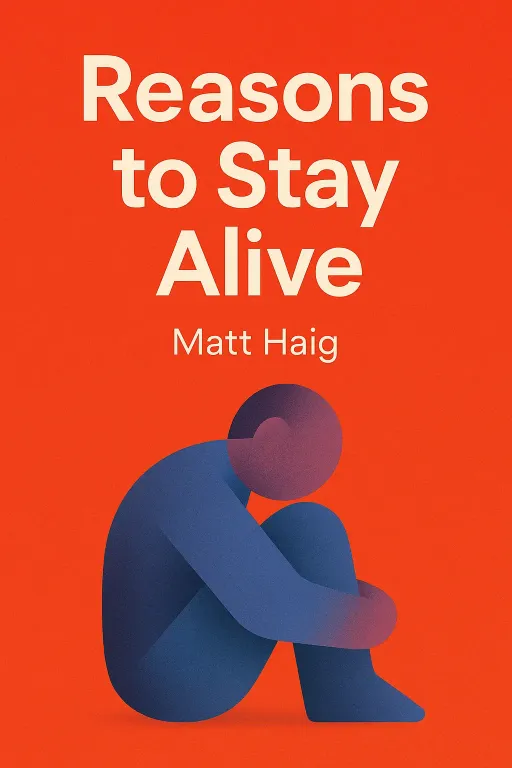
Nova: Exactly. And that's the 'fearful gift' we're exploring today, through the lens of Matt Haig's incredible book, 'Reasons to Stay Alive'. I'm your host, Nova, and I'm so glad to have Sierra here with me. Sierra, you have such a passion for history and politics, and this book, which seems like a personal memoir on the surface, has these deep, fascinating undercurrents that I think are right up your alley.
Sierra: I was so surprised by that, Nova. I came for the personal story but stayed for the profound analysis of history and society. It’s so much more than one man's struggle.
Nova: It really is. And that’s our map for today. Today we'll dive deep into this from three powerful perspectives. First, we'll confront the raw, personal reality of depression and how it lies to us. Then, we'll travel back in time to uncover the hidden strength it gave one of history's most iconic leaders. And finally, we'll zoom out to question whether our modern world itself is contributing to our anxiety. Ready to jump in?
Sierra: Absolutely. Let's do it.
Deep Dive into Core Topic 1: The Lie of the Mind
SECTION
Nova: So, Sierra, before we can even get to Lincoln and his 'fearful gift,' we have to understand the beast he was fighting. Matt Haig is unflinching in his description of depression, and he starts with a core, powerful idea: that depression lies.
Sierra: It’s the central thesis, really. That the hopelessness you feel isn't a logical conclusion, it's a symptom.
Nova: Precisely. And he illustrates this with a story so visceral it stays with you. He calls it "The Day I Died." He's 24 years old, living in a villa in Ibiza with his girlfriend, Andrea. On the surface, it's paradise. But internally, a storm is gathering. He describes this growing dread, this sense that something is fundamentally wrong. For three days, he's trapped in bed, unable to eat or sleep, consumed by a terror he can't name.
Sierra: The contrast between the idyllic setting and the internal hell is so stark.
Nova: It is. And it culminates in him walking out of the villa, towards a cliff overlooking the Mediterranean. The view is breathtaking—he describes the blue water, the sun—but it means nothing to him. He writes that in that moment, the desire to escape the pain is stronger than the fear of death. He's standing there, on the edge, believing that his only options are madness or death.
Sierra: And he's completely alone in that feeling, even if his girlfriend is just a short walk away.
Nova: That's the core of it. He uses this unforgettable metaphor. He says living with depression is like, "You are walking around with your head on fire and no one can see the flames." You're screaming, but you're making no sound. It’s this total, terrifying invisibility.
Sierra: That image of the 'invisible flames' is so powerful. It speaks to the profound isolation of the illness. It's not just sadness; it's a fundamental break from reality. And what's so incredible is that he jump. He turned back.
Nova: He did. He thought of his family, of Andrea, and that love, that connection, was just enough to pull him back from the brink. He was physically sick from the stress, but he was alive.
Sierra: And you know, the most powerful part of that whole section for me is his conclusion. He says, "So the fact that this book exists is proof that depression lies." The depression told him he had no future, that he'd never be well, that he'd never write again. And the book we're holding is the physical evidence that it was all a deception.
Nova: It’s the ultimate rebuttal, isn't it? The act of telling the story becomes the victory over the story the depression was trying to write for him. It's an act of defiance.
Sierra: A profound one. It establishes that this isn't a battle of logic; it's a battle against a disease that hijacks your perception. And surviving it means learning to distrust the most convincing voice you'll ever hear: your own.
Deep Dive into Core Topic 2: History's Hidden Strength
SECTION
Nova: Exactly. And that ability to survive the lie, to endure that fire, brings us to this incredible idea you and I were talking about before we started recording, Sierra. This idea of the 'fearful gift'. Let's talk about Abraham Lincoln.
Sierra: I'm so glad we're going here. This chapter was a revelation for me. As someone who studies history, we often get these sanitized versions of great figures.
Nova: Right? We see the stoic face on the five-dollar bill. But Haig pulls back the curtain. He tells us that Lincoln, in his early thirties, openly declared, "I am now the most miserable man living." His friends were so worried about his suicidal thoughts that they removed all the knives and razors from his room. He was, by any modern definition, suffering from severe, clinical depression.
Sierra: Which, if you told someone that, their first thought would be, "How could a man like that possibly lead a country through its most brutal war?"
Nova: And that is the billion-dollar question. Haig's answer, drawing from the work of biographer Joshua Wolf Shenk, is what's so radical. He quotes Shenk, who wrote: "Lincoln didn’t do great work because he solved the problem of his melancholy; the problem of his melancholy was all the more fuel for the fire of his great work."
Sierra: This is a radical reframing of historical leadership. It's a complete paradigm shift. We're taught a 'great man' theory of history where leaders are these unflappable, iron-willed figures, immune to doubt. But Haig, through Shenk, is arguing that Lincoln's greatest qualities were born from his suffering.
Nova: Say more about that. What qualities?
Sierra: Well, think about it. Empathy, for one. How could he understand the immense suffering of a divided nation, of soldiers dying and families being torn apart? Perhaps because he intimately understood suffering on a personal level. His famous quote, "Wherever I hear anyone arguing for slavery, I feel a strong impulse to see it tried on him personally," that's not just a political statement; it's a deeply empathetic one.
Nova: That's a fantastic point. The ability to feel another's pain.
Sierra: And his foresight, too. His caution. Haig brings up Winston Churchill, another leader who suffered from what he called his "black dog" of depression. The book suggests that these men were able to sense dangers that more 'normal,' optimistic minds might have missed. Their anxiety wasn't a bug; it was a feature. It made them more realistic, more prepared for the worst-case scenario.
Nova: So the depression wasn't an obstacle to their greatness, it was an ingredient.
Sierra: Precisely. It suggests that vulnerability isn't the opposite of strength; it can be its source. It’s a 'fearful gift' because the price is immense, the pain is real, but the insight it provides—into the human condition, into suffering, into empathy—is invaluable for a leader. It makes you wonder how many other historical figures we've misunderstood because we've ignored their 'invisible flames.'
Deep Dive into Core Topic 3: The Anxiety Economy
SECTION
Nova: Vulnerability as a source of strength... I love that. But it also makes you wonder, if this is such a fundamental part of the human condition, why does it feel like anxiety and depression are so rampant? Haig has a theory about that, which I think will resonate with your interest in political and social structures.
Sierra: He basically argues that we're living in a world that's perfectly designed to make us sick, right?
Nova: Perfectly designed. He calls our world an "anxiety machine." He argues that our economy thrives on creating dissatisfaction. He uses a brilliant quote from the writer David Foster Wallace, who said that the purpose of advertising is to "create an anxiety relievable by purchase."
Sierra: And it's everywhere. You're not thin enough, not rich enough, not happy enough, your phone is two years old... there's always something wrong with you that can be 'fixed' by buying something. It's a perpetual motion machine of inadequacy.
Nova: It is! And it's not just advertising. It's the sheer speed of life, the information overload. He quotes the philosopher Kierkegaard, who called anxiety "the dizziness of freedom." We have so many choices, so many potential lives we could be living, that we become paralyzed. We see it constantly on social media—everyone is curating their perfect life, and we're left comparing our messy reality to their highlight reel.
Sierra: It's almost a form of social control, isn't it? If a population is perpetually dissatisfied and anxious, they're more malleable, more focused on consumption than on questioning the systems around them. It's a distraction from bigger political and economic questions.
Nova: That's a really sharp analysis, Sierra. It takes it to another level.
Sierra: Well, Haig is making a deeply political point, even if he frames it personally. He's saying our collective mental health crisis isn't just a collection of individual chemical imbalances. It's a symptom of a sick society. We're being told to practice self-care—meditate, do yoga, buy this scented candle—to cope with a system that is fundamentally stressful and exploitative.
Nova: So we're treating the symptom, not the cause.
Sierra: In many ways, yes. Haig lists things that help him, like running and reading, and those are vital. But he's also asking us to look at the bigger picture. To recognize that the 'head on fire' feeling isn't always just a personal problem; it's a logical response to an increasingly illogical world.
Nova: It's a powerful and, frankly, validating perspective. It says, "You're not crazy for feeling this way. The world is kind of crazy."
Sierra: And that recognition, that externalizing of the problem, can be a huge source of relief. It's not all on you.
Synthesis & Takeaways
SECTION
Nova: It really can be. So, when we step back, we have this incredible arc. We start with a deeply personal, reality-bending illness that tells you your life is over...
Sierra: ... which we then see, through the lens of history, can paradoxically fuel the empathy and foresight of one of the world's greatest leaders...
Nova: ... and is now, in our time, being amplified and even weaponized by the very economic and social systems we live in. It's an amazing journey from the personal to the historical to the political.
Sierra: It really is. And it leaves me thinking... Haig's book is called 'Reasons to Stay Alive,' and he wrote his own list at the end. But after exploring all this, it makes you ask yourself a bigger question.
Nova: What's that?
Sierra: It's about where we find our own reasons. After this conversation, I feel like they can come from anywhere. What are the small, personal things, like the love that pulled Haig back from the cliff? What are the historical inspirations, like Lincoln's resilience, that show us strength in vulnerability? Or, and I think this is just as important, what are the acts of societal defiance—like choosing connection over consumption, or logging off social media—that become reasons?
Nova: That's a beautiful way to put it. It’s not a passive list, but an active search.
Sierra: Exactly. It's a question worth sitting with. What are your reasons? And I think finding them is one of the most important things any of us can do.
Nova: A perfect final thought. Sierra, thank you so much for this incredibly insightful conversation.
Sierra: Thank you, Nova. It was a pleasure.









