Innovation and Play
Golden Hook & Introduction
SECTION
Nova: The average professional spends up to seventy percent of their workday battling invisible friction and mental fatigue, trying to force focus through sheer willpower. But cognitive science shows that white-knuckling your way through tasks actually depletes your executive function, while game mechanics trigger effortless flow.
Atlas: Oh, I know that feeling of staring at a screen, waiting for inspiration to strike, while my energy just drains away. It is incredibly frustrating to feel like you are running on empty before the day has even properly begun.
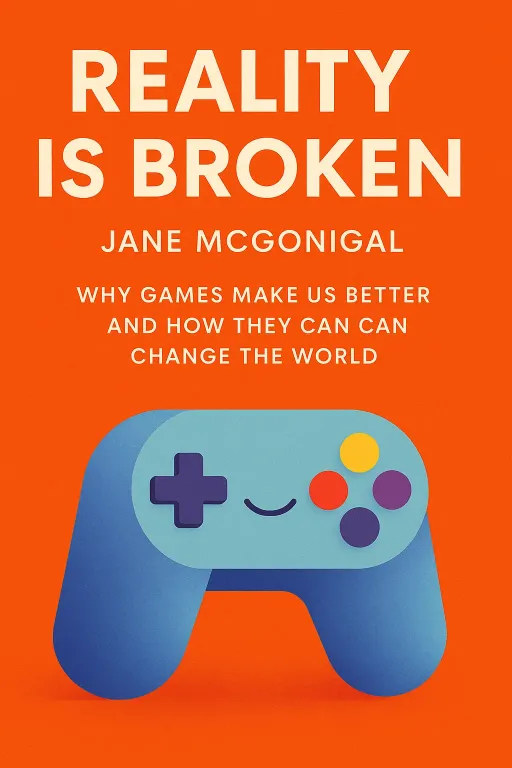
Nova: Exactly, and that is why we are looking at this from a completely different angle today. We are diving into two groundbreaking frameworks that, on the surface, seem to belong to entirely different worlds. We have Jane McGonigal's widely acclaimed book, Reality Is Broken, which explores how game design principles can revolutionize real-world productivity. And we are pairing that with Klaus Schwab's landmark work, The Fourth Industrial Revolution, which outlines the massive, macro-level technological shifts reshaping our entire global economy.
Atlas: That sounds like an incredible collision of ideas. You have the founder of the World Economic Forum, Klaus Schwab, talking about global systemic shifts, and then a world-renowned game designer like Jane McGonigal, who actually earned the world's first PhD in computer game design from UC Berkeley. It is a fascinating pairing. How do these two concepts connect for someone trying to optimize their daily workflow?
Nova: They connect at the exact point where human attention meets technological complexity. Schwab shows us the massive landscape we are forced to navigate, while McGonigal gives us the cognitive map to survive and thrive within it. The core of our podcast today is really an exploration of how we can use game design habits to make our professional tasks feel more engaging and less like chores. We will dive deep into this from three key perspectives. First, we will explore the macro shift of the modern workplace and why our current workflows are causing an engagement crisis. Then, we will break down the actual architecture of play and how game design mechanics trick our brains into loving hard work. Finally, we will focus on a highly practical, daily blueprint to help you implement micro-sprints and reclaim your cognitive energy.
The Macro Shift and the Engagement Crisis
SECTION
Nova: To understand why we feel so drained by modern work, we have to look at the world Klaus Schwab describes. He argues that we are living through a transition where the physical, digital, and biological spheres are actively merging. This represents a massive shift in how human beings interact with their tools.
Atlas: Now that you mention it, the sheer speed of change today is dizzying. We are constantly jumping between different software platforms, managing endless notification streams, and trying to make sense of abstract data. It feels like the nature of what we call work has changed completely, but our brains are still running on ancient software.
Nova: That is the precise issue. In previous industrial revolutions, work was highly tangible. You could see the assembly line moving, or you could physically stack the crates. The cause-and-effect loop of your labor was immediate and highly visible. Today, in this fourth wave, our work is highly abstract. We push pixels, we write emails, we manage complex databases. This abstraction creates a massive amount of cognitive friction because our brains are naturally wired for concrete, immediate feedback.
Atlas: Can you give an example of what that actually feels like in our day-to-day work?
Nova: Think about the difference between clearing a physical desk and clearing a digital inbox. When you clean a physical desk, you feel the weight of the papers, you see the stack diminishing, and you experience a satisfying sense of completion when the surface is clear. With an email inbox, you might archive fifty messages, only to receive thirty more while you were working. The environment is constantly shifting, the boundaries are fluid, and there is no natural endpoint. This lack of clear boundaries and immediate feedback loops leads to a state of chronic cognitive fatigue.
Atlas: Wow, that is a massive shift in how we define labor. It explains why someone can sit at a desk all day, not lift anything heavier than a coffee cup, and still walk away feeling absolutely exhausted. We are constantly burning mental calories just trying to orient ourselves in this abstract digital landscape.
Nova: Yes, we are swimming in digital pollution. Schwab highlights that this systemic complexity demands a completely new set of cognitive skills. We need high-level synthesis, rapid adaptation, and deep focus. Yet, the environments we work in are designed to fragment our attention. Every ping, every notification, every open tab is a tiny cognitive tax. By the time we actually sit down to do the deep, meaningful work, our executive control centers are completely spent.
Atlas: That makes complete sense. It is like trying to run a marathon while wearing lead boots. We are fighting the system we are working in just to get our basic tasks done. So, how do we begin to redesign this experience?
Nova: This is where Jane McGonigal's insights become essential. She spent years researching why virtual worlds are so incredibly compelling. Millions of people around the world willingly spend hours solving highly complex, difficult puzzles in video games, often after a long day of actual work. They are paying money to do labor inside a game, and they are doing it with intense enthusiasm. The breakthrough moment comes when we realize that games are not actually about escapism. They are about active engagement. Games are perfectly designed learning environments that provide the exact cognitive rewards that our modern workplaces lack.
The Architecture of Play
SECTION
Atlas: Wait, hold on, are we really suggesting that we can turn a stressful corporate job into a game? That sounds a bit like trying to put a coat of paint on a crumbling building. Surely there is a fundamental difference between playing a game and doing actual, high-stakes professional work.
Nova: That is a very common skepticism, and it is crucial to address it. Gamifying work is not about adding points, badges, and leaderboards to dry tasks. That is what game designers call exploitationware, and it rarely works because it feels artificial. True gamification is about understanding the psychological architecture of play. McGonigal identifies four defining traits of any game. First, a clear goal that gives players a sense of purpose. Second, rules that place limitations on how players can achieve that goal, which actually unleashes creativity. Third, a reliable feedback system that tells players how close they are to the goal. And fourth, voluntary participation, which ensures that everyone accepts the goals, rules, and feedback.
Atlas: That makes sense, but how do we actually construct those rules for ourselves? The voluntary participation part seems especially tricky when you have a mortgage to pay and a boss to answer to.
Nova: It is all about how we frame the obstacles we face. In a game, we willingly accept voluntary obstacles. Think about golf. The goal of golf is to put a tiny ball into a small hole in the ground. The most efficient way to do that would be to walk over and drop the ball in with your hand. But we invent rules. We say you must stand hundreds of yards away, you must hit the ball with a metal stick, and you must navigate sand pits and water hazards. The obstacles are what make the game satisfying. When we overcome those self-imposed limits, our brains release dopamine.
Atlas: It is like golf, where the entire point is the self-imposed difficulty. Without those rules, it is just a mundane task. With them, it becomes a lifelong pursuit of mastery.
Nova: Exactly. And we can apply this exact same logic to our professional tasks. Let us look at a fascinating real-world case study from Jane McGonigal's research. Microsoft was facing a massive challenge with their language localization software. They had to review thousands of dialog boxes and program screens in dozens of different languages to ensure the translations were accurate and fitted the user interface. It was incredibly dry, tedious, and mind-numbing work, and their engineers hated doing it.
Atlas: That sounds like the ultimate cognitive chore. How did they possibly turn that into something people actually wanted to do?
Nova: They designed a game called the Language Quality Game. They created a simple, visual interface where employees could review dialog boxes and flag errors. But they added a layer of friendly competition. They set up leaderboards comparing different regional offices, like Redmond versus Tokyo. They introduced progress bars showing how close each team was to achieving full localization for their specific language. They even allowed employees to deliberately flag errors in other offices' work, creating a playful rivalry.
Atlas: That is a perfect example of turning a mind-numbing chore into a collective mission. What was the actual result of that experiment?
Nova: The results were staggering. Over forty-five hundred employees participated voluntarily. They reviewed over five hundred thousand dialog boxes, finding thousands of bugs that would have otherwise slipped through. Some employees even participated on their weekends, simply because they wanted to help their regional office climb to the top of the leaderboard. They took a task that was previously viewed as a chore and turned it into a highly engaging, cooperative challenge.
Atlas: So you are saying we need to deliberately design our own daily obstacles to make our work feel more like a game?
Nova: Yes. We can design our own micro-games within our daily workflows. When we face a complex, overwhelming task, we can establish a highly specific goal, set up strict, self-imposed rules, and create an immediate feedback loop. This shifts our relationship with the task from passive endurance to active engagement.
The High-Performance Gamification Blueprint
SECTION
Atlas: I can see how this works on a corporate scale, but let us bring this down to the individual level. I am thinking about our listeners who are managing high-pressure projects, dealing with constant distractions, and trying to maintain peak performance. How do they actually build these game design habits into their daily routines?
Nova: The most effective entry point is to implement a daily micro-sprint at the very start of the day. This is a highly structured, twenty-minute block dedicated to a single, high-impact task, with absolutely zero distractions. You set a timer, close every single browser tab except the one you need, and focus entirely on making progress.
Atlas: Oh, I have been there, trying to make everything absolutely flawless before even starting, which usually just leads to putting it off entirely. How does the micro-sprint help us overcome that perfectionism trap?
Nova: The micro-sprint works because it shifts your focus away from the quality of the final output and onto the momentum of the process. You are releasing the need for perfection. You are not trying to write the perfect report or design the perfect system in those twenty minutes. You are simply trying to maintain an uninterrupted state of action. The voluntary obstacle here is the strict time limit and the ban on distractions. By gamifying the time window, you lower the cognitive barrier to entry.
Atlas: How would someone actually set up one of these micro-sprints tomorrow morning?
Nova: You start by defining your goal with surgical precision. It cannot be something vague like work on the presentation. It must be write three slides for the presentation. Then, you establish your rules. For twenty minutes, you are not allowed to check email, look at your phone, or open a new browser tab. Your feedback system is the timer ticking down and a physical progress bar you draw on a piece of paper. As you complete each slide, you physically cross it off or fill in a segment of the bar.
Atlas: That sounds incredibly doable, and it completely reframes the pressure we put on ourselves. Instead of staring at a massive, overwhelming project, you are just playing a quick, twenty-minute game against the clock.
Nova: It is highly effective. And the science behind this is fascinating. When you successfully complete a micro-sprint, your brain receives a small hit of dopamine from achieving that micro-goal. This builds cognitive momentum. It is far easier to continue working after those twenty minutes because you have already overcome the initial friction. You are leveraging the Zeigarnik effect, which is our brain's natural tendency to remember uncompleted tasks and want to push them to completion.
Atlas: That is a brilliant way to use our own psychology to our advantage. But what about the rest of the day? How do we maintain this level of engagement when we are pulled into meetings and administrative tasks?
Nova: We have to apply the same game design principles to our larger workflows. This means creating clear feedback loops for our long-term goals. If you are working on a project that will take six months to complete, you cannot rely on the final delivery for your sense of reward. You must design micro-milestones. Create a visual dashboard where you can track your progress daily. Celebrate the completion of each phase. By making the invisible progress visible, you sustain your motivation over the long haul.
Atlas: That is a crucial point. In the modern workplace, so much of our progress is invisible. We do all this work, but at the end of the day, our computer screen looks exactly the same. By creating physical, visual representations of our progress, we are giving our brains the concrete feedback they crave.
Nova: Exactly. We are essentially designing our own user interface for our work. We cannot always control the macro-level complexity that Klaus Schwab describes, but we can absolutely control how we interact with our immediate tasks. We can choose to view our work as a series of formless chores, or we can choose to design it as a series of engaging, structured challenges.
Synthesis & Takeaways
SECTION
Atlas: That gives me chills, thinking about how much human potential is locked up in poorly designed systems. If we can shift our perspective, we can transform how we experience our daily labor.
Nova: That is the deeper meaning of these ideas. When we look at the macro shifts of the Fourth Industrial Revolution through the lens of game design, we realize that the engagement crisis is not a personal failure. It is a design flaw. Our workplaces and workflows were designed for a different era, one that prioritized compliance and repetition over creativity and deep focus.
Atlas: It is a profound realization. We are trying to solve modern, complex problems using outdated cognitive habits. By bringing the principles of play into our professional lives, we are not trivializing our work. We are actually elevating it. We are designing environments that respect human psychology and unlock our highest potential.
Nova: That is the ultimate takeaway. Play is not the opposite of work. It is the highly optimized partner of meaningful productivity. By designing clear goals, establishing creative rules, and building rapid feedback loops, we can transform our most demanding professional challenges into sources of deep focus and genuine satisfaction.
Atlas: I love that. It is a complete reframing of what it means to be productive. For everyone listening, I highly encourage you to try a micro-sprint tomorrow morning. Set your goal, establish your rules, and see how much momentum you can build in just twenty minutes.
Nova: This is Aibrary. Congratulations on your growth!