

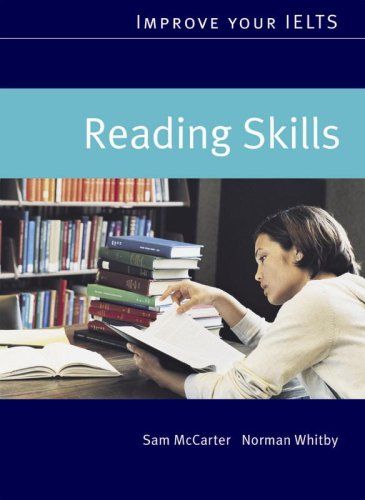
Reading skills
Introduction
Nova: Picture this. You are sitting in an exam hall. You have three dense academic passages in front of you, forty questions, and exactly sixty minutes on the clock. Your heart is pounding as you stare at the first paragraph about the mating habits of deep-sea crustaceans. Sound familiar? That is the IELTS Academic Reading test, and for millions of test-takers around the world, it is hands down the most stressful sixty minutes of their academic journey.
Nova: : That is so real, Nova. And honestly, the Reading section gets talked about as the hardest module for a reason. You have to read at speed, process complex academic language, and answer questions that are designed to trick you. It is not just about understanding English — it is about understanding the game.
Nova: Exactly. And that is why a little book, just ninety-six pages long, has become something of a cult classic among IELTS students around the world. We are talking about Improve Your IELTS Reading Skills by Sam McCarter and Norman Whitby, published by Macmillan Education back in 2007. Nearly two decades later, this compact guide is still one of the most recommended resources for IELTS reading preparation.
Nova: : A ninety-six-page book taking on the beast that is the IELTS Reading test? That does not sound like much. What makes it so special?
Nova: That is the fascinating thing. Sam McCarter is not just some author who sat down and wrote a textbook. He has been in the trenches of English language teaching for over thirty years — he started as a volunteer teacher in Sierra Leone, taught academic and medical English at Southwark College in London, and has authored more than seventy books. This guy understands how test-takers think and where they stumble. And the book he co-wrote with Norman Whitby takes that deep understanding and packs it into ten incredibly focused units.
Nova: : All right, I am intrigued. Let us dig into this. Today on the show: why Sam McCarter's approach to reading skills has helped thousands of IELTS candidates, what makes his methodology different, and why this little book from 2007 still matters in 2026.
Who Is Sam McCarter?
The Man Behind the Method
Nova: Before we dive into the book itself, let us talk about the person behind it, because the methodology makes so much more sense when you understand where Sam McCarter comes from. He began his career as a volunteer English teacher in a secondary school in Sierra Leone, West Africa. That experience of teaching with limited resources, in a high-stakes environment, shaped everything he did later.
Nova: : That is quite a beginning. It is not the typical path of an ELT author, is it?
Nova: Not at all. He then moved to the UK and became a lecturer in academic and medical English at Southwark College in London, where he organized IELTS courses specifically for overseas doctors and healthcare professionals. These were people whose entire careers depended on getting a specific band score. The pressure was immense. And McCarter had to figure out how to teach reading skills efficiently, systematically, and in a way that produced real results under time pressure.
Nova: : So he is not writing from theory alone. He built his approach by working with students whose licenses to practice medicine depended on passing this exam.
Nova: Exactly. And over the years, he authored or co-authored an astonishing roster of titles. Think about this: IELTS Testbuilder 1 and 2, Ready for IELTS, Oxford EAP, Academic Writing Practice for IELTS, Tips for IELTS — the man has over seventy books on Goodreads with thousands of ratings. But his Improve Your IELTS Skills series, co-authored with Norman Whitby, remains one of his most popular. The Reading Skills volume alone has a 4.13 rating on Goodreads from over 150 ratings, which for a test prep book is genuinely impressive.
Nova: : I think what strikes me is that he did not just write one book and call it a day. He built an entire ecosystem of IELTS preparation materials, each targeting a different skill or approach. It suggests he really understood that reading, writing, listening, and speaking each need their own specific pedagogy.
Nova: That is exactly right. And with reading, McCarter identified a core problem that most students face. They approach the IELTS reading test the same way they approach reading in daily life — slowly, carefully, trying to understand every word. But the test is not designed for that. It is designed to assess whether you can extract specific information from complex texts under severe time constraints. McCarter's entire book is built around breaking that habit and replacing it with something much more strategic.
How Ten Units Build Reading Mastery
The Architecture of the Book
Nova: Let us walk through the structure of the book, because it is quite elegantly designed. The book has ten topic-based units, and each unit is divided into three sections: Skills, Vocabulary, and Exam Practice. That triad repeats through every chapter, and it is the engine that drives improvement.
Nova: : So every unit follows the same rhythm. That sounds almost too simple.
Nova: It is simple, but the execution is where the magic happens. The Skills section in each unit introduces specific reading techniques — skimming, scanning, identifying keywords, recognizing paraphrases — and it gives you targeted exercises to practice each one in isolation. The Vocabulary section builds a bank of academic words related to the unit's theme. And then the Exam Practice section throws you into an authentic IELTS-style passage with real question types, using the exact skills you have just practiced.
Nova: : So it is like: learn the technique, build the vocabulary, then apply everything under test conditions. That is a tight feedback loop.
Nova: Precisely. And the topics are chosen strategically too. The units cover themes that appear over and over in real IELTS exams — change and consequences, health, environment, education, technology, society. By the time a student finishes all ten units, they have not just practiced reading skills. They have built a working vocabulary across the major academic themes that IELTS draws from.
Nova: : That is smart. You are not just learning to read better. You are also building the background knowledge and vocabulary that make reading easier in the first place.
Nova: Right. And the book levels the difficulty progressively. It starts with relatively straightforward question types — short answer questions, sentence completion — and then gradually introduces the harder ones like True, False, Not Given and Matching Headings. Speaking of which, can we talk about True, False, Not Given for a moment?
Nova: : Oh please. That question type has broken so many spirits.
Nova: It really has. And McCarter gives it the attention it deserves. His technique boxes for True, False, Not Given are some of the most quoted pieces of advice in IELTS circles. He teaches students to locate the statement topic in the passage, check if the information matches exactly for True, look for direct contradictions for False, and then — critically — confirm whether the topic is actually mentioned at all before marking Not Given. The biggest mistake students make is letting outside knowledge or assumptions creep in. McCarter trains you to be almost ruthlessly literal.
Nova: : I feel like that is the whole philosophy of the book in one example. He does not just tell you the answer. He gives you a replicable process.
Skimming, Scanning, and the Art of Keyword Hunting
The Core Strategies
Nova: Let us go deeper into the actual strategies, because this is where McCarter's book really separates itself from more generic test prep materials. The first big insight is about skimming. McCarter argues that you should be able to skim any IELTS passage in under two minutes — ideally ninety seconds — and walk away with the main idea.
Nova: : Ninety seconds for a passage that might be 900 words long? That sounds terrifying.
Nova: It does, but here is the key. Skimming is not reading. It is not even speed reading. McCarter teaches you to use a pencil as a guide, moving your eye from left to right across each line, but only processing the nouns and the key verbs. You are hunting for the skeleton of the argument, not the flesh. What is the topic? What is the author's main claim? Where does the argument go? That is it. He actually says: resist the urge to slow down for interesting details. That is the discipline.
Nova: : So you are training yourself to read incompletely on purpose. That feels counterintuitive for most students who have been taught their whole lives to read thoroughly.
Nova: That is exactly the mental shift. And then scanning is the companion skill. Once you know the general structure of the passage from skimming, you use scanning to locate specific information — dates, names, numbers, key terms — without reading the surrounding text. McCarter describes it as training your eyes to move in efficient search patterns across the page.
Nova: : And then the third pillar is keyword identification, right? This is where the technique boxes really shine.
Nova: Yes. McCarter drills this relentlessly. For every question, you identify one or two keywords, then you go hunting for those exact words or their synonyms in the passage. The synonym recognition part is crucial, because IELTS almost never uses the same words in the question and the passage. If the question says "financial difficulties," the passage might say "economic hardship." McCarter's vocabulary banks in each unit are partly designed to build your synonym recognition, because that is often the difference between a band 6 and a band 7.
Nova: : It sounds like the book is essentially teaching you to think like the test designer. To anticipate where the traps are going to be.
Nova: That is a brilliant way to put it. And McCarter adds one more technique that I think is underrated: the error analysis log. He encourages students to keep a record of every mistake they make, categorizing it — was it a vocabulary gap? A misunderstood paraphrase? Did I rush and not re-read? Did I use outside knowledge when I should not have? This turns wrong answers from failures into data. You start seeing patterns in your own weaknesses, and then you can target them.
Nova: : So the book is not just about what to do right. It is about learning systematically from what you do wrong. That is a much more sophisticated approach than I expected from a ninety-six-page book.
What Students and Teachers Actually Say
Strengths, Weaknesses, and Real-World Impact
Nova: No book is perfect, and honest reviews of McCarter's Improve Your IELTS Reading Skills are refreshingly candid about both its powers and its flaws. Let us start with what people love. The number one praise is the authentic exam practice. The passages mirror the length, complexity, and question formats of real IELTS tests so closely that students report significantly less test-day shock.
Nova: : That matters enormously. The psychological advantage of walking into an exam and thinking "I have seen this before, I know what to do" cannot be overstated.
Nova: Exactly. The technique boxes are also universally praised. They are described as a "strategic playbook" — concise, actionable, and placed right next to the relevant exercises so you never have to flip back and forth. And the progressive difficulty curve is well-calibrated. Students who start at band 4.5 genuinely feel the book meeting them where they are and then pulling them upward.
Nova: : But what about the drawbacks? Every book has them.
Nova: The most common complaint is about layout and navigation. Some exercises within units lack clear numerical identification, which can make it frustrating to find specific activities when you are reviewing. There are also pages where different exercises run together without clear visual separation. For a self-study learner trying to follow a plan, this can be genuinely annoying. The book is also from 2007, and while the question types have not fundamentally changed, some students wish for more contemporary passage topics.
Nova: : That is interesting. So the core methodology is strong, but the user experience could be smoother. What about results? Does it actually work?
Nova: The testimonials tell an interesting story. On Quora and Reddit, you see students saying they started with this book at band 5.5 or 6.0 and worked their way up to 7.0 or 7.5. But here is the nuance: the students who succeed are almost always the ones who engage with the book systematically — the ones who keep the error log, who time themselves, who treat the technique boxes as a study curriculum rather than skipping straight to the practice tests. The book demands discipline. It does not offer shortcuts.
Nova: : So it is not a magic bullet. It is a training program, and you get out what you put in.
Nova: Perfectly said. And I think that is why McCarter's approach has endured. In a market flooded with "IELTS hacks" and "secret tips" and "guaranteed band 7 in 7 days," McCarter's book says: no, here is how you actually build the skill. It is almost old-fashioned in its respect for the learner's intelligence.
Nova: : I respect that. There is something honest about a book that says "this will take work" rather than promising miracles.
Conclusion
Nova: So what do we take away from Sam McCarter's Improve Your IELTS Reading Skills? First, it is a book built on genuine teaching experience, not theory. McCarter spent decades in classrooms watching students struggle with the same problems over and over, and the book addresses those problems directly. Second, its structure is deceptively simple — ten units, three sections each — but the systematic progression from skills to vocabulary to exam practice creates a powerful learning loop.
Nova: : And the strategies themselves — skimming in ninety seconds, scanning for keywords, recognizing paraphrases, keeping an error log — these are not tricks. They are trainable skills that transfer beyond the IELTS exam into real academic reading.
Nova: That is the deeper point, is it not? A medical student who learns to skim a research paper for its main argument in two minutes, or to scan for specific data without reading every word, or to recognize when information has been paraphrased — these are skills they will use for the rest of their career. The IELTS test is the gateway, but the reading ability lasts a lifetime.
Nova: : And yet the book is not without its rough edges. The layout can be frustrating, the navigation could be clearer, and it demands a level of self-discipline that not every learner brings. But for those who do show up and do the work, it delivers.
Nova: If you are an intermediate IELTS candidate — somewhere between band 4.5 and 7.5 — and you are willing to engage with a systematic, skill-building approach rather than chasing quick fixes, this book deserves a place on your desk. Pair it with the companion volumes on Writing and Listening and Speaking, and you have a complete, coherent preparation system from one of the most experienced voices in IELTS education.
Nova: : And if you are beyond IELTS — if you are a teacher looking for a model of how to structure reading instruction — there is a lot to learn here too. The technique box format, the error analysis methodology, the integration of vocabulary and skills practice — these are transferable ideas.
Nova: Here is our final thought. In a world where test preparation often feels like learning to beat a system, Sam McCarter's book reminds us that the best way to beat the system is to actually get better at the skill. That is a message worth holding onto, whether you are facing an IELTS exam or any other challenge that rewards genuine growth over shortcuts.
Nova: : This is Aibrary. Congratulations on your growth!