Navigating Workplace Dynamics & Communication
Opening
SECTION
Nova: Content` format, and section headers. No stage directions.<Transcript>
Golden Hook & Introduction
SECTION
Nova: Alright, Atlas, quick game. I’m going to throw out a word related to the workplace, and you just hit me with the first thing that comes to mind. Ready?
Atlas: Oh, I love these! My brain is prepped for rapid-fire. Hit me.
Nova: "Meeting."
Atlas: Unnecessary.
Nova: "Teamwork."
Atlas: Buzzword.
Nova: "Conflict."
Atlas: Avoidance. Or, sometimes, explosion.
Nova: Precisely! And that's where we're going today, isn't it? That tension between the official, structured world of work and the messy, human reality of it. We're diving into two brilliant books that tackle this head-on.
Atlas: Absolutely. Because 'avoidance' and 'explosion' are definitely not sustainable strategies for anyone trying to build something meaningful.
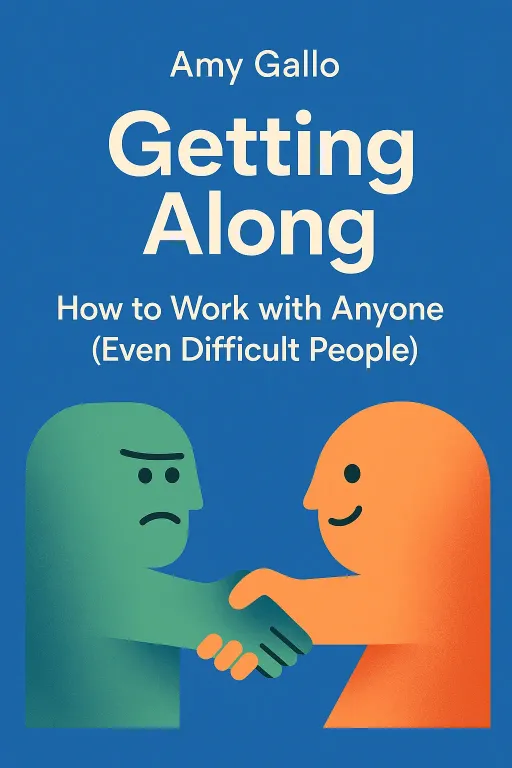
Nova: Exactly. Today, we're unpacking Amy Gallo's, which offers incredibly practical, evidence-based strategies for navigating those challenging workplace relationships – think dealing with difficult colleagues, managing conflict productively. Amy Gallo is actually a highly respected expert from the Harvard Business Review, so her advice is rooted in extensive research and real-world application, making it incredibly credible for anyone facing these daily struggles.
Atlas: Oh, I see. So, the explicit, direct communication stuff. That’s foundational for any leader, any builder.
Nova: It is. But then we’re layering on Michelle P. King’s. This book is a masterclass in understanding the unspoken cues, the cultural nuances in modern workplaces. King, with her deep background in gender, leadership, and organizational psychology, brings a unique lens to how power dynamics and subtle signals truly shape our interactions and influence. It’s about social intelligence, interpreting situations, and responding appropriately.
Atlas: That makes me wonder, how often are we missing half the conversation because we're not tuned into the unspoken? For our listeners who are visionary leaders, connecting dots, and trying to empower others, this blend of explicit and implicit skills sounds like an absolute superpower.
Nova: It absolutely is. The core of our podcast today is really an exploration of how to navigate the complex human landscape of the modern workplace, blending both explicit communication strategies and the subtle art of understanding unspoken cues. Today we'll dive deep into this from two perspectives. First, we'll explore how to master explicit communication for productive conflict and getting along, then we'll discuss the crucial skill of decoding unspoken dynamics by 'reading the air.'
Mastering Explicit Communication: Strategies for Productive Conflict & Getting Along
SECTION
Nova: So let's start with Amy Gallo and. It's almost counterintuitive, but Gallo argues that conflict isn't necessarily bad. It's how we engage with it that matters.
Atlas: Hold on, but for someone in a high-stakes environment, or a founder who's constantly prioritizing ruthlessly, conflict can feel like a massive time sink, a distraction from building momentum daily. Isn't it just easier to avoid it, or power through?
Nova: That’s a common perspective, and Gallo addresses it directly. She suggests that avoiding conflict often leads to resentment, passive-aggression, and ultimately, bigger blow-ups. What she advocates for is conflict. Think of it this way: imagine a team working on a new product launch. One team member, let's call her Sarah, consistently criticizes every idea in meetings, often with a dismissive tone. The team leader, David, feels frustrated, and the team's morale is dipping.
Atlas: Oh, I know that feeling. It’s like a slow leak of energy from the room every time Sarah speaks. You just want to shut it down.
Nova: Exactly. David's initial impulse might be to ignore Sarah, or to subtly exclude her from key discussions. But Gallo would advise against that. She offers a framework. First, David needs to. This means reflecting on his own emotions, identifying his goal for the conversation, and trying to understand Sarah's perspective. Is she genuinely trying to improve the product, or is there something else going on?
Atlas: So, it’s not about confronting her with "You're being negative!" but more like, "What's driving this?" That’s a shift in mindset.
Nova: It truly is. Then comes the phase. David might approach Sarah privately, saying something like, "Sarah, I've noticed you've had strong feedback on several of our recent ideas, and I value your perspective. Can you help me understand your main concerns regarding X, Y, and Z?" He's not accusing; he's inviting. He's using "I" statements, focusing on observations, and expressing curiosity.
Atlas: That sounds like a delicate dance. Especially if Sarah is, let's say, a senior engineer who feels her expertise isn't being fully appreciated. A founder might be tempted to just say, "Look, we need to move fast, either get on board or get out."
Nova: And that's where the empathy comes in, Atlas. David might discover Sarah feels overlooked, or that she genuinely sees a critical flaw others are missing. The key is active listening without immediately defending. He might even uncover a valid point that improves the product. The outcome of this approach isn't just about resolving the immediate conflict; it's about building a stronger working relationship, fostering psychological safety, and ultimately, making better decisions. This process transforms a potential blow-up into an opportunity for growth and understanding, which is vital for cultivating human potential within a team.
Atlas: That’s a great way to put it. It shifts from a battle to a collaboration. So, David prepares, he engages thoughtfully, and then what?
Nova: Then comes. After the conversation, David reflects on what went well, what he could have done differently, and what he learned about Sarah and the team dynamics. This continuous loop of preparation, engagement, and reflection builds his conflict resolution muscle. It’s about seeing conflict as a skill to be honed, not just a problem to be solved. And for leaders, this is about empowering their team to navigate disagreements constructively, not just dictating solutions.
Decoding Unspoken Dynamics: The Art of 'Reading the Air' for Influence and Effectiveness
SECTION
Nova: And that naturally leads us to the second key idea we need to talk about, which often acts as a counterpoint to what we just discussed – the invisible side of workplace dynamics, the things that aren't said aloud. This is where Michelle P. King’s becomes indispensable.
Atlas: Oh, I like that. The 'invisible language.' Because sometimes, even if you’re saying all the right things, you can still feel like you’re missing something crucial. For our listeners who are strategists, trying to connect dots and understand the big picture, this feels like an essential layer.
Nova: It absolutely is. King argues that much of what truly happens in an organization isn't in the official meeting minutes or the explicit directives. It's in the subtle power plays, the unspoken agreements, the cultural norms, the non-verbal cues. Imagine a scenario: A new project manager, let's call her Maria, joins a well-established team. She's been told that the team is very collaborative and democratic. In her first big meeting, a decision needs to be made about a critical project timeline.
Atlas: So Maria, following the explicit rules, encourages open discussion, asks for everyone’s input, maybe even calls for a vote.
Nova: Exactly. She facilitates a robust discussion. Everyone speaks, she feels good about the "collaborative" process. But then, a few days later, she notices the timeline she thought was decided is subtly being undermined by a couple of senior team members. Things are slowing down, new "concerns" are being raised.
Atlas: That sounds like a frustrating mystery. She followed the rules, but the outcome is different.
Nova: That’s where comes in. Maria, through King’s lens, needs to look beyond the words. She needs to observe the non-verbal cues. Who sits where in the meeting? Who speaks first? Who do people look at when someone makes a controversial point? What’s the team's history with similar decisions? Are there unspoken alliances or rivalries?
Atlas: So, it's like watching a play, but the real plot is happening beneath the dialogue. It's about figuring out who the actual influencers are, not just the ones with the official titles.
Nova: Precisely. Maria might notice that whenever a specific senior engineer, let's call him Mark, cleared his throat or subtly shook his head, the energy shifted, even if he said nothing directly against the timeline. Or perhaps the team culture values consensus through informal hallway conversations the official meeting. The meeting itself is just a formality.
Atlas: Wow, that’s kind of heartbreaking, in a way. All that effort in the meeting, only for the real decision to have already been made in the coffee break. But it’s also incredibly insightful for someone who needs to influence and be effective.
Nova: It gives you a strategic advantage. King’s work is about developing that social intelligence to interpret these signals. It's not about being manipulative; it's about understanding the full picture, building deeper connections, and navigating the social landscape ethically. By understanding the unspoken, Maria can then adjust her approach. She might realize she needs to have a pre-meeting chat with Mark, or she needs to observe who the informal leaders are and engage them differently.
Atlas: I’m curious, how do you 'read the air' when you're working remotely, or when teams are globally distributed with huge cultural differences? That sounds like the ultimate challenge for a resilient cultivator.
Nova: That’s a fantastic point. King acknowledges that remote work and diverse teams amplify the challenge. It requires even more intentionality. It might mean paying closer attention to tone in messages, the timing of responses, or even explicitly asking about cultural norms around decision-making. It’s about actively seeking out the "invisible" data points, not just waiting for them to appear. It's about developing a keen sensitivity to human potential in all its forms, spoken and unspoken.
Synthesis & Takeaways
SECTION
Nova: So, what we've really explored today is this powerful combination: mastering the explicit tools for communication and conflict from Amy Gallo, and then elevating that with Michelle P. King’s insights into the unspoken, the 'reading the air.'
Atlas: That makes sense. You need both. You can be the most articulate person in the room, but if you're missing the undercurrents, you're only getting half the story. And for our listeners, who are building, connecting, and cultivating, these aren't just 'soft skills'; they're fundamental to strategic success and fostering genuine human connection.
Nova: Absolutely. These skills are about moving beyond surface-level interactions to truly understand and influence the dynamics at play. They're about creating environments where people feel heard, understood, and effectively engaged, even when disagreements arise. It’s about building momentum daily, not just in tasks, but in relationships.
Atlas: I can see how that would be a game-changer. It’s about trusting your inner compass, but also equipping that compass with the right data points, both verbal and non-verbal.
Nova: Precisely. And if you're looking for a tiny step to put this into action, something you can do immediately: before your next team meeting, consciously observe the non-verbal cues of your colleagues. Try to "read the air" to understand underlying dynamics before speaking. Notice who defers to whom, who looks away, who maintains eye contact when a difficult topic comes up.
Atlas: That’s actually really inspiring. It's a simple observation, but it could unlock so much more understanding. It's like a mini-experiment for deeper engagement.
Nova: It is. And that understanding is what allows you to respond not just effectively, but empathetically. It allows you to cultivate that human potential we talk about so much. It's about seeing the big picture, connecting the dots, and building with purpose, truly embracing the journey, not just the destination.
Atlas: That’s a powerful way to frame it. These insights aren't just about surviving the workplace; they’re about thriving in it and helping others do the same.
Nova: This is Aibrary. Congratulations on your growth!