

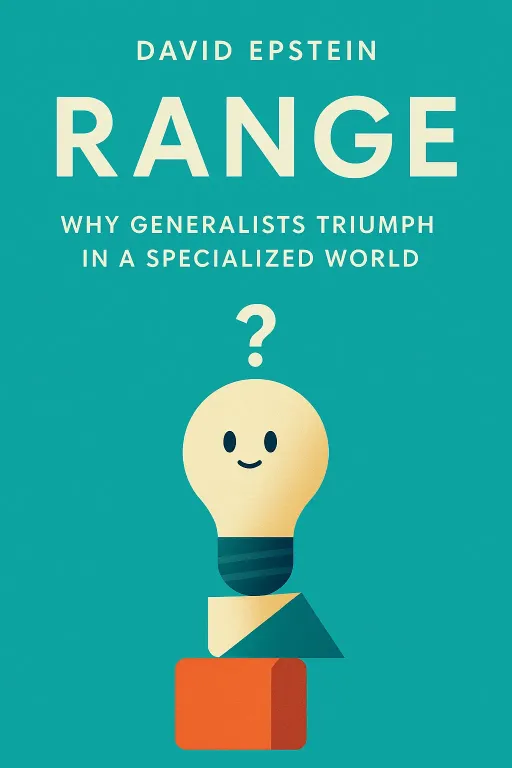
The Generalist's Edge: Why Range Rules in a Messy, Tech-Driven World
Golden Hook & Introduction
SECTION
Dr. Celeste Vega: Imagine playing a game of tennis, but suddenly, the court has no lines, the net is ten feet high, and you're playing with a windup toy instead of a ball. That’s what cognitive scientist Robin Hogarth calls Martian tennis—the ultimate wicked environment. Yet, we're constantly told that the only way to succeed is to specialize early, like Tiger Woods practicing golf swings at age two. But what if that hyper-focused path is actually a trap? Today, we're challenging the cult of the head start. We're diving into David Epstein's brilliant book,, to explore why generalists triumph in a specialized world. We'll tackle this from three angles: first, why real-world problem-solving is a wicked game; second, how lateral thinking with withered technology sparks true innovation; and third, why slow, frustrating learning is actually your secret weapon. I'm Dr. Celeste Vega, and joining me today is Nelle Ashley, a data analyst in the tech industry. Nelle, welcome!
Nelle Ashley: Thanks, Celeste! I am so excited to be here. As someone who works with data every day, this book completely blew my mind. In tech, we are constantly pushed to specialize—to master one specific tool, one language, one narrow domain. But felt like a massive permission slip to stay curious, to keep exploring, and to realize that my diverse interests aren't a distraction—they're actually my biggest strength.
Dr. Celeste Vega: I love that. A permission slip to stay curious. And that's exactly what Epstein argues. He starts the book with this fascinating contrast between Tiger Woods and Roger Federer. Tiger is the poster child for early specialization. His dad put a putter in his hand when he was seven months old! By age two, he was on national television driving a golf ball past Bob Hope. It was deliberate, intense, hyper-focused practice from infancy.
Nelle Ashley: Right, and then you have Roger Federer. His mom was a tennis coach, but she didn't push him at all. As a kid, Roger played soccer, squash, skiing, wrestling, swimming, skateboarding, basketball, table tennis... you name it! He didn't specialize in tennis until he was a teenager. His parents actually had no plan A or plan B. They just wanted him to have fun and develop his overall athleticism. Yet, both reached the absolute pinnacle of their sports.
Dr. Celeste Vega: Exactly! And Epstein's core argument is that while the Tiger Woods model works beautifully in certain narrow domains, most of the world—especially the modern, complex, tech-driven world—looks a lot more like Roger Federer's playground.
Deep Dive into Core Topic 1
SECTION
Dr. Celeste Vega: This brings us to our first major concept: the difference between kind and wicked learning environments. This distinction is so crucial for understanding why range matters. Let's break it down. A kind learning environment is like chess or golf. The rules are crystal clear, the boundaries are defined, and when you make a move, you get immediate, accurate feedback. If you make a mistake, you know it instantly, and the same patterns repeat over and over.
Nelle Ashley: That makes total sense. In chess, a grandmaster like Susan Polgar can look at a board for a fraction of a second and reconstruct the entire layout because she has chunked thousands of repeating patterns into her memory. Her father, Laszlo Polgar, actually raised his three daughters to be chess prodigies through intense, early specialization. It worked because chess is a kind environment. But Celeste, as a data analyst, when I look at real-world business problems, they look nothing like a chessboard.
Dr. Celeste Vega: Exactly! Real-world problems exist in what Hogarth calls wicked learning environments. In a wicked world, the rules of the game are often unclear or completely unwritten. Feedback is delayed, inaccurate, or sometimes non-existent. Patterns don't just repeat neatly; they morph and shift.
Nelle Ashley: Yes! This resonates so deeply with my work. When you're learning data analysis in a bootcamp or through tutorials, you're working in a kind environment. The datasets are perfectly clean, the columns are labeled, and there's a clear right answer at the back of the book. But when you step into a real tech company, the data is incredibly messy. It's full of missing values, duplicate records, and system glitches. And worse, the business questions themselves are wicked. A stakeholder will come to you and say, 'Our user engagement is dropping, figure out why.' There's no rulebook for that.
Dr. Celeste Vega: That is such a perfect example, Nelle. In a wicked environment, relying solely on narrow, specialized experience can actually lead to disastrous results. Epstein shares this terrifying story about a renowned physician in New York who was famous for his ability to diagnose typhoid fever before patients even showed symptoms. He would feel around their tongues with his bare hands, make a positive diagnosis, and sure enough, they would get sick. He felt incredibly successful and experienced.
Nelle Ashley: Oh, I remember this from the book! It turned out he was actually a carrier of typhoid himself. He was literally infecting the patients with his bare hands during the examination! His repetitive success was teaching him the absolute wrong lesson because he was in a wicked environment where he couldn't see the feedback loop.
Dr. Celeste Vega: It's a chilling metaphor for overspecialization, isn't it? When we only look through a narrow straw, we miss the bigger picture. Epstein also talks about Daniel Kahneman's early career in the Israel Defense Forces. Kahneman was tasked with assessing officer candidates. They had this physical test where a team of eight soldiers had to get themselves and a heavy telephone pole over a six-foot wall without touching the ground or the wall. Kahneman and his fellow evaluators would watch them and confidently predict who would make a great leader. But when they tracked the actual performance of these candidates in officer training and combat... their predictions were barely better than blind guessing!
Nelle Ashley: That story really struck me because it shows how confidence doesn't equal competence, especially in complex systems. The evaluators were looking at a highly specific, physical task and trying to extrapolate that to the wicked, unpredictable environment of actual warfare. In tech, we do this all the time. We hire people based on their ability to solve a highly specific coding puzzle on a whiteboard, and then we're surprised when they struggle to navigate the messy, collaborative, and ambiguous reality of building a product for real users.
Dr. Celeste Vega: Spot on! Whiteboard coding is a kind environment; building a product is a wicked one. When we overspecialize, we develop what psychologists call learned inflexibility. We get so good at using our one specific hammer that we start treating every problem like a nail, even when we're dealing with a screw or a lightbulb.
Deep Dive into Core Topic 2
SECTION
Dr. Celeste Vega: This brings us to our second core topic, which is one of my absolute favorite parts of the book: lateral thinking with withered technology. This phrase was coined by Gunpei Yokoi, a legendary creative mind at Nintendo. Nelle, tell us about Yokoi's story. It's just incredible.
Nelle Ashley: Oh, it's a masterpiece of innovation! Yokoi didn't have an elite degree in cutting-edge electronics. He was actually hired by Nintendo in 1965 just to service their card-making machines. But he was a tinkerer. In his free time, he used leftover materials in the factory to create a toy—a lattice-like extending arm. The president of the company saw it, loved it, and told him to develop it as a product. It became the Ultra Hand, a massive commercial hit!
Dr. Celeste Vega: And that was just the beginning. Yokoi realized that Nintendo couldn't compete with tech giants like Sony or Sega on raw computing power. They didn't have the resources. So, he developed this philosophy: lateral thinking with withered technology. 'Withered technology' refers to mature, cheap, well-understood tech that has already been mass-produced. And 'lateral thinking' means taking that cheap, old tech and finding a completely novel, creative way to use it.
Nelle Ashley: Yes! And the ultimate realization of this philosophy was the Nintendo Game Boy, which was released in 1989. At the time, competitors were releasing handheld consoles with color screens and cutting-edge processors. But those consoles were expensive, bulky, and had terrible battery life—they would die after a couple of hours. Yokoi did the exact opposite. He designed the Game Boy with a cheap, low-tech, black-and-white screen—basically the same tech used in calculators. It was withered technology. But because it was cheap and durable, the Game Boy was affordable, fit in a pocket, and ran for thirty hours on a couple of AA batteries! It completely crushed the competition and became the best-selling console of the twentieth century.
Dr. Celeste Vega: It's such a powerful lesson. Innovation doesn't always come from chasing the bleeding edge of technology. It often comes from looking laterally at what already exists and combining it in a new way. Epstein also shares the story of Andy Ouderkirk, a physical chemist at 3M. Ouderkirk challenged a two-hundred-year-old principle of physics called Brewster's law. He wondered if you could layer hundreds of thin plastic sheets to create a film that could reflect light near-perfectly at any angle.
Nelle Ashley: Right, and his colleagues thought he was crazy! But Ouderkirk formed a diverse, interdisciplinary team. They drew inspiration from the iridescent blue morpho butterfly, which gets its brilliant color not from pigment, but from the microscopic structure of its wings reflecting light. They ended up creating multilayer optical film. At first, the company didn't know what to do with it—they actually used it in glitter! But eventually, this 'glitter' technology was applied to cell phones, laptops, LED light bulbs, and solar panels. It became a multi-billion-dollar invention. It was even used in pocket-sized projectors to communicate with trapped Chilean miners in 2010!
Dr. Celeste Vega: That is the power of range in action. Ouderkirk's team succeeded because they weren't just hyper-specialized chemists; they were looking at biology, physics, and manufacturing. They were connecting dots across domains. Epstein actually cites a study on comic book creators by Alva Taylor and Henrich Greve. They analyzed thousands of comic books and found that the creators who were the most innovative and commercially successful weren't the ones with the most years of experience or the most resources. It was the creators who had worked across the greatest breadth of genres!
Nelle Ashley: That makes so much sense to me. As a data analyst, I've noticed that the most valuable insights don't come from just knowing how to write the most complex SQL query. They come when I combine my data skills with insights from other fields—like psychology, design, or business strategy. If I understand a user behaves a certain way from a psychological perspective, I can write a much better query to find that behavior in the data. If we only focus on the technical tools, we lose the human context.
Dr. Celeste Vega: Exactly. You're bringing your unique range to the data. You're not just a data analyst; you're a translator between the numbers and the human experience. And that's why generalists are so valuable in tech. They are the glue that connects the specialized silos.
Deep Dive into Core Topic 3
SECTION
Dr. Celeste Vega: Now, let's talk about how we actually acquire this range. This brings us to our third topic: desirable difficulties. This is a concept from the science of learning that completely challenges how we think about education and career development. Nelle, when you're trying to learn a new skill, what does it usually feel like when you're making fast progress?
Nelle Ashley: It feels amazing! You feel smart, you feel efficient, you're checking off boxes. If I'm taking an online coding course and I can solve all the exercises instantly because the hints are right there, I feel like I'm mastering it.
Dr. Celeste Vega: Right! It feels great. But the research shows that this feeling of rapid, easy progress is often an illusion. It's what psychologists call fleeting progress. Epstein shares this fascinating experiment with two rhesus macaque monkeys, Oberon and Macduff. They had to memorize lists of random pictures in a specific order. One group of monkeys was given automatic hints on every trial. They learned the sequences incredibly fast and looked like geniuses during practice. But when the training wheels were taken off and they were tested without hints... they performed terribly! Meanwhile, the monkeys who had to learn through trial and error, with no hints at all, struggled and made slow progress during practice. But on test day, they performed beautifully.
Nelle Ashley: That is such a powerful metaphor for how we learn. The hints made the monkeys look good in the short term, but they prevented them from doing the hard cognitive work of building lasting mental models. When the hints disappeared, their knowledge evaporated.
Dr. Celeste Vega: Exactly. And this happens to humans, too. Epstein highlights a massive study at the U. S. Air Force Academy. They analyzed data on over ten thousand cadets randomly assigned to calculus sections taught by different professors over a decade. They found that the professors who were the absolute best at helping students get high grades in Calculus I actually harmed those students' performance in subsequent, advanced math and engineering courses!
Nelle Ashley: That is mind-blowing! The teachers who made their students 'overachieve' in the short term were actually the worst for their long-term learning. Why was that?
Dr. Celeste Vega: Because those professors were teaching to the test. They were giving students clear procedures, formulas, and hints to solve the immediate problems. It made the class feel easy and satisfying, and the students gave those professors glowing evaluations. But the professors who made their students struggle—who forced them to make connections, grapple with ambiguity, and solve problems without a pre-learned method—were rated poorly by students. Yet, those struggling students went on to absolutely crush their advanced courses because they had developed flexible, adaptable knowledge.
Nelle Ashley: Wow. This explains so much of the frustration I felt early in my career. When you're struggling with a bug in your code for three hours, it feels incredibly inefficient. You feel like you're failing. But in reality, that struggle—that 'desirable difficulty'—is where the real learning is happening. You're not just memorizing a syntax; you're learning how to debug, how to think logically, and how to navigate frustration.
Dr. Celeste Vega: Yes! The most effective learning often looks highly inefficient in the short term. It involves exploration, experimentation, and even setbacks. Epstein argues that we need to embrace a 'sampling period' in our lives and careers. Just like Roger Federer sampled different sports, we need to sample different interests, roles, and domains before we specialize. It might feel like we're falling behind our peers who specialized early, but we're actually building a broader foundation that will allow us to leap ahead later.
Nelle Ashley: That is so reassuring, Celeste. I think many young professionals, especially in tech, feel this intense pressure to have their entire career path figured out by age twenty-two. We look at the 'Tiger Woods' of coding who started programming at age five and feel like we're lagging. But Epstein's research shows that a non-linear path—what he calls 'flirting with your possible selves'—is actually a massive advantage. We learn who we are only by living, not before.
Synthesis & Takeaways
SECTION
Dr. Celeste Vega: Absolutely. We learn who we are by doing. As we wrap up today's conversation, let's synthesize the big ideas we've explored. First, we live in a wicked world where the rules are constantly changing, and having a broad range of experiences is crucial for navigating that complexity. Second, true innovation often comes from lateral thinking—combining mature, simple tools in creative ways rather than just chasing the newest trend. And third, don't be afraid of slow, frustrating learning. Those desirable difficulties are what build flexible, lasting knowledge. Nelle, what is one actionable takeaway you'd leave our listeners with today?
Nelle Ashley: I would say: embrace your own 'Saturday morning experiments.' This is a concept from Oliver Smithies, a Nobel Prize-winning biochemist who used to spend his Saturday mornings doing playful, unscientific experiments just out of pure curiosity. One of those playful experiments actually led to the invention of gel electrophoresis, which revolutionized molecular biology! So, my advice is to carve out a little bit of time every week to explore something completely outside your narrow domain. Read a book on architecture, take a pottery class, learn about psychology. Don't worry about how it connects to your career right now. Just trust that those diverse dots will connect in beautiful, unexpected ways down the road.
Dr. Celeste Vega: What a beautiful note to end on. Embrace the play, embrace the struggle, and expand your range. Nelle, thank you so much for sharing your insights and your analytical perspective with us today.
Nelle Ashley: Thank you, Celeste! This was an absolute joy.
Dr. Celeste Vega: And to our listeners, thank you for tuning in to. Until next time, keep exploring, keep connecting, and remember: in a specialized world, your range is your superpower.









