

Why Your Research Needs More Serendipity: The Hidden Power of Unplanned Discovery.
Golden Hook & Introduction
SECTION
Nova: What if the very thing we champion in innovation—efficiency, direct paths, and hyper-focus—is actually the biggest roadblock to true breakthrough? That's right, sometimes, the best way to find something extraordinary is to stop looking so hard.
Atlas: Whoa, that sounds almost heretical in today's world of "optimize everything." You're telling me our obsession with speed and directness might be blinding us?
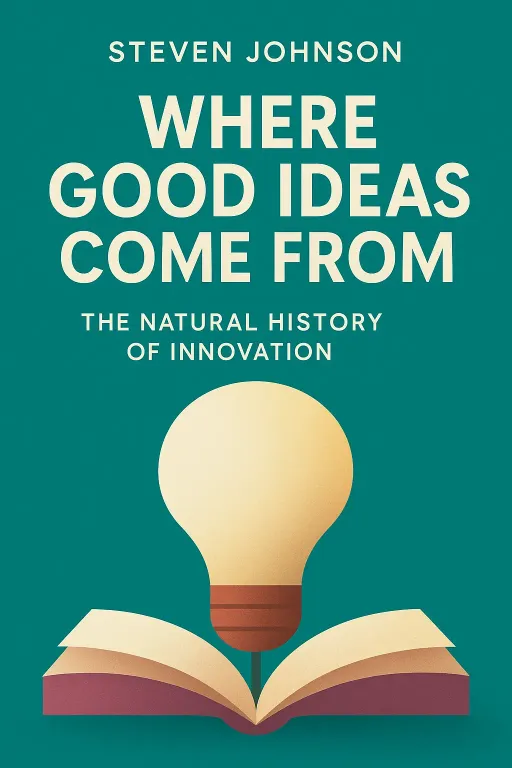
Nova: Precisely. Today, we're unraveling a fascinating paradox, inspired by insights from Steven Johnson's and David Epstein's. These aren't just academic texts; they're deep dives into the very nature of discovery.
Atlas: Both widely acclaimed, but what makes their perspectives so crucial right now, when everyone's chasing the next big thing with laser focus? Especially for someone trying to build resilient systems or inform future strategy, efficiency feels like a non-negotiable.
Nova: Well, that's our first core idea: The Efficiency Trap – why over-optimization kills breakthroughs. It’s about understanding the 'blind spot' in our pursuit of direct discovery.
The Efficiency Trap: Why Over-Optimization Kills Breakthroughs
SECTION
Atlas: A blind spot in efficiency? That almost sounds like an oxymoron. As someone who values data-driven leadership and sustainable growth, I'm constantly looking for the most direct route to impact. Where does this disconnect happen?
Nova: It happens when we become so fixated on the "direct path" that we miss the "adjacent possibilities." Imagine you're trying to find a specific type of flower in a perfectly manicured garden. You know exactly where to look, and you're incredibly efficient at it. But what if the most beautiful, groundbreaking flower isn't in that garden at all? What if it's in the wild, untamed forest just next door, growing in an unexpected combination with other plants?
Atlas: So, our carefully constructed research plans, our KPIs, our Gantt charts… they’re like the garden fence, keeping out the wild forest of new ideas?
Nova: Exactly! Over-structuring your research can stifle what we call serendipity – the hidden power of unplanned discovery. Many of the world's most significant breakthroughs didn't come from a direct line of inquiry. They emerged from unexpected connections, from "happy accidents" that occurred because someone wasn't looking for specific thing, but was open to. Think about it: Penicillin wasn't discovered because Fleming set out to find an antibiotic. He was studying staphylococci and noticed a mold contaminating his petri dishes.
Atlas: Oh man, the contaminated petri dish! That’s a classic. But how do you for a contaminated petri dish in a world where research grants demand strict methodologies and clear objectives? It sounds almost irresponsible to just 'wait for an accident.'
Nova: It's not about waiting for an accident, but about cultivating an environment where those "accidents" are more likely to happen and, crucially, more likely to be noticed. Johnson, in, delves deep into historical patterns of innovation, showing how groundbreaking ideas rarely spring from isolated genius. Instead, they emerge from what he calls "liquid networks"—dense, open, connected environments where diverse concepts can collide and form new insights. It's about increasing the collision surface area of ideas.
Atlas: So, it's not just about what know, but who you're connected to, and what disparate ideas are bouncing around that space? That makes me wonder about our modern work environments, which often push for hyper-specialization.
Nova: Precisely. When everyone is hyper-specialized and siloed, those collisions become rarer. The "blind spot" is that we optimize for the known, for incremental improvements, and in doing so, we sometimes inadvertently close ourselves off to the truly novel, the paradigm-shifting discoveries that often lie at the intersection of different fields or unexpected observations.
Architecting the Accidental: Building Environments for Serendipitous Discovery
SECTION
Atlas: Okay, so the problem is clear: our quest for efficiency might be making us blind to extraordinary opportunities. That’s a powerful insight. But if hyper-efficiency is the trap, how do we intentionally invite the 'unplanned' without just throwing everything against the wall and hoping something sticks? How do we?
Nova: That's where the insights from both Johnson and Epstein become incredibly powerful. Johnson's work points to the historical fact that innovation flourishes in "open, connected environments." Think of the coffeehouses of Enlightenment Europe, or the early days of Silicon Valley garages. These were places where diverse ideas, disparate fields, and different kinds of people could freely interact and exchange thoughts without rigid agendas.
Atlas: Right, like those old stories of scientists and artists mingling, sparking inspiration in unexpected ways. But in a more structured research setting, what does an "open, connected environment" actually look like? Are we talking about mandatory coffee breaks?
Nova: Well, mandatory coffee breaks might help! But it's more about building systems that encourage it. It means facilitating cross-pollination. It means creating physical or virtual spaces where people from different departments or disciplines can genuinely interact, share half-baked ideas, and discover common threads they never knew existed. It's about reducing the friction for those "diverse concepts to collide."
Atlas: What about David Epstein's? How does that fit in with this idea of diverse inputs?
Nova: Epstein champions the power of generalists and cross-disciplinary thinking. He argues that in a world that increasingly pushes for early specialization, those who draw from broad experiences and varied fields are often the ones who come up with the most creative and robust solutions. They have a wider mental toolkit, allowing them to make connections that specialists might miss because they’re too deep in their own silo.
Atlas: So, for a strategic historian, this would mean not just diving deeper into historical archives, but perhaps also studying modern psychology or even chaos theory to see patterns? Or for a resilient builder, looking at how natural ecosystems adapt to stress, not just engineering principles?
Nova: Absolutely! That's the essence of cultivating serendipity. It's about actively seeking out those broader experiences, engaging with different perspectives, and deliberately exposing yourself to ideas outside your immediate domain. It’s about designing "experimentation" not just in the lab, but in your own intellectual diet. It could be joining a book club outside your field, attending conferences that aren't directly relevant to your day job, or even just having regular conversations with people who think fundamentally differently than you do.
Atlas: That makes sense. It’s like, instead of trying to find the needle in the haystack more efficiently, you're actually building a better magnet by having a broader understanding of metal. It's about enhancing your perceptual range, to borrow from Epstein.
Nova: Exactly! It's about fostering a mindset that values exploration over pure exploitation. It's not about abandoning your goals, but about recognizing that the most innovative path to those goals might not be a straight line. It might involve a few detours, a few unexpected turns, and a willingness to embrace the messiness of discovery.
Synthesis & Takeaways
SECTION
Atlas: Wow. So, it's not about being directionless, but about building better navigation systems that account for unexpected detours and even encourage them. It's a profound shift from trying to control every variable to creating conditions where brilliant accidents can thrive.
Nova: That's beautifully put. It really boils down to this deep question: How might you intentionally introduce more 'unplanned' exposure to diverse ideas into your daily research process, your team's strategy, your very way of thinking? Think about it. Are you creating those "liquid networks" in your own life? Are you encouraging the generalist mindset?
Atlas: That's a powerful challenge. Not just about doing more, but thinking differently about how breakthroughs actually happen, and how we can consciously design for the magic of the unplanned. It asks us to trust that inner compass, even when it leads us off the well-worn path.
Nova: Indeed. It's about recognizing that the most impactful growth often comes from stepping outside our comfort zones, embracing the journey, and allowing for the beautiful chaos of true discovery.
Nova: This is Aibrary. Congratulations on your growth!









