

The Art of Engaging Minds: Crafting Lessons That Stick
Golden Hook & Introduction
SECTION
Nova: Okay, Atlas, quick game: I’ll give you a subject, and you tell me the most boring way to teach it. Ready?
Atlas: Oh, I like this! Give me your worst.
Nova: Differential equations.
Atlas: Just… read the textbook, cover to cover, in a monotone voice, with no examples. And then, a pop quiz.
Nova: That’s perfect! Now, what if we tried to make even stick? What if we could take any dense, complex subject and make it not just understandable, but genuinely unforgettable?
Atlas: That sounds like a superpower, honestly. For anyone trying to communicate something important, whether in a classroom, a boardroom, or just at a dinner party, the idea of making your message is the holy grail.
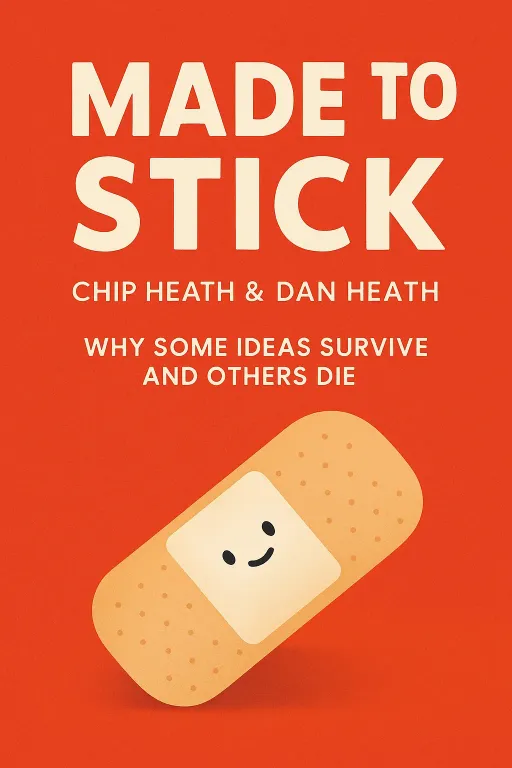
Nova: Absolutely. And that's precisely what we're dissecting today, as we draw profound insights from two seminal works: by Chip and Dan Heath, and by David Epstein. These aren't just books; they're blueprints for transforming knowledge into wisdom that not only sticks but also empowers a deeper, more interconnected understanding of the world.
Atlas: You know, it’s fascinating how the Heath brothers, coming from a background in business and public policy, managed to distill the essence of communication into something so universally applicable. It makes you wonder if the best insights often come from outside the expected fields, bringing a fresh perspective.
Nova: It really does. And David Epstein, a science writer by trade, also brings that broad, investigative lens to his work, exploring how diverse experiences sculpt our abilities. Both books, in their own ways, are about mastering the art of engaging minds. Today we'll dive deep into this from two perspectives. First, we'll explore the 'why' and 'how' behind making our ideas unforgettable, then we'll discuss the profound impact of connecting these ideas across broad disciplines to foster true mastery and insight.
The SUCCESs Framework: Making Ideas Stick
SECTION
Nova: So, let's start with the first challenge. How you make a differential equation, or any complex idea, truly unforgettable? The Heath brothers offer a brilliant framework in called SUCCESs. It stands for Simple, Unexpected, Concrete, Credible, Emotional, and Story. These aren't just buzzwords; they're the architectural elements of ideas that resonate and endure.
Atlas: Okay, I’m listening. Because I imagine a lot of our listeners, especially those in academic or teaching roles, have brilliant insights that just don't land. They know their stuff, but the message gets lost.
Nova: Exactly. Let's take 'Unexpected' and 'Concrete' first, because they often work hand-in-hand. Think about the famous "Taco Bell Chihuahua" advertising campaign from the late 90s. It was a dog, speaking Spanish, saying "¡Yo quiero Taco Bell!"
Atlas: Oh man, I remember that! It was everywhere. You couldn't escape it.
Nova: Right? It was unexpected—a talking dog for a fast-food chain. And it was incredibly concrete: a small, specific dog, a clear catchphrase. The Heath brothers would say it worked because it violated expectations and then immediately offered something tangible to grasp onto. It was simple, too. A simple message, delivered unexpectedly, with a concrete image.
Atlas: But wait, isn't that just marketing? How does a talking chihuahua help me explain, say, quantum mechanics to a room full of aspiring physicists?
Nova: That’s a great challenge! But the principles are universal. Think about the story of Barry Marshall and Robin Warren, who discovered that bacteria,, caused stomach ulcers. For decades, the medical community believed ulcers were caused by stress and diet. That was the established wisdom.
Atlas: And they were wrong.
Nova: Precisely. Marshall and Warren's idea was incredibly. It flew in the face of conventional medical dogma. To make it and, Marshall, after initial skepticism from peers, famously drank a petri dish full of himself, developed ulcers, and then cured them with antibiotics.
Atlas: Whoa. He the bacteria? That’s dedication to a hypothesis! That’s a story right there.
Nova: It is! It was a dramatic, personal that made the abstract idea of a bacterium causing ulcers undeniably and. That act of self-experimentation created instant credibility and made the complex scientific concept stick in a way no dry paper could. It defied expectations, provided a tangible demonstration, and had an emotional hook. That's the SUCCESs framework in action, even in a groundbreaking scientific discovery.
Atlas: That’s actually really inspiring. So it’s not just about flashy ads; it’s about framing information in a way that bypasses our assumptions and gives us something solid to hold onto.
The Power of Range: Interdisciplinary Learning for Deeper Understanding
SECTION
Nova: Exactly. And that naturally leads us to the second key idea we need to talk about, which often acts as a counterpoint to what we just discussed. Because making idea stick is powerful, but for someone deeply immersed in academic pursuit, trying to cultivate a 'scholar's mind,' often the challenge isn't just one idea; it's connecting the ideas. How do we build a curriculum that fosters critical thinking, not just memorization, and creates a truly impactful learner?
Atlas: That makes me wonder about the conventional wisdom. We're constantly told to specialize, to pick a niche, to go deep. It feels like the path to expertise is a straight, narrow line.
Nova: And that's where David Epstein's steps in, brilliantly challenging that notion. His core premise is that broad, interdisciplinary learning often trumps early specialization, especially in complex, unpredictable fields. He argues that generalists, those with, are often better equipped to solve novel problems and make groundbreaking connections because they draw from a wider array of experiences and knowledge domains.
Atlas: But wait, isn't that counter-intuitive for academics? In many fields, you hear about the 10,000-hour rule, the need to dedicate your life to one specific area to achieve mastery.
Nova: It's a common misconception, yes. Epstein isn't saying specialization is bad, but rather that and we specialize matters. He uses the compelling example of Roger Federer versus Tiger Woods. Woods was a prodigy, hyper-specialized in golf from a very young age. Federer, on the other hand, played a multitude of sports as a child – table tennis, badminton, basketball, skiing – before focusing on tennis much later.
Atlas: And Federer became one of the greatest tennis players of all time. So, the broad background actually him.
Nova: Precisely. That diverse sporting background developed a broader athletic toolkit, better adaptability, and a unique style that set him apart. In academia, it's the same. Someone with a 'scholar's mind' isn't just a deep well in one area; they're a intellectual architect, able to build bridges between seemingly disparate fields. Nova's take, as you know, is that effective teaching merges clear communication with a broad conceptual understanding, empowering learners to connect dots across disciplines.
Atlas: So basically you’re saying that for someone looking to contribute original thought, to truly master the art of teaching, it’s not enough to just know your subject inside out. You also need to know its neighbors, its cousins, its distant relatives in the intellectual landscape.
Nova: Exactly! It's like standing in a dense forest. If you're a specialist, you know every tree, every leaf in your section. But the generalist, with range, has a bird's-eye view. They see the entire ecosystem, how the different groves connect, where the rivers flow, and where new paths might be forged. That perspective is invaluable for crafting curricula that foster deeper critical thinking and analytical skills, allowing students to genuinely connect dots across disciplines rather than just memorizing isolated facts.
Synthesis & Takeaways
SECTION
Atlas: That’s such a powerful image. It really reframes what it means to be an expert, especially for those of us driven by a desire to contribute meaningfully and shape the future. It's not just about having knowledge; it's about making that knowledge and.
Nova: Absolutely. Ultimately, effective teaching isn't just delivering information; it's about crafting sticky ideas a broad, interconnected framework. It's about remembering that the goal is not merely to impart facts, but to empower learners to become intellectual architects themselves, building bridges between knowledge domains. This approach fosters not just learning, but a love for inquiry, a desire to understand the 'why' behind the 'what.' This is about shaping future thinkers and problem-solvers, giving them the tools for both deep understanding and broad application.
Atlas: Honestly, that sounds like a much more fulfilling way to learn and to teach. It’s about building a foundation that allows for continuous growth, rather than just filling a bucket with facts.
Nova: It truly is. So, for our listeners aspiring to teach, to lead, to inspire... what's one core concept you teach, or one area you're passionate about, that you could explain differently, perhaps more unexpectedly, or by drawing on a seemingly unrelated field? How can you make insights not just learned, but truly and?
Atlas: And how can you use that broader perspective, that 'range,' to create lessons that don't just teach a subject, but teach a way of thinking?
Nova: This is Aibrary. Congratulations on your growth!









