

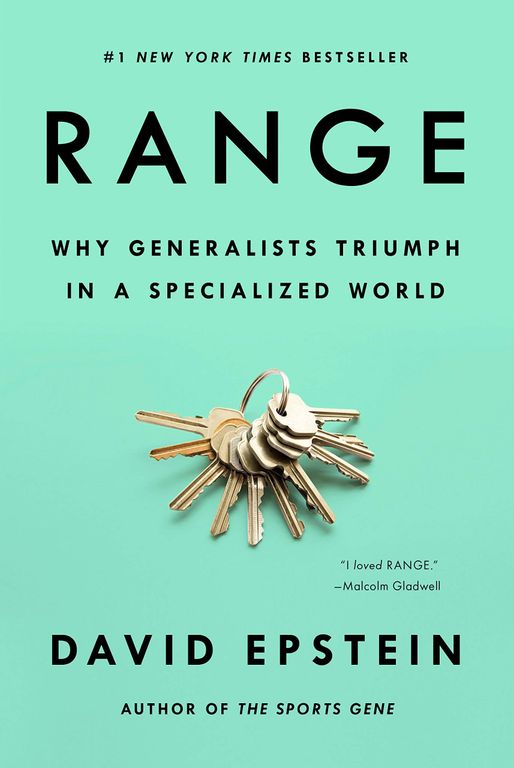
Range
Why Generalists Triumph in a Specialized World
Introduction
Nova: Imagine you are a parent and you want your child to be the absolute best in the world at something. Most of us have been told there is only one way to do that. You start them early, you make them focus on one single thing, and you never let them look back. We call it the cult of the head start.
Nova: Exactly. It is the blueprint that gave us the ten thousand hour rule. But David Epstein, in his book Range, argues that for most of us, following the Tiger Woods path is actually a terrible idea. He points to another athlete who had the exact opposite journey. A kid who played squash, fencing, basketball, handball, skiing, and wrestling before he ever took tennis seriously. His mother, who was a tennis coach, actually refused to coach him because he just wanted to play around.
Nova: It was Roger Federer. And Epstein uses these two icons to ask a fundamental question. In a world that is becoming increasingly complex and specialized, who actually wins? Is it the specialist who starts early, or the generalist who takes the long way around? Today we are diving into Range: Why Generalists Triumph in a Specialized World. We are going to look at why your diverse, messy background might actually be your greatest competitive advantage.
Nova: Not just a good thing, Leo. In many fields, it is the only thing that leads to true innovation. We are going to break down why the world is not a golf course, why quitting is often a strategic move, and how being a late bloomer is actually the secret to lasting success.
Key Insight 1
The Trap of Kind Environments
Nova: To understand why the Tiger Woods model is so seductive but also so limited, we have to talk about the work of psychologist Robin Hogarth. He divided the world into two types of learning environments: kind and wicked.
Nova: It is the definition of a kind environment. In a kind environment, the rules are clear, the boundaries are set, and most importantly, the feedback is immediate and accurate. When you hit a golf ball, you see exactly where it goes. You do it again, you adjust, and you get better. Chess is the same way. The pieces always move the same way, and the board never changes. In these worlds, narrow specialization and massive repetition work wonders.
Nova: A wicked environment is one where the rules are often unclear or incomplete. There may or may not be repetitive patterns, and they may not be obvious. Feedback is often delayed, inaccurate, or completely absent. Think about medicine, or business, or international relations. You can make a decision today and not know if it was the right one for five years. Or worse, you get positive feedback for a bad decision because of luck.
Nova: Precisely. Epstein argues that we have taken the lessons from kind environments, like sports and music, and tried to apply them to a wicked world. When you specialize too early in a wicked environment, you become a human version of a computer program that is over-optimized for a single task. You are great as long as the world stays exactly the same. But the moment the rules change, you are lost.
Nova: That is the old saying, but Epstein suggests we should look at it differently. Generalists have range. Because they have explored different fields, they have a broader library of analogies to draw from. When they encounter a new problem in a wicked environment, they do not just look for a familiar pattern. They can pull a solution from an entirely different domain. They are better at what Epstein calls far transfer, which is the ability to apply knowledge from one context to a completely different one.
Nova: Absolutely. There is a place for specialization. But Epstein’s point is that we are pushing for it way too early. We are forcing kids to choose their life path at eighteen before they even know what the options are. He argues that the most successful people actually go through a sampling period first. They try a lot of things, they fail at most of them, and that diversity of experience is what eventually makes their specialization so powerful later on.
Key Insight 2
The Virtue of the Sampling Period
Nova: Let's talk about that sampling period. One of the most striking studies Epstein cites looks at elite athletes. We always hear about the ones who started at age three, but the data shows that most elite athletes actually had a near-universal sampling period. They played a variety of sports, often until their late teens, before they narrowed down.
Nova: You would think so, but the variety of movement and the different types of coordination they learned in other sports actually made them more resilient and more creative when they finally specialized. They did not burn out as fast, and they had a wider range of physical tools. This applies to careers too. There is a concept called match quality, which is basically the degree of fit between your talents and the work you do.
Nova: Exactly. And the only way to find high match quality is through trial and error. If you specialize too early, you are essentially guessing what you are good at and what you will enjoy for the next forty years. Epstein points out that people who switch careers later in life often see a temporary dip in income, but their long-term growth is much higher because their match quality is better. They have finally found the thing that fits them.
Nova: It is strategic quitting. Seth Godin talks about this too, but Epstein backs it up with incredible stories. Take Vincent van Gogh. He was a total failure at almost everything he tried. He was a failed art dealer, a failed teacher, a failed bookstore clerk, and a failed preacher. He did not even start painting seriously until his late twenties. He was the ultimate late bloomer.
Nova: Exactly. His range was his power. He was not just repeating the techniques of the masters; he was bringing his entire, messy life experience to the canvas. Epstein also mentions the Flynn Effect, which is the observation that IQ scores have been rising over time. But it is not that we are getting smarter in a general sense; it is that we are getting better at abstract, conceptual thinking. We are moving away from concrete, specialized knowledge toward the ability to connect disparate ideas.
Nova: Precisely. If you are worried that you are behind because you changed your major three times or you are starting a new career at forty, Epstein would say you are not behind. You are just increasing your range. You are building a foundation of diverse experiences that will eventually make you more effective than someone who has been doing the same thing since they were five.
Key Insight 3
Desirable Difficulties and Learning
Nova: Now, this next part really challenged me. It is about how we actually learn. Epstein talks about a concept called desirable difficulties. Basically, if learning feels easy and fast, you are probably not actually learning.
Nova: We all do. But Epstein points to research on math students. There were two groups. One group was taught using a method that made them perform really well on immediate tests. They learned the procedures, they practiced them, and they got the answers right. The other group was given problems without being told how to solve them first. They struggled, they got frustrated, and they performed worse on the immediate tests.
Nova: In the short term, yes. But when they tested both groups a year later, the group that struggled—the one that faced the desirable difficulty—retained the information far better. They actually understood the underlying concepts, whereas the first group had only memorized a procedure that they had since forgotten.
Nova: That is a perfect analogy. Epstein calls this the difference between using a hint and doing the work. When we specialize narrowly and early, we are often just learning hints and procedures. We become great at executing a specific task, but we do not understand the why behind it. Generalists, because they are constantly moving between different fields, are forced to struggle more. They have to figure out how things work from scratch over and over again.
Nova: It is. And this leads to what Epstein calls hyper-specialization. He tells a story about a group of world-class scientists who were all specialists in their very narrow niches. When they were presented with a problem that was just slightly outside their niche, they were actually less likely to solve it than a group of laypeople with broad interests. They were so blinded by their own expertise that they could not see the obvious solution.
Nova: Exactly. This is why some of the biggest breakthroughs in science and technology come from outsiders. They do not know what is impossible in a field, so they try things that the experts have already dismissed. They bring their range to a problem that has been stuck in a specialized silo for decades.
Case Study
Lateral Thinking with Withered Technology
Nova: One of my favorite examples in the book is about a man named Gunpei Yokoi. He was not a top-tier engineer. In fact, he worked at a playing card company in Japan called Nintendo back when they were trying to figure out how to get into the toy and electronic game market.
Nova: He is. But his philosophy was what made him a legend. He called it lateral thinking with withered technology. While other companies were racing to use the most cutting-edge, expensive, and complicated technology, Yokoi did the opposite. He looked for cheap, well-understood, withered technology that was already being used in other industries.
Nova: Exactly. He took the cheap liquid crystal displays from calculators and combined them with the simple buttons from credit card-sized games to create the Game & Watch series. Then he used a low-power, black-and-white screen for the Game Boy when everyone else was trying to make color screens that ate batteries for breakfast.
Nova: He was a generalist in an engineering world. He was not the best at any one technology, but he was the best at seeing how different technologies could be combined in new ways. Epstein uses this to show that innovation often happens at the intersection of ideas, not at the deep end of a single one.
Nova: That is the power of range. It allows you to see connections that specialists miss. Epstein also talks about the Challenger space shuttle disaster. He argues that it happened partly because of hyper-specialization. The engineers were so focused on their specific data and their specific parts that they lost sight of the big picture. They did not have the range to see how all the pieces were interacting in a wicked environment like a freezing cold launch pad.
Nova: It is the difference between being a narrow expert and a broad integrator. The world needs both, but right now, we are over-valuing the experts and under-valuing the integrators.
Conclusion
Nova: As we wrap up our look at Range, the biggest takeaway for me is a sense of relief. David Epstein’s research shows that there is no single path to excellence. If you feel like you are a late bloomer, or if you feel like your career path looks more like a zig-zag than a straight line, you are not failing. You are building range.
Nova: You should! Those are the things that give you your unique perspective. Remember, in a world of kind environments, machines will always win. They can specialize better than any human ever could. But in a wicked world, the human ability to integrate, to empathize, and to think laterally is our greatest strength.
Nova: Well said, Leo. If you want to dive deeper, I highly recommend picking up David Epstein's book. It is filled with even more stories, from Nobel Prize winners to professional forecasters, all proving that breadth is the new depth.
Nova: This is Aibrary. Congratulations on your growth!