

Radical Candor
Introduction
Nova: Imagine you just gave a massive presentation to the CEO of Google. You feel like you crushed it. You are walking out of the room, on cloud nine, and your boss pulls you aside. Most people would expect a high-five, right? But instead, she tells you that you sounded like an idiot because you said the word um every three seconds.
Nova: That boss was Sheryl Sandberg, and the person she was talking to was Kim Scott. That specific moment actually became the catalyst for one of the most influential management books of the last decade: Radical Candor. Kim Scott realized that Sheryl's feedback, as harsh as it sounded in the moment, was actually the kindest thing anyone had done for her career because it was clear and it was direct.
Nova: Exactly. In fact, she is very clear that being a jerk is the opposite of what she is teaching. Today, we are diving deep into Radical Candor: Be a Kickass Boss Without Losing Your Humanity. We are going to look at why being nice can actually be the most damaging thing you do to your team, how to tell the truth without being an office villain, and why the best relationships at work are built on a foundation of challenging people because you care about them.
Key Insight 1
The Four Quadrants
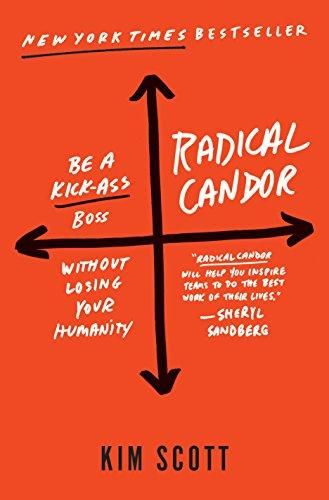
Nova: To understand Radical Candor, you have to visualize a simple two-by-two matrix. On the vertical axis, you have Caring Personally. On the horizontal axis, you have Challenging Directly. Radical Candor is the sweet spot in the upper-right corner where you are doing both at the same time.
Nova: You are spot on. Let us look at the bottom-right first: Challenging Directly but NOT Caring Personally. Kim calls this Obnoxious Aggression. This is the office bully. It is the person who gives feedback that is technically correct but delivered in a way that humiliates or belittles the other person.
Nova: That is the number one misconception! Kim Scott says that if you do not care personally, it is not Radical Candor. Now, move to the bottom-left: Not Caring and Not Challenging. That is Manipulative Insincerity. This is the most toxic one. It is passive-aggressive behavior, backstabbing, or just staying silent when you see a problem because you are too worried about your own reputation to speak up.
Nova: That is Ruinous Empathy. This is where you Care Personally but you fail to Challenge Directly. It is when you see someone failing, but you are so worried about hurting their feelings that you do not tell them the truth. You end up being nice to their face while they slowly drown in their own mistakes.
Nova: Precisely. Kim argues that Ruinous Empathy is actually responsible for the majority of management failures. We think we are being kind by holding back, but we are actually being selfish because we are prioritizing our own comfort over the other person's growth.
Key Insight 2
The Pillars of Trust
Nova: Not at all. Caring personally is not about knowing everyone's favorite color or birthday. It is about acknowledging that the people you work with are human beings with lives outside of their spreadsheets. It is about bringing your whole self to work and allowing others to do the same. Kim calls it being more than just professional.
Nova: The secret is that challenging someone is actually an act of care. Think about it: if you have a piece of spinach in your teeth, the person who tells you is the one who cares about you. The person who lets you walk into a meeting with it is the one who is failing you. In the book, Kim shares a story about a dog she had named Belvy.
Nova: So, Belvy was a sweet dog but totally untrained. One day, Kim was walking him, and he bolted toward a busy street. A stranger stepped in, grabbed the leash, and yelled at her, Stay! Then he looked at Kim and said, It is not mean to tell your dog to stay; it is mean to let him get hit by a car.
Nova: Exactly. When you realize that your silence is actually hurting the person, the fear of challenging them starts to fade. You start to see that by being clear, you are being kind. As Kim likes to say, Clarity is kindness.
Key Insight 3
The HHIPP Framework
Nova: Kim actually gives us a great acronym to keep us on track: HHIPP. It stands for Humble, Helpful, Immediate, In-person, and Private criticism or Public praise.
Nova: Right. You are not saying, I am right and you are wrong. You are saying, Here is what I am seeing, what do you think? It leaves room for you to be wrong. Radical Candor is a dialogue, not a lecture. Then there is Helpful. Your goal has to be to help the person succeed, not just to vent your frustration.
Nova: It is worse than useless; it is unfair. Imagine if someone told you today that you did something wrong in January. You can't fix January! And the In-person part is crucial because so much of our tone gets lost in Slack or email. You need to see the other person's face to gauge how they are receiving the message.
Nova: True, but Kim adds a nuance to public praise. It shouldn't just be, Great job, Leo. It needs to be specific. Tell the room exactly what Leo did that was great, so everyone else can learn from it. Specificity is what makes praise feel authentic rather than just empty flattery.
Nova: Actually, Kim says the very first thing you should do is ask for feedback yourself. You have to prove that you can take it before you start giving it. You have to show that you are in the foxhole with them.
Case Study
The Feedback Loop
Nova: Precisely. Kim outlines a specific order of operations. Step one: Solicit feedback. Ask your team, What can I do or stop doing that would make it easier to work with me? And when they give you that feedback, you can't get defensive. You have to listen, reward the truth, and then actually change your behavior.
Nova: Then you have hit gold! Because they were already thinking it; now it is just out in the open where you can fix it. Once you have shown you can take it, step two is giving praise. Focus on what is going right. Kim suggests a ratio—not a fake sandwich of praise-criticism-praise, but a genuine focus on building on strengths.
Nova: Kim hates it too! She says the sandwich is actually a form of Manipulative Insincerity. It is better to just be direct. Step three is giving criticism, and step four is Gauging. This is where you watch the other person's reaction. If they get sad, you move toward Caring Personally. If they get defensive, you have to move toward Challenging more Directly to make sure the point is landing.
Nova: Exactly. It requires a lot of emotional intelligence and a lot of energy. That is why it is called Radical. It is not the default state of human interaction. Most of us are conditioned from childhood to be nice or to follow the rule if you don't have anything nice to say, don't say anything at all. Kim is basically telling us to unlearn that for the sake of our teams.
Deep Dive
Challenges and Cultural Context
Nova: This is a really important critique, and Kim actually addressed this in the newer editions of the book. She acknowledges that gender bias and racial bias play a huge role in how feedback is perceived. A woman being Radically Candid is often unfairly pushed into the Obnoxious Aggression quadrant by others, even when she is being perfectly reasonable.
Nova: She introduced a new framework in her follow-up work called Just Work, but in Radical Candor, she emphasizes that the burden is on the person in power to create a safe environment. Leaders need to be aware of their own biases and ensure they aren't penalizing people for the very directness they claim to value.
Nova: It is harder, but it is more necessary than ever. In a remote environment, those small cues—the eye roll, the sigh, the look of confusion—are harder to catch. You have to be even more intentional about checking in. You have to ask, How is this landing? or Is this making sense? You can't rely on the hallway chat anymore, so you have to bake the candor into your scheduled time.
Nova: That is the foundation. You can't have Radical Candor without trust, but interestingly, you also can't build deep trust without Radical Candor. It is a bit of a chicken-and-egg situation. By being honest with someone, you are showing them that you respect them enough to tell them the truth. That respect is what builds the trust over time.
Conclusion
Nova: We have covered a lot of ground today, from the four quadrants of feedback to the story of Belvy the dog. The core takeaway from Kim Scott is that management isn't about power; it is about relationships. And the healthiest relationships are those where we can be our full, honest selves.
Nova: That is the big shift. Radical Candor is about moving from self-protection to people-growth. If you want to start today, don't go out and start critiquing everyone. Start by asking for feedback. Find out where your own blind spots are. Show your team that you are willing to be uncomfortable for the sake of getting better.
Nova: Exactly. Because at the end of the day, we spend too much of our lives at work to spend it being fake or being afraid. Radical Candor gives us a way to achieve great results while also being the kind of people we actually like being around.
Nova: Go for it. Just remember to care personally first. This is Aibrary. Congratulations on your growth!