

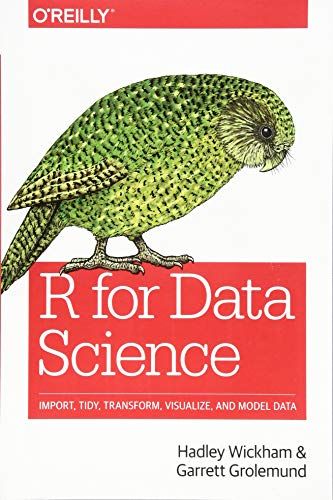
R for Data Science
Import, Tidy, Transform, Visualize, and Model Data
Introduction
Nova: Have you ever looked at a massive spreadsheet, thousands of rows of messy data, and felt that immediate sense of dread? Like you are staring at a mountain you have to climb with nothing but a spoon?
Nova: Exactly. And that is why the book we are talking about today is essentially the survival guide for that mountain. We are diving into R for Data Science by Hadley Wickham and Garrett Grolemund. It is often called the bible of modern data science, and for good reason. It did not just teach people how to code; it changed the entire philosophy of how we interact with data.
Nova: Because it flips the script on how you learn. Most programming books start with the boring stuff—integers, loops, memory management. But R for Data Science starts with the fun part: visualization. It shows you the reward before it makes you do the work. Today, we are going to break down the core pillars of this book, from the famous Tidyverse to the grammar of graphics, and see why it is still the gold standard even years after its first release.
Key Insight 1
The Whole Game
Nova: One of the most revolutionary things about this book is what Hadley calls the Whole Game approach. Instead of teaching you every single function in the R language, he focuses on a very specific cycle that every data project follows.
Nova: It can feel like that! But the book defines a clear path: Import, Tidy, Transform, Visualize, Model, and finally, Communicate. They call this the data science workflow. The genius of the book is that it does not start at the beginning of that list. It starts with Visualization.
Nova: Well, the book provides clean datasets to start with so you can see the power of R immediately. Think about it—if I show you a thousand lines of code to clean a CSV file, you might quit. But if I show you how to create a stunning, professional-grade scatter plot in three lines of code, you are hooked. You see the destination, which makes the journey of learning the messy stuff worth it.
Nova: It is more than just cleaning; it is a philosophy. In the book, they introduce the concept of Tidy Data. Hadley actually borrows a famous line from Tolstoy’s Anna Karenina to explain it. He says, Happy families are all alike; every unhappy family is unhappy in its own way.
Nova: He means that tidy datasets are all alike, but every messy dataset is messy in its own way. In a tidy dataset, every variable is a column, every observation is a row, and every value is a cell. It sounds simple, but once you commit to that structure, all the tools in the R ecosystem suddenly start working together perfectly. It is the secret sauce that makes the Tidyverse so powerful.
Nova: Precisely. The book argues that you should spend the bulk of your time getting your data into this tidy format because once you do, the transformation and visualization steps become almost effortless.
Key Insight 2
The Grammar of Graphics
Nova: Now, we have to talk about the crown jewel of the book: ggplot2. This is the package used for visualization, and it is based on something called the Grammar of Graphics.
Nova: Actually, yes! That is exactly how it works. Most graphing tools ask you to pick a chart type—like a bar chart or a pie chart. But ggplot2 asks you to describe the components of the plot. You have your data, you have your aesthetic mappings—like which variable goes on the x-axis or what color represents which category—and then you have your layers.
Nova: Exactly like Photoshop. You start with a blank canvas, you map your data to the axes, and then you add a layer of points for a scatter plot. Want a trend line? Just add another layer. Want to split that plot into five different panels based on the region? Add a facet layer. It is modular.
Nova: Right! And the book teaches you that this way of thinking allows you to create complex, multi-layered visualizations that would be a nightmare to code in other languages. It makes you think about what the data is actually saying rather than just clicking a button in a menu.
Nova: Not at all. In fact, the 2nd edition of the book, which was recently released with Mine Çetinkaya-Rundel joining as a co-author, leans even harder into making this accessible. They emphasize that data science is a team sport. It is about communication. The book spends a lot of time on how to use tools like Quarto to turn your code and charts into beautiful reports or websites. It is not just about the math; it is about the story you tell with the data.
Key Insight 3
The Power of the Pipe
Nova: If there is one thing that defines the modern R experience described in this book, it is the pipe. In the first edition, it was the magrittr pipe, which looks like a percent sign, a greater-than sign, and another percent sign. In the new edition, they have moved to the native R pipe, which is just a vertical bar and a greater-than sign.
Nova: It is all about readability. Imagine you are making a sandwich. Without a pipe, the code looks like this: PutInBread. You have to read it from the inside out, like a weird nesting doll.
Nova: Exactly. But with the pipe, the code reads like a recipe: GetIngredients pipe SliceCheese pipe SpreadMustard pipe PutInBread. It flows from left to right, just like you are reading a sentence. The output of one function becomes the input for the next.
Nova: And that is the heart of the Tidyverse philosophy. The book teaches you that code is not just for computers to execute; it is for humans to read. Hadley Wickham has often said that he writes code for his future self, because in six months, he will have forgotten what he was thinking. The pipe makes your intentions clear.
Nova: Definitely. The 2nd edition is a major overhaul. They have reorganized the entire book to follow that Whole Game flow even more strictly. They have added new chapters on things like Arrow, which allows you to work with datasets that are way too big to fit in your computer's memory. And they have replaced older tools with modern ones like Quarto for communication. It is a much more polished reflection of how data science is actually done today.
Key Insight 4
R vs. Python and the Community
Nova: It is a great question. The book does not really try to fight Python; instead, it shows where R shines. R was built by statisticians for statisticians. The Tidyverse, which this book is centered around, provides a cohesive, integrated experience that Python often lacks because its data tools are more fragmented.
Nova: That is a perfect analogy. If you are building a self-driving car or a complex AI model, Python is probably your best bet. But if your goal is to take a messy dataset, explore it, visualize it, and find the story inside it, the workflow in R for Data Science is incredibly hard to beat. It is fast, it is expressive, and the community is incredibly supportive.
Nova: They really are. And that is part of the book's legacy. It created a common language for that community. When you go on a forum and ask a question, people will often answer using the Tidyverse principles you learned in this book. It is more than just a textbook; it is the foundation of a global community of data practitioners.
Nova: Exactly. Hadley and Garrett emphasize that the most important part of data science is not the code itself, but the insight you gain from it. The code is just the vehicle. They even have a section on the importance of modeling, but they warn that a model is only as good as the visualization and transformation that came before it. You can't build a house on a swamp, and you can't build a model on messy, un-visualized data.
Conclusion
Nova: We have covered a lot of ground today. From the Whole Game approach that gets you visualizing data on day one, to the Tidy Data philosophy that saves you from spreadsheet nightmares, and the elegant Grammar of Graphics that turns charts into a language.
Nova: If you are listening and you have ever felt stuck in Excel or overwhelmed by data, this book is your invitation to a bigger world. You can read it for free online at r4ds. hadley. nz, which is another amazing thing about this project—the authors have kept it open-access to ensure anyone, anywhere can learn these skills.
Nova: Go for it! Just remember: every messy dataset is messy in its own way, but you now have the tools to fix it. This is Aibrary. Congratulations on your growth!