

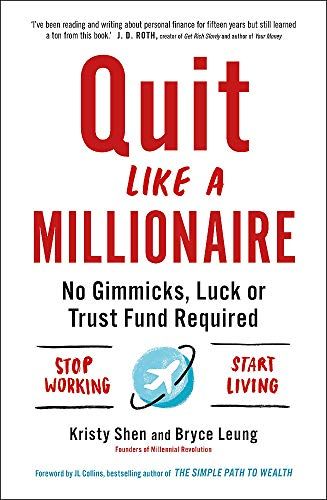
Quit Like a Millionaire
Introduction
Nova: Imagine growing up in a village in rural China, living on just forty-four cents a day, and playing in medical waste dumps because those were your only toys. Now, imagine that same person retiring at the age of thirty-one with a million-dollar portfolio and traveling the world full-time. It sounds like a fairy tale, but it is the actual life story of Kristy Shen, the author of Quit Like a Millionaire.
Atlas: Forty-four cents a day? I mean, I probably spent more than that on the electricity to power my toaster this morning. That is an incredible jump. But honestly, Nova, whenever I hear millionaire and retire early in the same sentence, my skepticism alarm starts ringing. Is this just another story about someone who got lucky with a tech IPO or had a secret trust fund?
Nova: That is exactly why this book is so different. Kristy and her husband Bryce Leung are famous in the FIRE movement—that is Financial Independence, Retire Early—specifically because they did it without luck, without a windfall, and definitely without a trust fund. They used math, a bit of engineering logic, and something Kristy calls her scarcity mindset to build a system that anyone can technically follow.
Atlas: Okay, I am listening. But if the secret is just eating beans and rice for fifteen years, I might have to check out early. Is there more to it than just extreme frugality?
Nova: Oh, way more. We are talking about a complete tactical manual for financial freedom. From choosing a career based on return on investment to creating a yield shield that protects you from stock market crashes. Today, we are breaking down how they did it and how you can use their blueprint to reclaim your own time.
Key Insight 1
The Power of Scarcity
Nova: To understand the strategy, you have to understand where Kristy started. She calls it her Scarcity Power. Most people see growing up poor as a disadvantage, but she argues it was her greatest competitive edge because it made her immune to lifestyle inflation.
Atlas: I get that. If you have survived on nothing, a Honda Civic feels like a Rolls Royce. But how does that translate into a million dollars? You cannot just save your way to a million on a minimum wage job, right?
Nova: Exactly. And this is where she gets controversial. She hates the advice follow your passion. She says that is advice for rich kids. Instead, she used what she calls the Pot System to choose her career. She literally calculated the cost of different university degrees against their expected starting salaries.
Atlas: So she treated her education like a stock purchase? That is cold, Nova. What happened to doing what you love?
Nova: She argues that if you follow your passion into a mountain of debt for a degree that does not pay, your passion becomes your prison. By choosing computer engineering—which had a high ROI—she bought her freedom. She says, do what you are good at to get the money, then use the money to do what you love.
Atlas: It is hard to argue with the logic, even if it feels a bit unromantic. So she gets the high-paying job, she lives like a student because of that scarcity mindset, and the gap between her income and her spending just explodes. But then what? Does she just dump it all into a savings account?
Nova: Not a chance. She and Bryce became obsessed with the math of the stock market. They realized that the biggest obstacle for most people is not the math, it is the psychological need to own a home. They actually calculated that in their city, Toronto, renting and investing the difference would make them millionaires years faster than buying a house.
Atlas: Wait, that goes against every piece of advice my parents ever gave me. Renting is throwing money away, right? That is the classic line.
Nova: Kristy calls that the Homeownership Myth. She shows that when you factor in property taxes, maintenance, interest, and the opportunity cost of that massive down payment, the math often favors renting and investing in low-cost index funds. That decision alone accelerated their retirement by nearly a decade.
Key Insight 2
The Math of Freedom
Nova: Once they had the savings, they had to figure out the magic number. How much do you actually need to never work again? They used the Four Percent Rule, which is a staple of the FIRE movement.
Atlas: I have heard of that. It is the idea that if you withdraw four percent of your portfolio every year, adjusted for inflation, your money should last at least thirty years, right?
Nova: Right. It comes from the Trinity Study. For Kristy and Bryce, that meant once they hit one million dollars, they could live on forty thousand dollars a year forever. But here is the catch—and this is where Kristy’s engineering brain really shines—the four percent rule has a major flaw called Sequence of Returns Risk.
Atlas: That sounds like a fancy way of saying the market might crash the day after you quit your job.
Nova: That is exactly what it is. If the market drops twenty percent in your first year of retirement and you still pull out your four percent, you are cannibalizing your portfolio when it is down. It is like trying to heal a wound by picking the scab.
Atlas: So how do you stop that? Do you just go back to work the second the S&P 500 dips?
Nova: No, you build a Yield Shield. This is one of the most brilliant parts of the book. Instead of just holding total market index funds, they shifted a portion of their portfolio into assets that pay high dividends and interest—like REITs, preferred shares, and corporate bonds.
Atlas: Okay, but why? Does that not just limit your growth?
Nova: In the long run, maybe. But the goal is not infinite growth; it is stability. The Yield Shield generates enough cash flow that even if the stock market prices are crashing, the dividends keep hitting their account. They can live off that income without ever having to sell their shares at a loss.
Atlas: So the Yield Shield is like a moat around your retirement castle. It keeps the market volatility from actually touching your lifestyle.
Nova: Exactly. And they pair that with a Cash Cushion. They keep about two to three years of living expenses in high-interest savings or short-term GICs. If the market goes into a multi-year bear market, they stop withdrawing from the portfolio entirely and just live off the cash until things recover.
Key Insight 3
The World as Your Backyard
Nova: Now, here is the part that usually makes people jealous. Once they hit their million and quit, they did not just sit in a condo in Toronto. They became nomads. And this was not just for fun—it was a financial strategy called Geographic Arbitrage.
Atlas: I have seen the Instagram photos. Working from a beach in Thailand. But is it actually cheaper, or are they just spending their retirement fund on plane tickets?
Nova: It is significantly cheaper. Kristy points out that their cost of living in Southeast Asia or parts of Europe was often half of what it was in Canada. By spending less while their money was still growing in the US and Canadian markets, they actually became richer after they retired.
Atlas: That is wild. So by leaving a high-cost city, they effectively gave themselves a massive raise without doing any work.
Nova: Precisely. She calls it the backup plan. If the market crashes and the Yield Shield is not enough, you do not go back to work; you just move to a cheaper country for a year. Your forty thousand dollars a year goes a lot further in Chiang Mai than it does in New York City.
Atlas: It makes the whole idea of retirement feel much less fragile. But I have to ask, what do they actually do all day? I feel like I would be bored out of my mind after three months of sitting on a beach.
Nova: That is a common misconception. Kristy writes about how she actually became more productive after quitting. She finally had the time to write this book, to build her blog, Millennial Revolution, and to mentor others. She argues that retirement is not about doing nothing; it is about having the power to say no to things you hate so you can say yes to the work that actually matters to you.
Atlas: So it is not really about quitting; it is about graduating from the need for a paycheck.
Nova: That is a great way to put it. She even mentions that she and Bryce ended up making more money from their creative projects in retirement than they did as engineers, simply because they were finally working on things they were passionate about.
Key Insight 4
The Psychology of the Exit
Nova: One of the most underrated parts of Quit Like a Millionaire is the chapter on the One More Year syndrome. It is this psychological trap where even after you have the money, you are too terrified to actually quit.
Atlas: I can see why. Your job is your identity, your social circle, and your safety net. Walking away from a six-figure salary to live off a spreadsheet takes some serious guts.
Nova: Kristy struggled with this too. She felt like she was jumping off a cliff without a parachute. She had to realize that her scarcity mindset, which helped her save the money, was now working against her by making her feel like she would never have enough.
Atlas: So how did she break out of it? Did she just wake up one day and hand in her notice?
Nova: She used math to kill the fear. She ran simulations for every possible disaster—a 2008-style crash, hyperinflation, a medical emergency. When the math showed she would still be okay in 95% of those scenarios, the fear lost its power. She realized that the risk of staying in a soul-crushing job was actually higher than the risk of the market failing.
Atlas: Because you can always make more money, but you can never get back those years of your life. That is a heavy realization.
Nova: It really is. She also talks about the social pressure. People told her she was crazy, that she was ruining her career, that she would be a burden on society. She had to learn to ignore the scripts that society writes for us—the script that says you must work until you are sixty-five and then die shortly after.
Atlas: It sounds like the book is as much about psychology as it is about money. It is about deprogramming yourself from the idea that your worth is tied to your productivity for a corporation.
Nova: Exactly. She wants people to realize that money is just a tool. If you use it to buy stuff, it is a pretty weak tool. But if you use it to buy your time, it is the most powerful thing in the world.
Conclusion
Nova: We have covered a lot today—from the scarcity mindset and the Pot System for career ROI to the technical details of the Yield Shield and the freedom of geographic arbitrage. Kristy Shen’s journey from forty-four cents a day to a million-dollar retirement is a masterclass in intentional living.
Atlas: It really shifts the perspective. It is not about being a miser; it is about being an engineer of your own life. Even if someone does not want to retire at thirty-one, the idea of building a Yield Shield or questioning the homeownership myth is incredibly valuable for anyone who wants more security.
Nova: The biggest takeaway is that financial independence is not a destination for the lucky few; it is a series of mathematical choices. You do not need a miracle; you need a plan and the discipline to stick to it when everyone else is telling you to buy a bigger house or a newer car.
Atlas: I think I am going to go look at my own pot of career ROI and maybe check the exchange rate in Portugal. This has been eye-opening, Nova.
Nova: If you are ready to stop trading your life for a paycheck, Quit Like a Millionaire is the roadmap you have been looking for. It is time to stop following your passion and start following the math so your passion can finally pay off.
Nova: This is Aibrary. Congratulations on your growth!