

Quantum Leaps: Bridging Physics and Metaphysics
Golden Hook & Introduction
SECTION
Nova: Okay, Atlas, quick game. I'll say a classic physics concept, and you give me the most un-physics-like thing it makes you think of. Ready?
Atlas: Oh, I like that! Bring it on, Nova. My brain is prepped for maximum absurdity.
Nova: Quantum entanglement.
Atlas: Hmm, quantum entanglement… that’s like when you lose one sock in the dryer, and suddenly all your other socks feel a little less attached to their partners. They’re still there, but their essence is… elsewhere.
Nova: That’s surprisingly profound! And a perfect segue into our exploration today, because we’re diving into a realm where the inexplicable connection of socks in a dryer starts to feel perfectly normal. We’re talking about bridging the seemingly vast chasm between the hard data of physics and the ephemeral nature of metaphysics.
Atlas: That’s going to resonate with anyone who’s ever stared at a missing sock and felt a profound existential dread. What exactly are we untangling today?
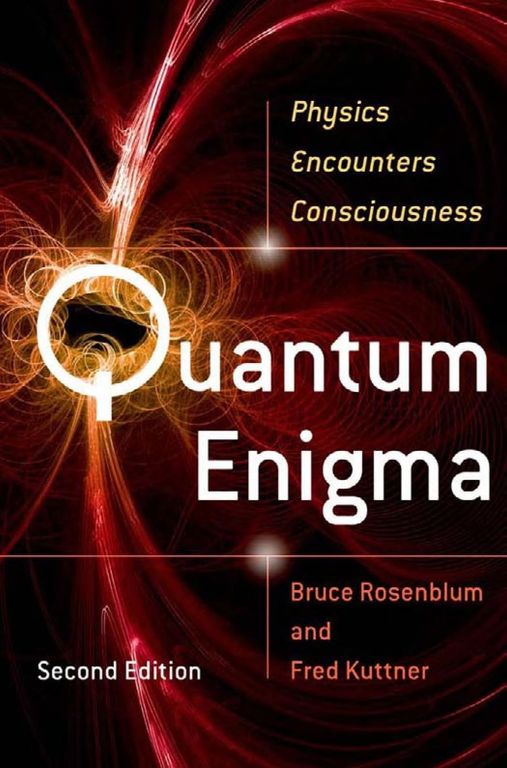
Nova: Today we’re cracking open two fascinating books that dare to ask: what if the universe isn't just a collection of inert particles, but something far more… conscious? We’re looking at Bruce Rosenblum and Fred Kuttner’s “Quantum Enigma: Physics Encounters Consciousness” and Fritjof Capra’s groundbreaking “The Tao of Physics: An Exploration of the Parallels Between Modern Physics and Eastern Mysticism.”
Atlas: Oh, I’ve heard whispers about “The Tao of Physics.” It’s one of those books that pops up on every "mind-expanding" reading list. What’s the big idea that links these two?
Nova: Well, Rosenblum and Kuttner are physicists themselves, and their book, “Quantum Enigma,” really emerged from their own struggle to reconcile the bizarre implications of quantum mechanics with classical understanding. It's a deep dive into the measurement problem, which essentially says the act of observing a quantum system changes it. They're just laying out the scientific facts, and those facts lead them to some uncomfortable, almost mystical, conclusions about consciousness. It’s widely acclaimed for its clear explanation of super complex topics, even if some in the scientific community find its metaphysical leanings a bit too… out there.
Atlas: So they’re physicists, not philosophers, struggling with philosophy because of their physics? That’s a powerful endorsement.
Nova: Exactly! And then you have Capra’s “The Tao of Physics,” which came out decades earlier and was a huge cultural phenomenon. Capra, also a physicist, wasn't just observing the strange parallels; he was actively seeking them out. He published it at a time when there was a lot of counter-cultural interest in Eastern thought, and he became a pivotal figure in connecting science and spirituality. It became a bestseller, wildly popular, especially among those seeking a more holistic view of the world. It really introduced a generation to the idea that science and mysticism might not be so far apart after all.
Atlas: So, one is almost reluctantly arriving at metaphysical conclusions from physics, and the other is enthusiastically building bridges between them. That’s a fascinating dynamic.
Nova: It is. Both books, in their own unique ways, present a compelling argument that the seemingly solid, objective world we perceive is far more fluid, interconnected, and even dependent on consciousness than classical physics ever suggested. It’s like they're both saying: "Hey, that spiritual wisdom about unity and interconnectedness? Science might actually be catching up."
Atlas: That’s a bold claim. For our listeners who are navigating a world that often feels incredibly rigid and material, this idea of fluidity and interconnectedness, especially involving consciousness, can feel a bit… abstract.
The Observer Effect and the Nature of Reality
SECTION
Nova: It certainly can. And that’s where we start, Atlas, with what Rosenblum and Kuttner so compellingly lay out in “Quantum Enigma”: the perplexing measurement problem. At its core, it highlights the inexplicable role of the observer, and by extension, consciousness, in shaping reality at the quantum level.
Atlas: Okay, so "measurement problem." For those of us who aren't quantum physicists, what does that actually mean? Are we talking about a scientific error, or something more fundamental?
Nova: That’s a great question, because it’s not an error. It’s a foundational mystery. Imagine an electron. In the quantum world, before you observe it, it doesn't have a definite position or momentum. It exists as a "wave of probability," a superposition of all possible states simultaneously. But the moment you measure it, the wave "collapses," and the electron snaps into a single, definite state.
Atlas: So you're saying it's not just that we its state, it's that our act of looking it to have a state? That sounds a bit out there.
Nova: Exactly! It’s as if the universe is waiting for us to ask the question before it gives an answer. Neils Bohr, one of the pioneers of quantum mechanics, famously said, "There is no quantum world. There is only an abstract quantum physical description. It is wrong to think that the task of physics is to find out how nature is. Physics concerns what we can say about nature."
Atlas: Hold on. So he’s saying physics isn’t about, but about? That’s a massive philosophical shift tucked inside a scientific statement.
Nova: It absolutely is. And this isn't some fringe theory. This is mainstream quantum mechanics. Rosenblum and Kuttner, as reputable physicists, grapple with this head-on. They argue that if observation collapses the wave function, and an observation requires an observer, then consciousness appears to be an integral part of how reality manifests. They're not saying consciousness reality, but that it plays an undeniable, active role in its actualization from potentiality.
Atlas: So basically, my morning coffee doesn't truly exist until I decide to look at it? That feels like a very high-stakes game of peek-a-boo.
Nova: Not quite on that macro scale, thankfully! The quantum effects are usually confined to the very, very small. But the is profound. It suggests that the objective reality we take for granted might not be so objective after all. It’s a participatory universe.
Atlas: That gives me chills. I mean, if consciousness is playing a role, even at a fundamental level, what does that imply about the nature of reality itself and our place within it? For many, the material world is all there is, a fixed stage. This turns the lights on in the audience.
Nova: It does. And this is where Capra’s work from “The Tao of Physics” becomes incredibly illuminating. He looked at these very same paradoxes and found striking parallels in Eastern mystical traditions—Taoism, Buddhism, Hinduism. These traditions have, for millennia, emphasized the interconnectedness of all things, the illusion of separateness, and the fundamental role of consciousness in experiencing reality.
Atlas: So, physicists are rediscovering ancient wisdom through cutting-edge science? That’s quite the full circle.
Nova: It truly is. Capra highlights concepts like the Buddhist idea of not as nothingness, but as a dynamic, interconnected field of potential. He sees resonance with the quantum vacuum, which isn't empty space but a seething cauldron of virtual particles popping in and out of existence. Or the Hindu concept of, the ultimate reality that underlies all phenomena, which echoes the idea of a unified field in physics.
Atlas: I can see how that would challenge conventional thinking. It’s like science is finally providing language for what mystics have been describing for centuries. But it's also a huge leap. How do we go from "an electron needs an observer" to "everything is connected like a unified Brahman"?
Nova: That’s the intellectual bridge Capra builds. He’s not saying physics mysticism, but that the conceptual frameworks are remarkably similar. Both suggest that our ordinary, fragmented perception of the world is just one way of looking at a deeper, unified reality. The ego, the individual self, creates boundaries where none truly exist.
Atlas: So, for listeners who might feel overwhelmed by the sheer complexity of the world, or the feeling of isolation, this idea of inherent interconnectedness could be incredibly powerful. It changes the narrative from a lone struggle to a part of something much bigger.
Beyond the Material Veil: Implications for Our Daily Lives
SECTION
Nova: Precisely. And this isn’t just theoretical navel-gazing. Both books, by revealing this deeper, fluid, interconnected reality, challenge us to reconsider our daily perceptions. If our observation affects quantum outcomes, how might our beliefs and expectations influence our own personal reality?
Atlas: That’s a fascinating jump. Are you saying my belief that I'm going to have a bad day actually helps a bad day?
Nova: It’s not a direct, simplistic causal link like that. We’re not magic bullet creators. But consider the psychological and neurological evidence for how our expectations shape our experience. The placebo effect is a powerful example. Your belief in a sugar pill can trigger real physiological changes, because your mind expects it to. That’s not quantum physics, but it’s a macroscopic echo of the principle: consciousness matters.
Atlas: So it’s less about directly collapsing a wave function in my coffee cup, and more about how my internal "observer" shapes my engagement with and interpretation of the world around me.
Nova: Exactly. Capra, in particular, emphasizes the experiential nature of this understanding. It’s not enough to intellectually grasp that everything is interconnected; the Eastern traditions are about that unity. Meditation, for example, is a practice designed to quiet the mind and transcend the illusion of separation, allowing for a direct experience of this underlying unity.
Atlas: So, the "tiny step" of reflecting on how my daily perceptions are influenced by my beliefs is actually a practical application of these profound ideas. It's about becoming a more conscious observer of my own internal state and how that frames my external reality.
Nova: It absolutely is. And the "deep question" we posed earlier—if consciousness plays a role in the quantum world, what does this imply about the nature of reality itself and our place within it?—becomes less an abstract philosophical query and more a call to personal inquiry. If reality is participatory, then our participation holds immense significance.
Atlas: Which, for those who crave understanding, who synthesize information, and who are driven by a quest for truth, is incredibly empowering. It means our internal world isn't just a passive recipient of external data; it's an active ingredient.
Nova: It really reframes our relationship with existence. Instead of being isolated observers in a fixed, indifferent universe, we become co-creators, or at least co-participants, in a dynamic, unfolding reality. It’s a profound shift from a mechanistic worldview to one that is alive, interconnected, and responsive.
Atlas: That makes perfect sense. It’s about recognizing the profound influence of our inner landscape on our outer experience, and vice versa. It’s not just about what we see, but how we see it.
Synthesis & Takeaways
SECTION
Nova: So, ultimately, what both “Quantum Enigma” and “The Tao of Physics” illuminate is that the universe is far stranger, and far more wondrous, than we often allow ourselves to imagine. They challenge us to expand our definition of reality.
Atlas: And for anyone who feels like they’re constantly seeking to connect disparate fields, to find coherence in a fragmented world, these books offer a powerful framework. They suggest that the coherence is already there, beneath the surface, waiting for us to perceive it.
Nova: Indeed. The journey of understanding isn't about finding a single, static answer, but about embracing the dynamic interplay between the seen and the unseen, the measurable and the felt. It's a journey into quantum metaphysics, into ancient hidden knowledge, and into the very core of consciousness itself.
Atlas: That’s actually really inspiring. It’s not about having all the answers, but about asking better questions and trusting that the process of inquiry itself is a path to truth.
Nova: And it’s a journey we can all embark on, simply by becoming more mindful of how our own consciousness shapes our everyday experiences. It’s about moving from a passive receiver to an active participant in the grand cosmic dance.
Atlas: That gives me chills. It shows us that our role in the universe is far grander than we often assume.
Nova: This is Aibrary. Congratulations on your growth!