

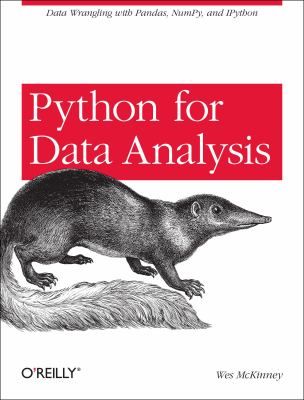
Python For Data Analysis
Introduction
Nova: Welcome back to the show. Today we are diving into a book that is often called the bible of modern data science. If you have ever typed import pandas as pd into a code cell, you are living in the world this book built. We are talking about Python for Data Analysis by Wes McKinney.
Atlas: It is funny you call it the bible because, for a lot of people, it is more like the manual for a superpower. But I have to ask, Nova, with all the online tutorials and AI coding assistants we have now, does a physical book about a software library still hold up? Or is this just a nostalgia trip for people who remember when Python was just for web scripts?
Nova: That is the perfect place to start. This book is not just a manual; it is the origin story of the entire Python data ecosystem. Wes McKinney did not just write a book about pandas; he created pandas. He was the one who looked at the landscape of data tools back in 2008 and realized something massive was missing. He wrote this book to bridge the gap between theoretical data science and the messy, gritty reality of cleaning and manipulating data.
Atlas: So it is less about how to code and more about how to think about data in Python? I am curious to see if it is still the gold standard, especially with the third edition having just come out recently. Let us peel back the layers on how one guy's frustration at a hedge fund basically changed the way the entire world processes information.
Key Insight 1
The Genesis of a Revolution
Nova: To understand why this book is so important, you have to go back to 2008. Wes McKinney was working at AQR Capital Management, a huge quantitative hedge fund. At the time, if you wanted to do serious data analysis, you were likely using R or maybe Excel if the dataset was small enough. But Wes was frustrated. He loved Python for its general-purpose power, but it was terrible at handling labeled data or time series.
Atlas: Wait, so pandas was born out of a hedge fund? That explains why it is so obsessed with time series and financial data. But what was the specific pain point? Was it just that Python was slow?
Nova: It was not just speed; it was the structure. Think about a spreadsheet. You have rows, columns, and labels. In 2008, Python did not have a native way to handle that easily. You had to jump through hoops using lists of dictionaries or basic arrays. Wes wanted a tool that felt like an Excel spreadsheet but had the programmatic power of Python. When he could not find it, he started building it. That became pandas.
Atlas: And I am guessing the industry did not just jump on board immediately? Open sourcing a tool developed at a hedge fund sounds like a legal nightmare for starters.
Nova: It actually took some convincing to get AQR to let him open source it in 2009. But once it was out there, the community realized that this was the missing link. Before pandas, Python was a niche language for scientists and web developers. After pandas, it became a legitimate threat to R and SAS. The book, which first came out in 2012, was Wes's way of saying, here is the blueprint for this new way of working.
Atlas: It is wild to think that a single library could shift the gravity of an entire industry. But the book covers more than just pandas, right? It talks about the whole stack.
Nova: Exactly. It covers the holy trinity: NumPy for the heavy lifting, pandas for the data structures, and matplotlib for the visuals. Wes argues that you cannot really understand pandas without understanding the NumPy arrays underneath it. It is like trying to drive a car without knowing there is an engine under the hood.
Atlas: I like that analogy. So the book is basically teaching you how the engine works while you are learning to drive. But for someone starting today, is the history lesson worth the price of admission?
Nova: Absolutely, because the problems Wes was solving in 2008—missing data, misaligned time series, messy formatting—are the exact same problems we face today. He just gave us the vocabulary to talk about them. He calls it data munging or data wrangling. Before this book, those were just chores. After this book, they became a professional discipline.
Key Insight 2
The Core Mechanics: Beyond the Spreadsheet
Atlas: Okay, so we have the history. Let us get into the meat of the book. One thing that always trips people up when they first open Python for Data Analysis is the sheer amount of time spent on NumPy. Why does Wes insist on starting there? Why not just jump straight into the fun stuff with pandas DataFrames?
Nova: Because NumPy is the foundation of everything. Wes explains that pandas is essentially a high-level wrapper around NumPy arrays. If you do not understand how NumPy handles memory and vectorization, you are going to write slow, inefficient code. He spends a lot of time on the ndarray because that is where the performance comes from. If you are looping through data with a for-loop in Python, you are doing it wrong. Wes wants you to think in terms of arrays.
Atlas: That is a big mental shift for people coming from a traditional programming background. You are telling me I should stop writing loops and start thinking in blocks of data?
Nova: Precisely. It is called vectorization. Instead of saying, multiply this number by two, then the next number by two, you tell the computer, multiply this entire column by two all at once. The book does a fantastic job of showing how this is not just faster to write, but orders of magnitude faster for the computer to execute.
Atlas: And then we get to the star of the show: the DataFrame. I have heard people describe the DataFrame as a spreadsheet on steroids. Is that how Wes presents it?
Nova: In a way, yes. But he goes deeper into the mechanics of indexing. This is where the book really shines. He explains that a DataFrame is not just a table; it is a collection of Series objects that share an index. The index is the secret sauce. It allows you to align data from different sources automatically. If you have a list of stock prices from Monday and a list of volumes from Tuesday, pandas uses the index to make sure they line up correctly. That sounds simple, but doing that manually is a nightmare.
Atlas: I can see why that would be a game changer for finance. But what about the criticism that the book is too focused on the mechanics? I have seen some reviews saying it tells you how to use the tools but not necessarily how to be a data scientist.
Nova: That is a fair critique, but I think it misses the point of the book. Wes is a toolmaker. He is teaching you how to use the scalpel, not how to perform the entire surgery. He assumes you have a problem to solve. His goal is to make sure the tool does not get in your way. The book is very much a reference guide for the mechanics of data manipulation. If you want a book on statistical theory, this is not it. But if you want to know how to reshape a table with 10 million rows without crashing your computer, this is the only book you need.
Key Insight 3
The Art of Data Wrangling
Atlas: Let us talk about the messy stuff. Wes uses the term data munging a lot. It sounds like something you do to a swamp. What does he actually mean by that in the context of the book?
Nova: It is exactly like cleaning a swamp. Wes points out a famous statistic in the book: data scientists spend about 80 percent of their time cleaning and preparing data and only 20 percent actually analyzing it. He dedicates a massive portion of the book to things like handling missing data, filtering out outliers, and transforming strings.
Atlas: Handling missing data always feels like guesswork to me. Does he give a framework for how to deal with those annoying NaN values?
Nova: He does. He walks through the trade-offs of dropping data versus filling it in. Do you use the mean? The median? Do you carry the last known value forward? He shows how pandas makes these operations a single line of code. But more importantly, he explains the data types. Understanding the difference between a floating-point NaN and a null object is crucial, and he breaks that down so you do not get unexpected errors in your models.
Atlas: What about merging datasets? That is usually where my code breaks. You have two different files, different formats, and you need them to talk to each other.
Nova: Wes devotes an entire chapter to data wrangling: join, combine, and reshape. He uses database-style logic—left joins, right joins, inner joins—but applies it to Python objects. He also introduces the concept of hierarchical indexing, which is basically having multiple levels of labels on an axis. It allows you to work with higher-dimensional data in a two-dimensional table. It is mind-bending at first, but once you get it, you can perform complex aggregations that would take hundreds of lines of SQL.
Atlas: It sounds like he is trying to give us the power of a relational database without the overhead of actually setting one up.
Nova: That is a great way to put it. He wants you to be able to do sophisticated data engineering right in your Jupyter notebook. And speaking of notebooks, the book is also a great primer on the interactive development workflow. He was an early adopter of IPython, which became Jupyter. He argues that data analysis is an iterative process. You try something, you look at the plot, you tweak the code, and you try again. The book is structured to support that flow.
Key Insight 4
Time Series and the Financial Legacy
Atlas: We mentioned earlier that Wes came from a hedge fund background. How does that influence the later chapters of the book? I noticed there is a pretty heavy emphasis on time series data.
Nova: This is arguably the strongest part of the book. Because pandas was built to solve financial problems, its time series capabilities are world-class. Wes goes into detail about frequency conversion, resampling, and moving window statistics. If you need to take tick-by-tick stock data and turn it into five-minute bars, or if you need to account for leap years and different time zones, he shows you exactly how to do it.
Atlas: Time zones are the bane of my existence. Does he actually make them manageable?
Nova: As manageable as they can be. He covers the pytz and dateutil libraries and how they integrate with pandas. But the real magic is in the resampling. You can take a dataset and say, give me the mean of this value for every two-week period starting on a Wednesday, and pandas just does it. He shows how these tools allow you to explore patterns in data that would be invisible if you were just looking at raw numbers.
Atlas: It is interesting because even if you are not in finance, almost everything is a time series if you look at it long enough. Website traffic, sensor data, sales figures—it all has a timestamp.
Nova: Exactly. And that is why the book has such broad appeal. He uses financial examples because they are complex and demanding, but the techniques apply to any domain. He also touches on categorical data, which is a more recent addition to pandas. It is a way to store data that has a fixed set of values—like gender or country—much more efficiently. It saves memory and speeds up computations, which is vital when you are dealing with the massive datasets we see today.
Atlas: It seems like he is constantly looking for ways to squeeze more performance out of Python. Is that a recurring theme in the book?
Nova: Always. Wes is obsessed with efficiency. He knows that Python has a reputation for being slow, so he is constantly showing you the right way to do things so you do not hit those performance bottlenecks. He even includes a chapter on advanced NumPy and how to interface with C code if you really need to go fast. He wants to prove that Python can be a high-performance data language.
Key Insight 5
The Third Edition and the Future of Data
Atlas: So, the third edition came out recently. Technology moves fast—pandas 2.0 is out now, and Python itself has changed a lot since the first edition in 2012. What is new in the latest version of the book?
Nova: The biggest change is the modernization of the code. The third edition is updated for Python 3.10 and pandas 2.0. It moves away from some of the older, deprecated ways of doing things. But perhaps the most interesting part is how Wes addresses the evolution of the ecosystem. He talks about things like Apache Arrow, which is a project he co-created to solve the problem of data interoperability.
Atlas: Apache Arrow? I have heard the name, but how does it relate to the book?
Nova: Think of it this way: pandas is great for analyzing data in memory on one machine. But what if your data is in a Spark cluster, or a cloud database, or a different language like R or Julia? Moving that data back and forth used to involve a lot of slow conversion. Arrow is a standardized memory format that lets different tools share data instantly without copying it. In the new edition, Wes hints at how pandas is being rebuilt to use Arrow under the hood, which will make it even faster and more memory-efficient.
Atlas: So the book is not just a look back at what pandas was, but a roadmap for where it is going. That makes it feel a lot more relevant than just a syntax guide.
Nova: Definitely. He also updated the visualization sections. While matplotlib is still the foundation, he acknowledges the broader ecosystem of tools like Seaborn and Plotly. He stays focused on the core, though. He wants you to have a solid foundation so that when the next trendy library comes along, you understand the principles it is built on.
Atlas: One thing I noticed is that Wes has made the book available for free online on his website. That is a pretty bold move for a best-selling author.
Nova: It speaks to his commitment to the open-source community. He wants the knowledge to be accessible. He sees the book as a living document. By keeping it updated and available, he ensures that the next generation of data scientists starts on the right foot. It is not just about selling copies; it is about maintaining the health of the Python data ecosystem.
Conclusion
Nova: We have covered a lot of ground today. From the early days at a hedge fund to the future of Apache Arrow, Python for Data Analysis is more than just a technical manual. It is the story of how Python became the language of data.
Atlas: It is clear that Wes McKinney did not just write a book; he provided the scaffolding for an entire industry. Even if you use AI to write your code today, understanding the principles of DataFrames, vectorization, and data wrangling that Wes outlines is what separates a script kiddie from a real data professional.
Nova: Well said. If you are serious about data, this book belongs on your shelf—or at least in your browser bookmarks. It teaches you to respect the data, to understand its structure, and to manipulate it with precision. It is about the craftsmanship of data.
Atlas: I am definitely going to look at my next import pandas as pd with a bit more respect. It is not just a library; it is a decade of engineering and a specific philosophy of how we interact with information.
Nova: That is the perfect note to end on. If you want to master the tools that power the modern world, start with the man who built them. This is Aibrary. Congratulations on your growth!