

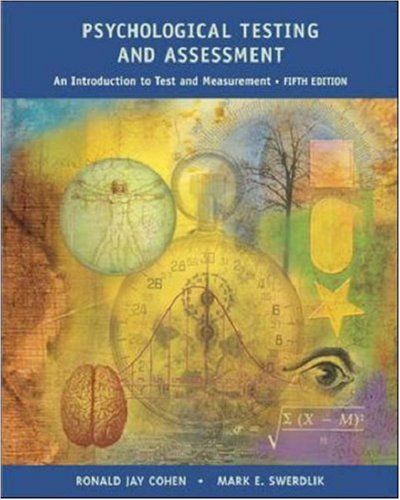
Psychological testing and assessment
The Score That Shapes Lives: Introducing Cohen's Essential Guide
The Score That Shapes Lives: Introducing Cohen's Essential Guide
Nova: Welcome to 'The Deep Dive,' the podcast where we dissect the texts that shape how we understand the human mind. Today, we're tackling a behemoth in psychology education: Ronald Jay Cohen’s 'Psychological Testing and Assessment: An Introduction to Tests and Measurement.' Alex, have you ever stopped to think about how many times a standardized score has influenced a life decision—a job offer, a diagnosis, a placement in a school?
Nova: The promise, as I see it, is to ground the student in the philosophical, historical, and methodological bedrock. It’s not just about to administer the MMPI or the WAIS; it’s about those tests exist, they were built, and the inherent limitations are. Cohen and his co-authors treat testing as a serious scientific endeavor, not just a box-ticking exercise.
Nova: He does. He meticulously traces the journey from early attempts at measuring intelligence, often fraught with cultural bias, right up to the sophisticated, computer-scored instruments we use today. It’s a narrative that constantly reminds the reader: measurement is a human invention, and therefore, it carries human imperfections. It sets the stage perfectly for the heavy lifting in the next sections.
Nova: Precisely. It’s about building critical consumers of data. Let’s move into the first major pillar of that foundation: understanding what we are actually measuring, and how we distinguish between testing and assessment.
Key Insight 1: Defining the Field
The DNA of Measurement: Testing vs. Assessment and Historical Context
Nova: One of the first distinctions Cohen hammers home is the difference between 'psychological testing' and 'psychological assessment.' They sound interchangeable, but in the field, they are distinct processes. What’s the takeaway there?
Nova: Exactly. Cohen emphasizes that a test score in isolation is often meaningless, sometimes even misleading. The assessment is the clinical judgment that contextualizes the score. Think of it like a single ingredient versus the entire meal. The ingredient—the test score—is important, but the meal—the assessment—is what nourishes the client’s understanding.
Nova: And this integration is built on history. Cohen dedicates time to showing how early intelligence testing, for instance, was heavily influenced by eugenics movements, which is a dark but necessary part of the story. He points out that early tests were often designed to existing social hierarchies rather than objectively measure potential.
Nova: It’s a constant vigilance. The book moves from this broad historical view to the very specific tools. It categorizes tests—ability tests, personality tests, interest inventories. It’s a taxonomy for the practitioner. For example, how does Cohen differentiate between projective tests, like the Rorschach, and objective tests, like a true/false personality inventory?
Nova: It’s a nuanced discussion. He doesn't dismiss them outright, but he demands rigorous justification for their use, always circling back to the central question: Does this tool actually for the purpose I intend?
Key Insight 2: Psychometric Rigor
The Twin Pillars of Trust: Validity and Reliability
Nova: He treats them as inseparable partners, but distinct. Reliability is about consistency. If I weigh myself five times in a row on a scale, and it gives me five wildly different numbers, that scale is unreliable. In testing, it means the score is stable over time or across different versions of the test.
Nova: Precisely. But reliability is only half the battle. A test can be perfectly reliable and still be useless. Imagine a scale that reliably tells you that you weigh 150 pounds, every single time, even though you actually weigh 180. It’s consistent, but it’s not measuring what it claims to measure—your true weight. That’s where validity steps in.
Nova: Criterion-related validity is particularly practical. It breaks down into predictive validity—can the test score predict future performance?—and concurrent validity—does the test score correlate with another established measure taken at the same time? For example, does a new screening tool for depression correlate highly with the established gold-standard clinical interview right now?
Nova: Cohen uses fantastic analogies to make this concrete. He often contrasts a poorly validated test with a well-validated one, showing how a low validity coefficient means that using the test adds little to no predictive power over random guessing. He stresses that validity is not a single, fixed attribute; it’s an accumulation of evidence supporting a specific interpretation of a score for a specific purpose.
Nova: The SEM is the ultimate humility lesson for the new practitioner. It forces you to communicate results not as absolutes, but as probabilities. If a client’s score is 115 with an SEM of 3, you have to explain that their true score likely falls between 112 and 118. This moves the conversation away from a definitive label and toward a range of possibilities.
Key Insight 3: Navigating the Minefield
The Ethical Tightrope: Culture, Law, and Professional Responsibility
Nova: The research confirms that Cohen’s text places significant emphasis on ethical considerations, often dedicating entire chapters to legal and cultural issues. Why is this so prominent in a book about?
Nova: Cohen provides case studies illustrating the real-world consequences of using culturally biased tests in high-stakes situations, like educational placement or employment screening. He forces the reader to confront the concept of 'test utility'—is the benefit derived from using the test worth the potential harm caused by its limitations when applied to this specific population?
Nova: That tiered system is Cohen’s way of saying: Know your limits. You shouldn't be administering a Level C test if you only have Level A training. It’s about respecting the complexity of the instrument. It’s the difference between using a simple screwdriver and operating heavy machinery.
Nova: And the concept of 'test security' is huge. Cohen warns against the casual sharing of test materials. If a test booklet or answer key gets into the public domain, the validity of that instrument for everyone who takes it afterward is compromised. It’s like publishing the answers to the final exam before the test is given.
Nova: Absolutely. He frames ethics not as a set of restrictive rules, but as the necessary framework that allows for meaningful, helpful psychological science to occur. Without that ethical scaffolding, the entire structure of testing collapses into guesswork and potential harm. Having established the foundations and the ethical boundaries, the final step is mastering the art of putting it all together in a useful report.
Key Insight 4: The Practical Application
From Raw Data to Clinical Insight: Test Development and Interpretation
Nova: We’ve covered the theory, the trust factors, and the ethics. Now, let’s look at the practical side that students often crave: test development and interpretation. How does Cohen demystify the process of creating a new psychological measure?
Nova: The vetting process is brutal, and Cohen makes that clear. Items that don't correlate well with the overall test score, or items that everyone gets right or everyone gets wrong, get tossed out. It’s an iterative process of refinement, often involving complex statistical procedures like factor analysis to ensure the items are actually clustering around the intended underlying dimensions.
Nova: Norms are the yardstick. Cohen stresses that norms are never permanent; they can become outdated as culture, education, and language shift. This is why we see test revisions every decade or so—it’s often a necessary re-norming process to maintain validity in a changing world.
Nova: The key is synthesis, tying back to our first point. A good report doesn't just say, 'Client scored in the 90th percentile on Verbal Comprehension.' It says, 'The client demonstrated strong verbal reasoning skills, which suggests an ability to process complex written instructions, a strength that should be leveraged in vocational planning.' It translates the score into functional language.
Nova: It’s about responsible stewardship of the data. The book teaches you how to be a translator—translating complex statistical concepts into meaningful narratives that guide intervention, placement, or diagnosis. It’s the culmination of everything: the history, the psychometrics, and the ethics, all synthesized into one professional document.
Conclusion: The Enduring Value of Critical Measurement
Conclusion: The Enduring Value of Critical Measurement
Nova: So, Alex, after diving into the structure and content of Cohen’s 'Psychological Testing and Assessment,' what is the single most important lesson a student should carry forward from this text?
Nova: I agree. It’s the ultimate antidote to diagnostic shortcuts. Cohen provides the tools to build a strong, evidence-based foundation, whether you’re designing a new measure or interpreting a decades-old inventory. The takeaway is that measurement is a profound responsibility because the results directly impact human lives and opportunities.
Nova: It teaches us that the most powerful assessment is one that is both scientifically sound and deeply humane. Thank you for exploring this foundational text with me today.
Nova: That wraps up our deep dive into Cohen’s essential guide. We hope you feel more equipped to question the scores you encounter and to wield measurement tools with the precision and care they demand. This is Aibrary. Congratulations on your growth!