

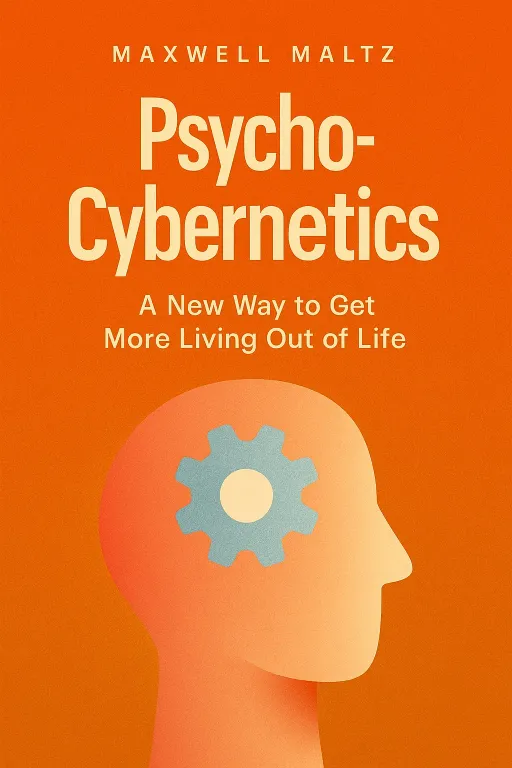
The Creator's Code: Unlocking Your Inner Success Mechanism
Golden Hook & Introduction
SECTION
Shakespeare: What if the biggest threat to your startup, to your creative project, isn't the market, the competition, or the funding, but a ghost in your own machine? A hidden blueprint that dictates your every move without you even knowing it?
Man: That's a powerful question, Shakespeare. It’s something I think every founder and creator grapples with, that feeling of an invisible barrier.
Shakespeare: Precisely. And today, we journey into the heart of that machine with a truly revolutionary text, Maxwell Maltz's "Psycho-Cybernetics." It's less a book and more a manual for the mind, written decades ago but more relevant than ever. And I'm thrilled to have you here, Man, because as a content head, an entrepreneur, and a Booktuber, you live at the intersection of creation and leadership.
Man: I'm excited to be here. This book is a classic for a reason, and I think its core ideas are timeless.
Shakespeare: Indeed. Today we'll dive deep into this from three perspectives. First, we'll uncover that hidden blueprint that governs your life: the self-image. Then, we'll discover the powerful success mechanism built into your own mind. And finally, we'll learn how to de-hypnotize yourself from the false beliefs that hold you back.
Deep Dive into Core Topic 1: The Self-Image: Your Personal Glass Ceiling
SECTION
Shakespeare: So let's begin with that blueprint. Man, as someone who builds things from the ground up, have you ever felt an invisible force setting the limits on a project or even on a person's potential?
Man: Absolutely. You see it all the time. You can have two people with the exact same skills and opportunities, and one soars while the other stays grounded. It's like there's an internal thermostat set to a certain level of success, and they just can't seem to push past it.
Shakespeare: An internal thermostat! What a perfect metaphor. Maltz, a plastic surgeon, discovered this firsthand. He thought his scalpel was a key to a new life. He would give someone a new nose, a new chin, and expect a new personality to blossom. And often, it did. A shy salesman would become a lion. A 'moronic' boy, as Maltz called him, became a bright executive.
Man: So the physical change did create a psychological one.
Shakespeare: In many cases, yes. But here is where the mystery deepens. He tells the story of a Duchess, a woman of high society, who was painfully shy her entire life because of a prominent hump on her nose. She believed this one flaw was the source of all her misery. So, Maltz performed the surgery, and the result was, by all accounts, a masterpiece. She had a beautiful, aristocratic nose.
Man: And she was transformed?
Shakespeare: Not one bit. She remained the same timid, self-conscious person. She still acted as if she were ugly. The mirror showed a new face, but her inner world, her self-image, was unchanged. Maltz realized he had only changed the house; he hadn't changed the inhabitant. The real key wasn't the physical face, but what he called the 'face of personality'—the self-image.
Man: That story is chilling because it's so relatable. It's the very definition of imposter syndrome. You see founders who raise millions of dollars in funding, but they still operate with a seed-stage scarcity mindset. They have all the external validation in the world, but their internal self-image is still that of a scrappy underdog who might fail at any moment.
Shakespeare: So the self-image is sticky, then? It resists new data?
Man: Exactly. It seems to have its own inertia. As a leader, you can tell someone on your team, "You're brilliant, you're a leader," but if their self-image is "I'm just a junior employee," they will find ways to subconsciously reject the promotion or sabotage the project. They can't accept a reality that contradicts their internal blueprint. It's fascinating and a little terrifying.
Shakespeare: Terrifying, yes, but also empowering. For if we can identify this blueprint, perhaps we can become its architect. And that leads us to our second great theme.
Deep Dive into Core Topic 2: The Success Mechanism: Your Inner Autopilot
SECTION
Shakespeare: The self-image is sticky because it's the master program. But Maltz gives us the keyboard to rewrite it. He reveals that every human being possesses a 'Success Mechanism,' a faithful servant awaiting orders. He borrows from the science of his day, Cybernetics, and compares our brain and nervous system to a self-guided torpedo.
Man: A torpedo? That sounds a bit aggressive.
Shakespeare: Perhaps. But think of its function. You don't tell the torpedo to get to the target—turn left, go up, dodge this. You simply give it the target. The torpedo then uses feedback—negative for when it's off course, positive for when it's on—to automatically correct its path and hit the goal. Maltz argues our brain works the same way. Our conscious mind is for selecting the goal. The 'doing' is the job of the automatic success mechanism.
Man: So willpower isn't about gritting your teeth and forcing the outcome. It's about holding the goal in your mind clearly enough for the autopilot to take over.
Shakespeare: Precisely! And the fuel for this autopilot is imagination. Maltz shares a wonderful story about a man named Les Giblin. He was a successful salesman, but he had a burning desire to become a public speaker on human relations. The problem? He had no experience and was terrified.
Man: A classic creator's dilemma. The ambition is there, but the proof of concept isn't.
Shakespeare: So what did he do? He didn't just 'think' about being a good speaker. He sat in his chair and it. He vividly imagined himself on stage, feeling the pressure of his feet on the floor, seeing the faces in the audience, hearing the sound of his own confident voice. He pictured them applauding. He didn't just create a thought; he created a synthetic memory of success. He generated the of a win before he ever stepped on stage.
Man: That is the ultimate 'fake it till you make it,' but on a neurological level. It's not about pretending for others; it's about creating practice runs for your own brain. You know, in content, we use A/B testing to see which headline or image works best. This is like A/B testing your own future personality. You're giving your nervous system a successful data point to work from.
Shakespeare: A brilliant connection! You're creating a memory of the future. And when Giblin finally did book himself, he said the 'winning feeling' he had manufactured in his armchair never deserted him. He became one of the most sought-after speakers in the country. He programmed his inner torpedo for success, and it found its target.
Man: This is so applicable. Before a big product launch or a major content campaign, a leader could gather their team and not just talk about the goals, but lead a visualization exercise. To have everyone what success looks like. That's far more powerful than just a number on a spreadsheet.
Shakespeare: A perfect analogy! But what if the system is already running a virus? What if we've been 'hypnotized' to fail?
Deep Dive into Core Topic 3: De-hypnotizing from Limiting Beliefs
SECTION
Man: That's the big question, isn't it? What do you do when the autopilot is programmed to crash the plane?
Shakespeare: Maltz argues that many of us are walking around in a state of self-hypnosis, completely unaware. We've accepted negative ideas about ourselves as truth, and our success mechanism faithfully carries out these negative instructions. He tells the almost unbelievable story of a salesman who was stuck.
Man: Let me guess, he had a limiting belief.
Shakespeare: A profoundly limiting one. This salesman consistently earned $5,000 a year. No more, no less. His manager, perplexed, gave him a better territory with more potential. He still made $5,000. The company increased his commission rate. He still made $5,000. He would work furiously at the beginning of the year, and then, as he approached his $5,000 limit, he'd mysteriously run out of steam. One year, he was on track to smash his record, and he suddenly fell ill and was out for weeks, landing him right back at...
Man: ...$5,000. Wow. So his subconscious was literally protecting his negative self-image. It was more comfortable to be a '$5,000 man' and be sick than to be a '$10,000 man' and be healthy, because the latter violated his core identity.
Shakespeare: Exactly. His own body conspired to keep him in line with his impoverished self-image. He had been hypnotized by his own belief that he was only worth that much. The cure wasn't a better sales script; it was to de-hypnotize himself from that false belief.
Man: This is so critical for leaders, and it speaks to the 'Caregiver' in me. You can give a team member all the resources, all the encouragement, but if they've been 'hypnotized' by a past boss or a difficult experience into believing they're 'not creative' or 'not a leader,' they will find a way to prove that belief true. The leader's job then becomes part-therapist, helping them see that the belief is just a story, not a fact.
Shakespeare: You must help them see the ghost in the machine. You must convince them that the old data is corrupted and that they can install a new, more powerful truth.
Synthesis & Takeaways
SECTION
Shakespeare: And so, the path Maltz lays before us is as clear as it is profound. First, we must become aware of our inner blueprint, this self-image that governs our world.
Man: Then, we need to take the controls. We must consciously use our imagination to program our built-in success mechanism, giving it a clear, positive goal to strive for.
Shakespeare: And finally, we must act as our own de-hypnotist, challenging and casting out the false, limiting beliefs that have held us captive. Understand your blueprint, program your autopilot, and debug the system.
Man: It’s a complete model for personal change. And for anyone listening who feels a spark of recognition in these stories—the Duchess, the salesman, Les Giblin—Maltz offers a very practical first step. It's not just theory.
Shakespeare: Ah, the 21-day challenge.
Man: Yes. He says it takes about 21 days to form a new mental habit. So, for anyone listening, especially my fellow creators and entrepreneurs, I'd propose an experiment. Just try it. Pick one area where you feel limited—public speaking, sales, leadership, anything. For the next 21 days, spend just five minutes a day vividly picturing the successful outcome. Don't just think it, it. Feel the confidence, see the positive result, hear the praise. See what happens. What have you got to lose but a limiting belief?









