

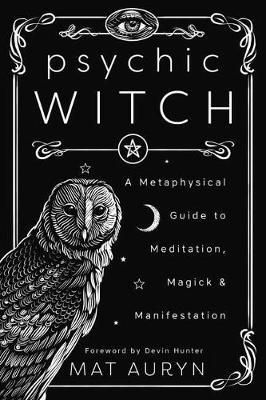
** The Energetic Architect: Deconstructing Manifestation for the Modern Mind
Golden Hook & Introduction
SECTION
Nova: Maja, in your world of finance and project management, everything comes down to one thing: managing finite resources—time, money, people—to achieve a specific, desired outcome. It's a high-stakes, high-focus game. But what if we could apply that same rigorous, systematic approach not just to a project plan, but to our own minds?
Maja: That’s a provocative question. My day is entirely about frameworks and methodologies. The idea of applying that to something as messy and chaotic as the human mind is… well, it’s ambitious.
Nova: Exactly! And that's why I'm so excited to talk about Mat Auryn's book,. Now, I know the title sounds a bit out there, but what if I told you it's less about pointy hats and more about being a high-performance architect of your own reality? It presents a system, a blueprint.
Maja: A system. Okay, now you have my attention. I'm a crafter, an ISTP. I like to understand how things are built. So, a system for something intangible? I'm curious to see the schematics.
Nova: Perfect. Because that’s exactly how we’re going to approach it today. We're going to look at this from three distinct angles. First, we'll explore the book's core 'project plan' for personal power: the three M's of Meditation, Magick, and Manifestation.
Maja: A project plan, I like it.
Nova: Then, we'll reframe personal energy as a tangible asset, almost like an unseen balance sheet, which I think will resonate with your finance background.
Maja: An energetic balance sheet. Interesting.
Nova: And finally, we'll dive into the strategic power of 'creative destruction'—the necessary death of old patterns to fuel new growth. Ready to put on your architect's hat?
Maja: Hat on. Let's deconstruct this.
Deep Dive into Core Topic 1: The Three M's: A Metaphysical Project Plan
SECTION
Nova: Alright, so let's start with the core engine of the book. Auryn lays out what he calls the Three Keys or the Three M's: Meditation, Magick, and Manifestation. It sounds mystical, but when you break it down, it's an incredibly logical sequence. He argues you can't have one without the others.
Maja: A critical path, then. A dependency.
Nova: Precisely. Let's start with the first M: Meditation. The book describes this as the foundational skill. But it’s not about forcing your mind to be empty. He paints a picture of stilling the 'monkey mind'—all those chattering thoughts about deadlines, emails, and what to have for dinner. It's about creating a clear, clean workspace in your head.
Maja: So, it's not about achieving zero thoughts, which seems impossible. It's about noise reduction. From a project management perspective, that sounds exactly like the discovery and scoping phase. Before you can build anything, you have to get all the stakeholders in a room and ruthlessly eliminate scope creep. You define what the project and, just as importantly, what it. You're creating a clean project charter.
Nova: What a perfect analogy! That's it. You're clearing the slate so you can write a single, clear objective. And only once that slate is clear can you move to the second M: Magick. And again, let's strip away the fantasy elements. Auryn defines magick simply as "the art and science of causing change to occur in conformity with will."
Maja: So, focused intent.
Nova: Focused intent, exactly. Once your mind is clear from the meditation phase, you direct all your will, all your focus, all your energy, towards that one specific outcome you've defined. This is the work. It's the execution phase of the project. It's the coding, the building, the writing. It’s the focused application of resources on the goal.
Maja: This is making so much sense. In a project, once the scope is locked, the team enters a sprint. They focus exclusively on the defined tasks. All their collective energy is directed at that one goal. You protect the team from distractions. So 'magick', in this context, is a state of profound, protected focus.
Nova: Yes! And that leads, logically, to the final M: Manifestation. This is the result. It's the project delivery. It's the finished app, the signed contract, the published book. It's the tangible, real-world outcome that is the natural consequence of the clear intention from meditation and the focused work of magick.
Maja: You know, what's so compelling about this framework is its insistence on process. In my world, we see teams that want to jump straight to the 'manifestation'—the launch party—without doing the hard work of scoping and execution. And it always, always fails. This system says the same thing: you can't just wish for a result. You have to do the foundational work. It’s a methodology, not a miracle.
Nova: A methodology, not a miracle. That's the perfect summary. It's about building, not wishing. And the primary material you're building with is energy.
Deep Dive into Core Topic 2: Energy as a Tangible Asset: The Unseen Balance Sheet
SECTION
Nova: And that's the perfect pivot to our second big idea. If you're going to build something, you need resources. The book argues that our primary, most fundamental resource is our own personal energy. This is where it gets really interesting for someone with a finance background: the idea of treating your energy as a tangible asset.
Maja: Okay, I'm intrigued. In finance, an asset is something that has economic value. How does he make energy 'tangible'?
Nova: Through practice. He doesn't just say "you have an aura." He gives you exercises to literally feel the energy between your own two hands, to sense the energetic field of a plant or another person. The goal is to move 'energy' from an abstract concept into a felt sensation. Because if you can feel it, you can manage it.
Maja: You can measure it. Or at least, you can get a sense of its state. Is it high or low? Is it stable or volatile?
Nova: Exactly! And once you can sense it, you can perform an audit. You can start to notice where your energy is going. Where are the leaks? That pointless argument you had online, that's an energy leak. Worrying about something you can't control, another leak. A draining colleague... a massive leak.
Maja: This is blowing my mind a little. You're describing a personal profit and loss statement, but for energy. A draining meeting is a cost of goods sold. A pointless worry is an unnecessary operational expense. They draw down your capital.
Nova: Yes! And on the other side, what are your assets? What generates energetic revenue? That moment of deep, focused work—what Cal Newport calls 'deep work'—that's an investment that yields a huge return. A walk in nature, a good conversation, even just five minutes of quiet meditation. Those aren't just 'nice things to do'; in this framework, they are acts of capitalizing your business.
Maja: So self-care is no longer a soft, fluffy concept. It's essential capital management. If my 'energetic capital' is low, I don't have the resources to fund my important initiatives—whether that's landing a new client at work or being present with my family at home. I need to manage my portfolio. I'm starting to think about my attention and focus in terms of ROI... a return on intention.
Nova: A return on intention! Maja, that is brilliant. That's the whole concept in a nutshell. You are the fund manager of your own energy. And every good fund manager knows that sometimes, to improve the portfolio's performance, you have to sell off the assets that are underperforming. You have to cut your losses.
Maja: You have to divest.
Nova: Exactly. And that brings us to the power of 'death'.
Deep Dive into Core Topic 3: The Power of the Void: Creative Destruction and Rebirth
SECTION
Nova: This idea of divesting brings us to our third point, which connects to the theme of 'death'. But we're not talking about it in a literal, morbid sense. In, the concepts of cleansing, banishing, and releasing are central. It's about strategic abandonment. It's the power of the void, of creative destruction.
Maja: In business, we call that 'sunsetting' a product or a project. It’s a controlled demolition. It's not a failure; it's a strategic decision to stop investing in something that's no longer serving the mission.
Nova: That is the exact right frame for this. The book is full of rituals, some of which sound very dramatic, like the 'Lesser Banishing Ritual of the Pentagram.' But if you strip away the ceremony, what is it? It's a powerful psychological and energetic tool. It's a formal process where you consciously identify a negative thought pattern—like imposter syndrome—or a draining emotional attachment, and you declare, with focused will, that it is 'banished' from your space.
Maja: It's a decommissioning protocol. I'm serious! When we sunset a legacy software system, we don't just turn it off. There's a whole process. We analyze why it's being replaced, we communicate the change, we archive the data, and then we have a formal shutdown. It's a deliberate act. This 'banishing' sounds like a mental decommissioning protocol for a bad habit or a limiting belief.
Nova: I've never heard it put that way, and it's perfect. You're not just ignoring the problem; you're actively, formally ending it. You're acknowledging its 'death' to create a void. And the book is clear: nature abhors a vacuum. When you create that void by banishing the negative, you create space that you can then consciously fill with something positive and intentional.
Maja: That makes sense. You don't just shut down the old server; you have the new, more efficient server ready to take its place. The act of 'death' or 'banishing' isn't the end goal. The goal is the rebirth of something better in the space you've just created. It's about resource reallocation. You're freeing up the energetic and mental 'server space' that was being wasted on a buggy, outdated program.
Nova: Exactly. So the 'death' of a limiting belief like "I'm not good enough" creates the space to install a new belief: "I am capable and resourceful." It’s a strategic upgrade of your personal operating system.
Synthesis & Takeaways
SECTION
Nova: So, when we pull it all together, it's pretty amazing. We've taken this book,, and through your lens, Maja, we've seen it as a project plan, a financial balance sheet, and a strategic decommissioning protocol.
Maja: It's a system for optimizing your own internal resources. It reframes these mystical concepts into a practical, actionable methodology for managing your focus and attention. That's the core takeaway for me. It’s not about believing in magic; it’s about understanding the mechanics of your own mind.
Nova: Beautifully put. So for everyone listening, especially the analytical minds, the crafters, the project managers out there who are maybe a little skeptical but also curious, here’s a practical experiment. A small piece of the system you can test yourself.
Maja: A pilot program.
Nova: A pilot program, yes! The book suggests a simple grounding and centering exercise. It's a mini-banishing of daily stress. So, before your next big meeting or a difficult conversation, take just three minutes. Close your eyes. Breathe deeply. And visualize roots growing from the soles of your feet, going deep down into the earth, anchoring you firmly.
Maja: Establishing a stable base.
Nova: A stable base. Then, visualize any distracting, stressful, or anxious energy in your body and mind—the 'monkey mind' chatter—and see it flowing down those roots, into the deep earth, where it's harmlessly absorbed and neutralized. You're not fighting the stress; you're just letting it flow away.
Maja: You're opening a valve and releasing the pressure.
Nova: Exactly. See it not as magic, but as a mental reset. A tool for your craft. A way to clear the workspace before you begin the project. Give it a try. You might be surprised at the return on that three-minute investment.
Maja: I will. Consider the pilot program launched.
Nova: Maja, thank you so much for bringing your incredible, analytical mind to this. You’ve given us a whole new language to understand these ideas.
Maja: This was fascinating. Thank you, Nova. It's given me a lot to think about—and a new kind of system to analyze.