

The 'Growth' Illusion: Why You Need to Redefine Economic Value.
Golden Hook & Introduction
SECTION
Nova: What if everything you've been taught about success, about progress, about 'more' being inherently better... was actually holding us back? What if growth isn't always the answer?
Atlas: Oh, Nova, you're already going for the jugular of capitalism! But honestly, the idea of 'growth at all costs' feels so ingrained in our society, almost like a natural law. Are we really saying it's... an illusion?
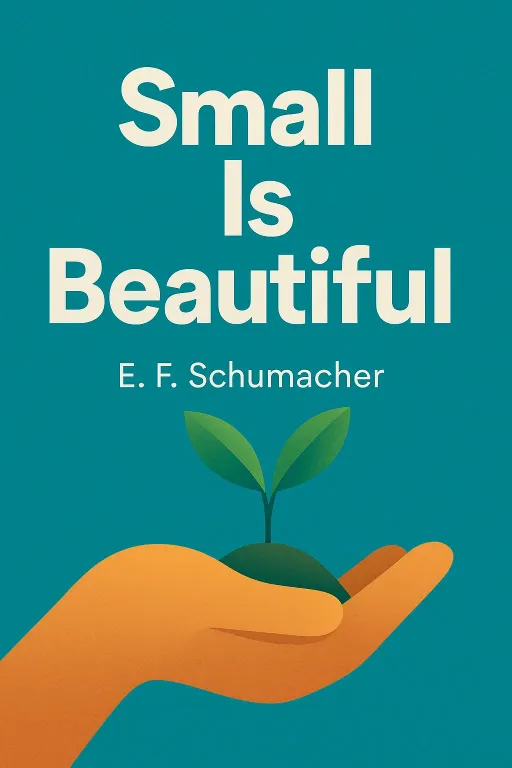
Nova: Absolutely. Today, we're dissecting "The 'Growth' Illusion: Why You Need to Redefine Economic Value." And to truly understand this profound shift, we're leaning into two seminal works. First, E. F. Schumacher's, a book written by an economist who also had a deep spiritual practice and dared to challenge the very foundations of industrial society. He was a pioneer in what we now call ecological economics.
Atlas: That's a fascinating background for an economist. It suggests a much broader perspective than just spreadsheets.
Nova: Exactly. And then there's Tim Jackson's, from an ecological economist who has advised governments worldwide on sustainable development. He's been at the forefront of challenging conventional growth models for decades.
Atlas: Those are heavy hitters. So, is the core idea that our obsession with GDP and endless expansion is actually obscuring a deeper, more meaningful definition of prosperity? For visionaries who are trying to build ethical frameworks, this feels like an essential conversation.
The Blind Spot of Quantitative Growth
SECTION
Nova: Precisely. Our current economic systems have a colossal blind spot. They equate growth—purely quantitative growth, usually measured by GDP—with progress. It’s like measuring the health of a forest solely by how quickly the trees are growing, without considering the soil quality, the biodiversity within it, or the fresh, clean air it provides to the surrounding ecosystem.
Atlas: That's a great analogy. So, when you say 'blind spot,' what are the critical elements our current system consistently ignores? For those of us trying to design equitable systems, understanding this foundational flaw is paramount.
Nova: It ignores quality of life, environmental limits, and social equity. Think about it: a country could report soaring GDP numbers, but achieve them by polluting its rivers, exploiting its workers, and creating products designed to fail quickly, forcing more consumption. Traditional economics often cheers the profit part, while completely glossing over the devastation to people and planet.
Atlas: That's actually quite infuriating. It feels like we've optimized for a single, narrow metric, and everything else—human dignity, planetary health, community well-being—becomes an 'externality,' an inconvenient side effect. Schumacher, in, was really prescient about this, wasn't he? He was talking about 'intermediate technology' decades ago.
Nova: He truly was. Schumacher wasn't just talking about technology; he was advocating for an economics that serves human well-being and ecological health, not just endless material accumulation. He saw the inherent dangers of unchecked scale, of wanting everything to be bigger, faster, more. He championed local economies, arguing quite powerfully that smaller, human-scale systems are inherently more resilient, more humane, and ultimately, more sustainable.
Atlas: And that directly challenges the 'bigger is better' mantra that's driven so much of our globalized economy. It's a fundamental shift in perspective. But for someone deeply embedded in designing large-scale, complex systems, the idea of 'small' can feel... inefficient, or even regressive. How do you scale 'small' when you're trying to implement change at scale, for example, in governance structures?
Redefining Prosperity Beyond Growth
SECTION
Nova: Ah, that's where Tim Jackson's comes in, and he directly addresses that tension. He challenges the very premise that economic growth is for prosperity. He provides a comprehensive roadmap for a sustainable economy that prioritizes human flourishing within ecological boundaries, rather than simply expanding endlessly.
Atlas: Prosperity growth. That sounds almost heretical in our current economic paradigm. For visionaries working to align systems with ethical principles, this really is the holy grail. But what does that actually in practice? How do you measure 'flourishing' without falling back into the old traps of quantitative metrics?
Nova: It means shifting our focus from to. Instead of asking 'How much did we produce?', we fundamentally change the question to 'How well are people living? Is the environment thriving? Are resources distributed equitably?' Jackson talks about 'flourishing,' which includes things like health, happiness, strong relationships, meaningful work, and a sense of purpose. These are qualitative measures of true wealth.
Atlas: So, it's about redefining value itself. It's not just about the numbers on a spreadsheet, it's about the lived experience, the actual well-being of individuals and communities. What are some of the more practical indicators or frameworks he suggests for this redefined prosperity? Because for those who need to ground theory in human practice, we need concrete ways to measure success.
Nova: He proposes indicators like Genuine Progress Indicators, or GPI, which actually account for environmental degradation and income inequality, rather than just the raw GDP number. He emphasizes the importance of investing heavily in public goods like education and healthcare, reducing working hours to allow for more leisure and community engagement, and designing products for durability and repairability, actively moving away from planned obsolescence.
Atlas: That’s a fundamentally different economic engine. It moves from consumption as the primary driving force to well-being and sustainability. And it feels deeply aligned with creating just and equitable systems. The idea of prioritizing community resource management, for instance, naturally flows from this. It's not about extracting wealth from the land or people, but cultivating shared value and resilience within a community.
Nova: Exactly. It's a profound shift in mindset, moving beyond mere quantity to a deeper understanding of qualitative well-being. Both Schumacher and Jackson are essentially asking us to 'grow up,' not just 'grow bigger.' To recognize that true progress isn't about endlessly filling a bucket, but about ensuring the bucket holds pure, life-giving water for everyone, forever. Their insights fundamentally shift how we measure success.
Synthesis & Takeaways
SECTION
Nova: So, Atlas, when we look at these powerful ideas—the blind spot of growth, and the vision of prosperity without it—what's the core takeaway for those listening who are driven by justice and building better systems, who are architects and visionaries in their own right?
Atlas: It's that the current economic operating system is fundamentally broken if your goal is equitable flourishing. The mandate to 'grow' at all costs is often a constraint, not a liberation. For those of us trying to design ethical frameworks for the future, it's a clear call to action to fundamentally rethink the metrics we use, and to prioritize qualitative value over quantitative expansion. It's about building systems that truly serve life, not just capital accumulation.
Nova: Beautifully put. It's about remembering that the economy is a tool, not an end in itself. Its inherent purpose is to serve humanity and the planet, not the other way around. And as Jackson powerfully points out, if we keep chasing endless growth on a finite planet, we're not just heading for a cliff, we're already tumbling. The true visionary move now is to redefine value itself, to understand what true prosperity really means.
Atlas: And that means actively seeking out and supporting local projects that demonstrate these principles, starting small where possible, and showing that these alternative models aren't just idealistic, but profoundly practical and entirely necessary. It's about connecting grand ideas to tangible actions.
Nova: Absolutely. It’s an urgent call to redefine success, and to design economies that truly nurture human and ecological well-being. It's not about less, it's about better.
Atlas: This is Aibrary. Congratulations on your growth!