

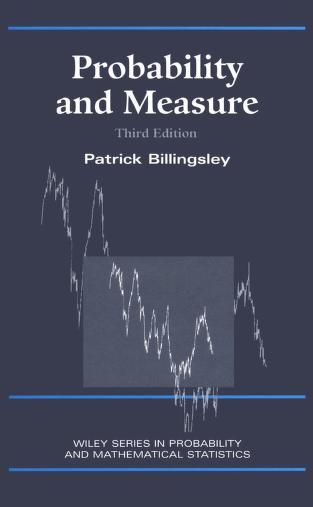
Probability and Measure
Introduction
Nova: Here's a question for you: what do a black-belt judo champion, a Hollywood actor who played a bad guy dying in a fiery car crash with Kirk Douglas, and one of the most revered probability theorists of the twentieth century all have in common?
Nova: : I'm going to guess it's the same person. Please tell me it's the same person.
Nova: It is! Patrick Billingsley — professor of statistics and mathematics at the University of Chicago, student of the legendary William Feller, and the author of "Probability and Measure," a book that has shaped how generations of mathematicians learn the deep foundations of probability theory.
Nova: : So this is a guy who read Beowulf in Old English, painted in his spare time, worked out every day for forty years, and also wrote what some people call one of the best math books ever written?
Nova: Exactly. And today we're diving into that book. It's been in print for over three decades, gone through multiple editions, and remains a standard graduate-level text worldwide. But what makes it so special? Why do people keep coming back to it? And what does it actually teach you?
Nova: : I'm ready. Take me into the world of measure-theoretic probability.
A Renaissance Mathematician
The Man Behind the Measure
Nova: Before we talk about the book itself, let's talk about the man, because Patrick Billingsley's life is honestly remarkable. Born in 1925 in Sioux Falls, South Dakota, he earned an engineering degree from the U. S. Naval Academy, served as a naval officer for nearly a decade, and lived in Japan where he got a black belt in judo.
Nova: : Hold on — he got a doctorate in mathematics from Princeton while still serving in the Navy?
Nova: Yes! He earned his master's in 1952 and his PhD in 1955 under none other than William Feller, one of the giants of probability theory. Then he joined the University of Chicago faculty in 1958 and stayed there until he retired in 1994.
Nova: : And the acting career? How does a probability theorist end up in a Kirk Douglas film?
Nova: Billingsley started acting in earnest in 1966 at the University of Chicago's Court Theatre. He held leading roles in more than twenty professional productions. Then a talent scout saw him in a play called "The Lover" in 1977, which led to an audition for the 1978 film "The Fury." He played a villain who dies in a fiery crash during a car chase through downtown Chicago. He went on to appear in eight films total, including "The Untouchables" in 1987 where he played the bailiff.
Nova: : That is genuinely wild. So this is the guy who wrote one of the most rigorous, demanding probability textbooks in existence.
Nova: And he brought that performer's sensibility to his writing. He once said, "When you teach, you perform in front of an audience. That's much like acting." His daughter Marty described him as a true Renaissance man — someone who read Mad Magazine alongside The New Yorker, watched Monty Python, and sang Child Ballads as lullabies.
Nova: : There's something about that breadth of life experience that seems to have informed his mathematical writing. You don't write a beloved classic by being just a technocrat.
Nova: That's exactly right. And his philosophical approach to mathematics came directly from his mentor Feller. Billingsley recalled Feller telling his students that "the best in mathematics, as in art, letters, and all else, consists of the general embodied in the concrete." That principle runs through every page of "Probability and Measure."
Borel's Normal Number Theorem
A Book That Opens with a Surprise
Nova: So here's the thing that makes "Probability and Measure" structurally brilliant. Most measure theory books open with definitions — sigma-algebras, measurable spaces, the whole abstract machinery. Billingsley does something radically different. He opens Chapter 1, page 1, with Borel's normal number theorem.
Nova: : What's Borel's normal number theorem?
Nova: It's a beautiful result. Take the unit interval, pick a point at random, and look at its binary expansion — the infinite sequence of zeros and ones. Borel proved that, with probability one, the proportion of ones in the first n digits converges to one-half as n goes to infinity. In other words, almost every number is "normal" in base two.
Nova: : So he's essentially proving the law of large numbers for coin tosses, but using nothing more than calculus and the length of intervals?
Nova: Exactly. He proves it rigorously using only the length of an interval and the Riemann integral of step functions. No abstract measure theory is needed at all. And in doing so, he shows the reader: look, here is a deep probabilistic result that mirrors what you already know from discrete probability, and it emerges naturally from the geometry of the unit interval.
Nova: : It's like he's showing you the destination before explaining the vehicle that gets you there.
Nova: That's the perfect metaphor. Billingsley himself wrote in the preface that the book's novelty is "the alternation of probability and measure, probability motivating measure theory and measure theory generating further probability." You see probability in action first, you feel the need for the heavier machinery, and then the machinery arrives precisely when you're ready to appreciate it.
Nova: : Most textbooks do the opposite — they build all the abstract scaffolding first, and by the time you get to applications, you've forgotten why you cared.
Nova: And that's why people love this book. In Chapter 1 alone, after Borel's theorem, you get probability measures, Lebesgue measure on the unit interval, laws of large numbers, gambling systems including bold play, Markov chains, and even large deviations and the law of the iterated logarithm — all before a single abstract integral appears.
Nova: : Wait, the law of the iterated logarithm in Chapter 1? That's usually a very advanced topic.
Nova: It is. But Billingsley pulls it off because he restricts to simple random variables — those with finite range — where expected values are just sums, not integrals. So measure theory without integration suffices for a completely rigorous treatment of infinite sequences of simple random variables.
Nova: : That's elegant. He's found a way to give students a huge amount of probabilistic insight before the heavy machinery comes in.
Seven Chapters to Mastery
The Architecture of the Book
Nova: Let's walk through the architecture of the book, because the structure is part of what makes it so effective. It has seven chapters. Chapter 1, as we've discussed, covers probability with minimal measure-theoretic tools. Then Chapter 2 develops general measure theory — outer measure, measures in Euclidean space, measurable functions.
Nova: : So he's finally giving you the formal framework.
Nova: Right. Chapter 3 is integration — the Lebesgue integral, product measures, Fubini's theorem, and in the third edition, L^p spaces with applications to statistics. Chapter 4 returns to probability with full power: random variables and distributions, expected values as integrals, the strong law of large numbers, the Poisson process, and ergodic theory.
Nova: : Interesting — the third edition replaced queuing theory with ergodic theory, right?
Nova: Yes. Billingsley felt ergodic theory fit better with the rest of the book and illustrated the connections between probability and pure mathematics more beautifully. He included applications to continued fractions and Diophantine approximation.
Nova: : That's the Feller principle again — the general embodied in the concrete.
Nova: Exactly. Then Chapter 5 covers convergence of distributions — weak convergence, characteristic functions, the central limit theorem, infinitely divisible distributions, and the method of moments. Chapter 6 returns to measure theory with derivatives and the Radon-Nikodym theorem, then applies them to conditional expectation and martingales. And Chapter 7 wraps everything up with stochastic processes — Kolmogorov's existence theorem, Brownian motion, and separability.
Nova: : That's an enormous amount of material. Over five hundred pages?
Nova: The third edition runs about six hundred pages with the appendix and notes. And here's a design choice I love: Chapters 5, 6, and 7 are independent of each other. You can read them in any order. So once you've gotten through the core four chapters, you can follow your interests.
Nova: : That's thoughtful course design. What about the problems?
Nova: Over three hundred problems, with extensive notes and solutions at the back. The notes on the problems alone run about thirty pages. Billingsley clearly cared deeply about the pedagogical experience. He wanted students to actually learn, not just read.
Nova: : And there's something else I noticed from the table of contents — he marks certain sections with stars to indicate they can be omitted on a first reading.
Nova: Yes! It's a small thing, but it shows respect for the reader. He's saying, "Here's the essential path. These starred sections are beautiful, but come back to them when you're ready." A lot of authors just dump everything on you and let you sink or swim.
Exposition as Art
Why This Book Endures
Nova: Let's talk about why "Probability and Measure" has survived while so many other textbooks have faded. This book was first published in 1978, and the third edition came out in 1995. Billingsley wrote in that preface, with characteristic wit, "I said in the preface to the second edition that there would not be a third, and yet here it is. There will not be a fourth."
Nova: : Which turned out to be true, though there is now an Anniversary Edition from Wiley that repackages the third edition with a new foreword.
Nova: The book's longevity comes down to Billingsley's voice as a writer. Mathematical exposition is a literary art, and Billingsley was a master of it. He won the Mathematical Association of America's Lester R. Ford Award for mathematical exposition. He served as the first editor of the Annals of Probability and as president of the Institute of Mathematical Statistics. He knew the craft.
Nova: : I've seen a review that called it "among the best books in math ever written." That's strong praise.
Nova: It is. And it's not just the prose — it's the philosophical commitment to showing the reader why things are true, not just that they are true. Billingsley wrote that his goal was "to write a book I would myself have liked when I first took up the subject, and the needs of students have been given precedence over the requirements of logical economy."
Nova: : What does he mean by "logical economy"?
Nova: He gives a specific example. Kolmogorov's existence theorem — the foundational result that lets you construct stochastic processes from finite-dimensional distributions — doesn't appear until Chapter 7, the very last chapter. In a logically economical book, you'd put it in Chapter 1. But Billingsley constructs the stochastic processes he needs earlier by special arguments, which "although technically redundant, motivate the general result."
Nova: : He's letting you see the show in rehearsal before the final performance.
Nova: Those are his exact words: "It is instructive, I think, to see the show in rehearsal as well as in performance." That's the theater actor speaking. He understood that learning mathematics is not about logical efficiency — it's about building intuition. You need to see the special cases, the concrete examples, the motivating problems, before the grand abstraction makes sense.
Nova: : I imagine that makes it a demanding read, though. You need some mathematical maturity.
Nova: Absolutely. Billingsley himself says the book presupposes knowledge of combinatorial and discrete probability, rigorous calculus including infinite series, and elementary set theory. It's a graduate-level text. One reviewer on a math forum put it well — Billingsley is good for self-study for the "mathematically mature" student who has had exposure to real analysis.
Nova: : So it's not a book you pick up on a whim?
Nova: No, but that's its strength. It respects the reader's intelligence. It doesn't condescend. And for those who are ready, it opens up the entire edifice of modern probability theory — from the central limit theorem to Brownian motion to martingales — in a unified, coherent framework.
Beyond the Book
The Billingsley Legacy
Nova: Let's zoom out and talk about Billingsley's broader contributions, because "Probability and Measure" is part of a larger body of work. He wrote five books total, including "Convergence of Probability Measures" in 1968 and "Ergodic Theory and Information" in 1965 — both of which became the authoritative works on their subjects for a generation.
Nova: : And in pure mathematical analysis, he has something named after him — the Billingsley dimension.
Nova: Yes! The Billingsley dimension is an extension of Hausdorff dimension to positive Borel measures. It's one of three fundamental quantities attached to an ergodic, invariant probability measure in a smooth dynamical system — the others being the Kolmogorov-Sinai entropy and the Lyapunov exponents. The relationship among these three quantities culminated in the celebrated Ledrappier-Young formula.
Nova: : That's a serious legacy in dynamical systems theory, not just probability.
Nova: And he also made important contributions to probabilistic number theory. He delivered the Wald lectures on the probability theory of additive arithmetic functions and the Rouse Ball lecture at Cambridge on prime numbers and Brownian motion. His article on that topic won the Lester R. Ford award.
Nova: : I'm curious — where does "Probability and Measure" fit among its competitors? There are other classic texts, like David Williams's "Probability with Martingales" or Rick Durrett's "Probability: Theory and Examples."
Nova: That's a great question. Each book has its audience. Williams is more compact and focuses heavily on martingales as the unifying theme. Durrett is encyclopedic and example-driven, great for reference. Billingsley sits in a sweet spot — it's comprehensive enough to be a reference, but it's also a coherent pedagogical journey. It's more measure-theoretic than Williams and more narrative-driven than Durrett.
Nova: : And it has that distinctive voice — the Feller-influenced commitment to embodying the general in the concrete.
Nova: Right. Billingsley's philosophy, drawn from Feller, was that you don't just state a theorem and prove it. You show it living and breathing in examples. You convince the reader that it matters. His books aren't just technically correct — they're persuasive. They make you want to believe the theorems.
Nova: : That's a rare quality in mathematical writing. Most textbooks are content to be correct.
Nova: It is rare. And I think that's why his colleague Steve Lalley, who wrote Billingsley's obituary, said that several generations of graduate students have learned their basic probability from these books and they continue to be used and cited. When a textbook shapes the thinking of multiple generations, it has transcended being a textbook. It becomes part of the intellectual fabric of the field.
Conclusion
Nova: So what have we learned about "Probability and Measure" by Patrick Billingsley? First, it's a book written by a remarkable person — a mathematician, actor, judo black belt, and true Renaissance man who brought a performer's sensibility to mathematical exposition.
Nova: : Second, it has a brilliantly unconventional structure. Instead of building abstract machinery first, it opens with Borel's normal number theorem — a deep probabilistic result proved with nothing more than calculus. Probability motivates the measure theory, not the other way around.
Nova: Third, it covers an enormous amount of ground — from the basics of probability measures through integration, convergence, conditional expectation, martingales, and stochastic processes — in seven carefully organized chapters that give the reader flexibility in how to approach the material.
Nova: : Fourth, its enduring appeal comes from Billingsley's commitment to the Feller principle: the best mathematics consists of the general embodied in the concrete. Every abstraction is earned through concrete examples.
Nova: And fifth, the book's legacy extends far beyond itself. Billingsley shaped how probability theory is taught and understood. His other works, his editorial leadership at the Annals of Probability, and his own research contributions — including the Billingsley dimension — make him one of the foundational figures of modern probability.
Nova: : If someone is mathematically mature and wants to truly understand the measure-theoretic foundations of probability, this is still the book to reach for.
Nova: Or as Billingsley might have put it, quoting Joseph Conrad in his own preface: after ages of good service, the river of mathematics spreads out "in the tranquil dignity of a waterway leading to the uttermost ends of the earth." His contribution to that river, though he called it small, has carried generations of students to places they couldn't have reached without it.
Nova: : This is Aibrary. Congratulations on your growth!