

Beyond Borders: Unpacking Global Interdependence in a Fragmented World
Golden Hook & Introduction
SECTION
Nova: You know, Atlas, I think one of the biggest misconceptions people have about the world is that geography is just... lines on a map. A static backdrop. Like a boring painting in a waiting room.
Atlas: Oh, absolutely! I mean, who hasn't looked at a map and thought, 'Yep, that's where France is, that's where Russia is, got it.' It’s all just landmasses, borders, maybe a few squiggly blue lines for rivers. What more is there to know?
Nova: . That’s the perception. But what if I told you that those seemingly innocuous lines, those mountains, those rivers, those vast plains and deep oceans, are actually the silent, often brutal, architects of history? The true puppet masters behind national destinies, conflicts, and alliances?
Atlas: Whoa, that sounds a lot more exciting than my high school geography class. So you’re saying it’s not just about where countries, but what their actually to them?
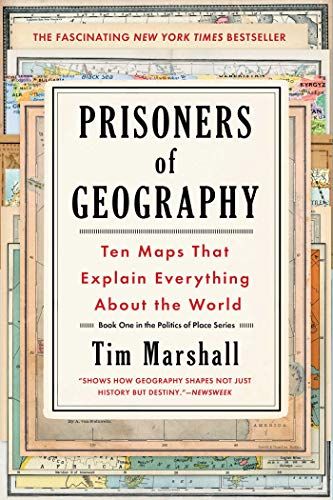
Nova: Precisely. And that's the profound insight we're diving into today, largely inspired by two absolutely foundational books: Tim Marshall's "Prisoners of Geography" and Robert D. Kaplan's "The Revenge of Geography." Marshall, a diplomatic editor and foreign correspondent for decades, literally reported from the front lines, giving his insights a gritty, on-the-ground realism that few can match. Kaplan, on the other hand, is renowned for his immersive, almost ethnographic reporting from some of the most remote and conflict-ridden corners of the globe. Both of them argue, with compelling clarity, that if you ignore the fundamental truths of geography, you're left with a woefully incomplete, almost fantastical, picture of global affairs.
Atlas: So, these aren't just academic treatises. These are books forged in the furnace of real-world observation. That makes me wonder, what kind of picture are we missing if we don't understand this geographical 'silent force'?
The Direct Impact of Physical Features
SECTION
Nova: Think of it this way: geography isn't just about 'where.' It's about 'how' and 'why.' Why nations act the way they do, why some are expansionist, why others are easily invaded, why certain conflicts seem to recur throughout history. Let’s start with one of the most classic examples: Russia.
Atlas: Ah, Russia. Always a geopolitical hot topic. What does geography tell us about Russia? Besides 'it's massive and cold.'
Nova: Well, it massive and cold, and those are actually crucial factors. Marshall brilliantly illustrates how Russia is, in many ways, a prisoner of its own geography. Look at the vast, flat European plain that stretches from France all the way to the Urals. It’s an open invitation for invasion. Historically, everyone from Napoleon to Hitler marched across it. This geographical vulnerability has instilled a deep-seated paranoia in Russian strategic thinking, a constant drive for buffer states, for 'strategic depth.'
Atlas: So, that explains the historical push west, the desire for a cordon sanitaire around its borders. But what about the 'cold' part?
Nova: The cold part is equally vital. Russia has very few warm-water ports. Most of its coastline is frozen for much of the year. This is a massive strategic disadvantage for a global power. It limits naval projection, trade, and economic reach. So, Russia's quest for warm-water ports – whether in the Black Sea, the Baltic, or even historically in the Pacific – isn't just an ambition; it's a geographical imperative that dictates much of its foreign policy.
Atlas: Wait, are you saying that Russia’s actions, like its involvement in Ukraine, or its naval presence in Syria, are fundamentally driven by this centuries-old geographical reality, rather than just ideology or a particular leader’s whims?
Nova: Absolutely. Ideology can dictate a nation pursues its goals, but geography often dictates those goals fundamentally are. The craving for a secure western flank, for access to warm seas – these are constant, regardless of who is in the Kremlin. That's the enduring power of geography.
Atlas: That's a fascinating lens to put on current events. It really shifts the focus from simply reporting on happened to understanding it was almost inevitable, given the landscape. What about China? Another massive player.
Nova: China offers another brilliant illustration. For centuries, China was largely protected by formidable natural barriers: the Himalayas to the southwest, vast deserts to the north and west, and the Pacific Ocean to the east. These barriers fostered a sense of self-sufficiency, a 'Middle Kingdom' mentality. But the Pacific, while a barrier, also became its pathway to the world.
Atlas: And now, it's about sea lanes and trade, right? The South China Sea comes to mind.
Nova: Precisely. China’s modern geopolitical strategy is heavily shaped by its dependence on sea lanes for trade and resources, particularly oil. The South China Sea isn't just about territorial claims; it's about securing those vital arteries, about projecting power into a region that is crucial for its economic survival and global influence. The Belt and Road Initiative, too, is a massive geographical project, seeking to create new land and sea routes that bypass existing choke points and extend its reach.
Atlas: So, while the mountains protected them historically, now the oceans present both opportunity and vulnerability. It seems geography is less about static lines and more about dynamic flows and choke points.
Nova: Exactly. It's about the eternal push and pull, the constraints and the opportunities that the land and sea present.
Long-Term Influence & Resource Distribution
SECTION
Nova: Now, if Marshall gives us the blueprint for immediate strategic decisions, Kaplan takes us further, showing how these ancient geographical constraints, resource distribution, and even cultural boundaries, born from the land, still exact 'revenge' on modern geopolitics. He shows how the past is literally etched into the landscape.
Atlas: "Revenge of Geography"—that sounds ominous. So it’s not just about current military strategy, but deeper, systemic influences?
Nova: It is. Think about the Middle East. We often hear about ancient grudges, religious divides, and political ideologies. But Kaplan argues that beneath all that, the scarcity of water, the location of major rivers like the Tigris, Euphrates, and Nile, and of course, vast oil reserves, have intrinsically linked the region's geography to its persistent conflicts and instability.
Atlas: So, the fight for control over water or oil isn't just about resources; it's about survival in a geographically harsh environment. The 'ancient grudges' are often just proxies for these deeper, life-or-death struggles for geographical advantage.
Nova: That’s a great way to put it. The political boundaries drawn by colonial powers often ignored these underlying geographical and ethnic realities, creating artificial states that are inherently unstable because they cut across natural resource zones or cultural landscapes. The Tigris and Euphrates don't care about a line on a map; they flow where they flow, and whoever controls them holds immense power.
Atlas: That makes me wonder about South America. I always think of it as this big, unified continent, but politically, it’s quite fragmented. Does geography play a role there too?
Nova: A massive role. Kaplan shows how the imposing Andes mountains, snaking down the entire western spine of the continent, have historically led to political fragmentation and distinct national identities. It’s incredibly difficult to unify populations separated by such formidable natural barriers. Look at the distinct cultural and political trajectories of countries on either side of the Andes.
Atlas: But can't modern infrastructure, like highways and tunnels, overcome those divisions? Or does geography still leave its indelible mark?
Nova: Infrastructure certainly mitigates some challenges, but geography creates a 'path dependency.' It shapes settlement patterns, trade routes, and even cultural identities over centuries. While you can build a tunnel through a mountain, the historical forces that led to distinct cultures developing on either side don't just disappear overnight. The 'revenge' is subtle but persistent. It means that global citizens trying to understand, say, the dynamics of a regional trade bloc, need to look beyond the headlines and consider the very ground beneath their feet.
Synthesis & Takeaways
SECTION
Nova: So, what we've really been exploring today is that geography is not just a passive stage upon which human drama unfolds. It's an active, often deterministic force, shaping the very nature of states, their ambitions, their vulnerabilities, and their interactions.
Atlas: It’s almost like a hidden operating system for the planet, running quietly in the background, dictating much of what we see on the news every day. As someone who appreciates critical analysis and patterns, this framework offers so much clarity. It's not about being fatalistic, but about being profoundly informed.
Nova: Exactly. Understanding these geographical realities allows us to move beyond superficial explanations for global events. It helps us see the deeper, often unchanging, forces at play. It's about recognizing that while humans make choices, those choices are always made within specific geographical constraints and opportunities.
Atlas: So, for our listeners, the global citizens and strategists out there, what's a tiny step they can take to apply this lens?
Nova: Pick one major global conflict you're following, any one that’s been in the news recently. Then, open up a physical map, or Google Maps, and trace its geographical roots. Ask yourself: How do the mountains, rivers, plains, coastlines, or resource distributions influence the strategies of the involved parties? How does it explain their historical actions? You'll be amazed at the clarity that emerges.
Atlas: That’s a powerful challenge. It means looking beyond the immediate political rhetoric and seeing the enduring, silent forces at play. It really makes you rethink everything.
Nova: It absolutely does. And once you see it, you can't unsee it.
Atlas: This is Aibrary. Congratulations on your growth!