

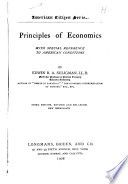
Principles of Economics
With Special Reference to American Conditions
Introduction
Nova: Imagine it is 1905. The United States is hurtling through the Gilded Age. Monopolies are massive, the gap between the rich and the poor is a canyon, and everyone is trying to figure out how this new industrial world actually works. Into this chaos steps a man named Edwin Robert Anderson Seligman with a book that would change the way we think about the very soul of the economy.
Atlas: You make him sound like a superhero, Nova. But we are talking about a textbook called Principles of Economics. Usually, when people hear principles and economics in the same sentence, they start looking for the nearest exit.
Nova: I know, I know. But Seligman wasn't just some dry academic. He was a powerhouse at Columbia University, a co-founder of the American Economic Association, and the guy who basically helped design the modern American tax system. This book wasn't just a list of formulas; it was a manifesto for the American citizen.
Atlas: So, it is not just about supply and demand curves? Because if I have to look at one more graph of wheat prices from the turn of the century, I might actually fall asleep right here.
Nova: Far from it. Seligman believed that economics was a living, breathing thing. He called it a social science in the truest sense. He wanted to move beyond the idea that we are all just isolated robots making selfish choices. He wanted to show how society itself creates value. Today, we are diving into his 1905 masterpiece to see why his ideas on social value and taxation still haunt our bank accounts and our political debates today.
Key Insight 1
The Man and the Moment
Nova: To understand the book, you have to understand Seligman. He came from a very wealthy banking family—the Seligmans were often called the American Rothschilds. But instead of just counting his money, Edwin became obsessed with how wealth is distributed and how the state should function.
Atlas: That is an interesting pivot. Usually, the kids of banking dynasties are not the ones leading the charge for progressive taxation. Was he a rebel?
Nova: Not a rebel in the sense of wanting to tear the system down, but he was a reformer. He saw that the old way of looking at economics—what we call the Classical School—was failing to explain the modern world. In 1905, when he published Principles of Economics, he was trying to bridge the gap between pure theory and the messy reality of American life.
Atlas: What was so messy about it back then? Besides the lack of air conditioning?
Nova: It was the transition from a frontier, agricultural society to an urban, industrial one. The old rules said the government should just stay out of the way. But Seligman looked at the slums, the trusts, and the railroads and said, wait a minute, the state has a role to play here. He wrote this book as part of the American Citizen Series, specifically to help regular people understand their responsibilities in this new economy.
Atlas: So it was like a manual for being a functional member of a modern society? That is a lot of pressure for a textbook.
Nova: Exactly. He believed that you could not be a good citizen if you did not understand the economic forces shaping your life. He spent forty-six years teaching at Columbia, and this book was the distillation of everything he thought a citizen needed to know. He was not just teaching students; he was trying to build a nation.
Atlas: And he did it with a massive, six-hundred-page tome. I am guessing he did not skip the details.
Nova: He definitely did not. He had one of the largest private libraries of economic literature in the world—over forty thousand volumes. He was a walking encyclopedia. When he wrote about the history of economics, he was not just quoting other people; he had likely read every single thing ever written on the topic in five different languages.
Atlas: That is intimidating. But it also means he had a lot of perspective. He was not just looking at the 1900s; he was looking at the whole timeline of human trade.
Nova: Precisely. He saw economics as an evolution. And that leads us to his most controversial and fascinating idea: the Social Theory of Value.
Key Insight 2
The Social Theory of Value
Nova: Most economists at the time were obsessed with marginal utility. The idea that the value of something is just based on how much the last person who bought it wanted it. It is very individualistic. But Seligman said, hold on, value is not just in your head. It is a social reflex.
Atlas: A social reflex? That sounds like something my brain does when I see a sale at the mall. What does he mean by that?
Nova: He argued that value is created by the collective needs and the collective pressure of society. Think about a piece of land in the middle of a desert versus a piece of land in the middle of Manhattan. The land itself might be the same size, but the value is created by the millions of people living around it.
Atlas: Okay, that makes sense. The people make the place valuable. But does not that just go back to supply and demand? Lots of people want Manhattan, so the price goes up?
Nova: Seligman went deeper. He called it Social Marginal Utility. He argued that society as a whole has a set of desires and priorities, and those priorities dictate what is valuable. It is not just a bunch of individuals making random choices; it is a social organism deciding what matters.
Atlas: That sounds a bit like he is saying society is one big person. Is he ignoring the individual?
Nova: Not ignoring, but recontextualizing. He believed that our individual choices are shaped by the social environment. You want a smartphone not just because you like glass and silicon, but because society has built a world where you need one to function. Therefore, the value of that phone is a social product.
Atlas: I can see why that would be a big deal. If value is a social product, then maybe the wealth created by that value belongs to society too?
Nova: You hit the nail on the head! That was the radical implication. If the community helps create the value of your business or your land, then the community has a legitimate claim to some of that wealth through taxation. This was his way of justifying a more active government.
Atlas: So he used a theory of value to build a bridge to a theory of taxes. That is a very clever move for a guy who loves public finance.
Nova: It was brilliant. He was moving away from the idea that taxes are a burden or a theft. Instead, he saw them as society reclaiming its share of the value it helped create. It changed the whole moral argument around money.
Key Insight 3
The Evolution of the Economy
Nova: Another huge part of Principles of Economics is Seligman's insistence that economic laws are not eternal. He hated the idea that there were these fixed, mathematical rules that applied to everyone from cavemen to Wall Street bankers.
Atlas: Wait, I thought that was the whole point of economics? You know, the invisible hand, the laws of markets? Are you telling me he thought the rules change?
Nova: Absolutely. He was heavily influenced by the Historical School. He believed that as society evolves, the economic rules must evolve too. What worked for a small village in the Middle Ages would be a disaster for a modern industrial city.
Atlas: That feels very common sense, but I bet it was heresy to some of the old-school economists who wanted everything to be like physics.
Nova: It was! He was constantly debating people who wanted to treat economics as a pure, abstract science. Seligman argued that you cannot separate economics from law, ethics, or history. He famously said that the economic life of a people is a part of its general social life.
Atlas: So, if the culture changes, the economy changes. If we start valuing environmental protection over raw production, the principles of economics actually shift?
Nova: Exactly. He saw the rise of labor unions, for example, not as a distortion of the market, but as a natural evolutionary step in a maturing industrial society. He did not see them as an outside force breaking the rules; he saw them as the rules updating themselves.
Atlas: It is like a software update for the country. Version 1.0 was subsistence farming, Version 2.0 was the industrial revolution, and he was trying to code Version 3.0.
Nova: That is a perfect analogy. And he was particularly interested in how the state—the government—acts as the developer in that scenario. He did not believe in laissez-faire, the idea that the government should just do nothing. But he also was not a socialist. He was looking for a middle path.
Atlas: The middle path is usually the hardest one to walk. Everyone from both sides ends up yelling at you.
Nova: And they did! But Seligman was respected because he backed everything up with mountains of data. He was one of the first economists to really use historical statistics to prove that the state's role in the economy has always grown as civilization gets more complex. He argued that a more advanced society actually requires more government, not less.
Key Insight 4
The Master of Taxation
Nova: We cannot talk about Seligman without talking about his obsession: taxes. In Principles of Economics, he lays out the groundwork for what would become his most famous contribution to the world—the progressive income tax.
Atlas: Ah, the thing we all love to hate every April. So we can blame Seligman for the tax brackets?
Nova: You can certainly thank him for the theory behind them. Before Seligman, most taxes were flat, or they were based on things like how many windows your house had. He argued for the Ability to Pay principle.
Atlas: Ability to pay. That sounds simple enough. If you have more, you pay more?
Nova: Right, but he gave it a scientific basis. He argued that the more money you have, the less each additional dollar means to you. The first hundred dollars you earn pays for your food—that is vital. The millionth dollar you earn pays for a third yacht—that is not vital. Therefore, taxing the millionth dollar at a higher rate causes less total suffering to the individual than taxing the hundredth dollar.
Atlas: It is the law of diminishing marginal utility applied to the government's wallet. It is actually very logical when you put it that way.
Nova: He was also a huge critic of the Single Tax movement, which was very popular at the time. Henry George had this idea that we should only tax land and nothing else. Seligman went to war with that idea in his writing. He thought it was too simple and that it ignored all the other ways people build wealth in a modern world.
Atlas: He seems like a guy who hated simple answers. He wanted the complexity of the world reflected in the laws.
Nova: He really did. He also studied what he called the incidence of taxation. This is the idea that the person who pays the tax to the government is not always the person who actually bears the burden. If you tax a landlord, they might just raise the rent. Then the tenant is the one actually paying the tax.
Atlas: That is a huge point. It is like a game of hot potato with money. And Seligman was the guy tracking where the potato actually landed.
Nova: He was the first to really map that out in a systematic way. He wanted to make sure that when the government passed a law to tax the rich, it did not accidentally end up hitting the poor. His work on this was so influential that he was called to testify before Congress and even advised the League of Nations later in his life.
Atlas: It is amazing how much of our daily lives—the way our paychecks look, the way our cities are funded—goes back to these debates he was having in 1905.
Conclusion
Nova: As we wrap up our look at Edwin Robert Anderson Seligman's Principles of Economics, it is clear that he was more than just an economist. He was a philosopher of the modern state. He taught us that the economy is not a machine that runs on its own, but a social project that we are all responsible for.
Atlas: It is a bit of a reality check. We often think of economics as this distant thing that happens in boardrooms or on stock tickers. But Seligman reminds us that it is about the values we share and the society we choose to build together. Even if the book is over a hundred years old, that message feels incredibly current.
Nova: He left us with the idea that as we grow as a civilization, our economic principles have to grow with us. We cannot stay stuck in the past. We have to be willing to look at the American conditions of our own time and ask: what does justice look like in the economy today?
Atlas: I might not be ready to read all forty thousand books in his library, but I definitely have a new appreciation for why those tax brackets exist and why my land in the city is worth more than my land in the woods.
Nova: And that is exactly what he wanted. He wanted the American citizen to be informed, engaged, and aware of the invisible threads that connect us all. Seligman showed us that wealth is a social product, and therefore, our prosperity is a shared responsibility.
Atlas: A powerful thought to end on. Thanks for taking us through this, Nova. It was a lot more interesting than a graph of wheat prices.
Nova: My pleasure! This is Aibrary. Congratulations on your growth!