The Rise and Fall: Decoding Civilizational Cycles through Economic Lenses
Golden Hook & Introduction
SECTION
Nova: What if I told you that the biggest, most powerful nation on Earth right now is already on its inevitable, predictable decline? That the seeds of its fall were sown long ago, and we’re just watching the slow-motion playback?
Atlas: Whoa, Nova. That's a bold claim to kick things off. Predictable decline? That sounds less like geopolitics and more like a Greek tragedy. What makes you so certain?
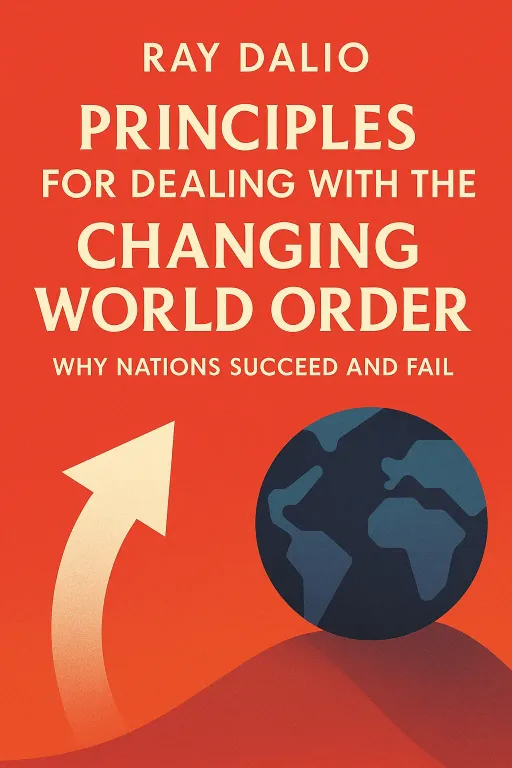
Nova: Well, it’s not just me. We’re diving into the incredibly insightful work of Ray Dalio, particularly his book,. Dalio is renowned as a legendary hedge fund manager, but what’s truly fascinating is how he stepped away from just market analysis to meticulously study 500 years of global history. He used that data, not just anecdotes, to identify these grand, recurring patterns. He saw history as a giant dataset, revealing a "Big Cycle" that governs empires.
Atlas: That’s a compelling origin story. A financial mind applying quantitative analysis to history, that’s not something you hear every day. So, he’s essentially saying there’s an algorithm to the rise and fall of civilizations? As someone who loves seeing patterns and connecting the past to the present, I’m intrigued. But what are the core variables in this historical algorithm?
Nova: Exactly! Dalio argues it’s a systematic process, not just random events. He identifies a handful of key factors that dictate a nation's trajectory, and they often operate in a predictable sequence. These aren't just abstract ideas; they're measurable forces like education, innovation, debt, and the coveted status of having a reserve currency.
The Big Cycle Mechanics: Economic Drivers of Rise and Fall
SECTION
Atlas: Education, innovation, debt, reserve currency… I can see how those are powerful, but how do they intertwine to create this "Big Cycle"? Give me the mechanics, Nova. How does a nation go from burgeoning power to eventual decline through these lenses?
Nova: Let’s break it down. Imagine a young, ambitious nation. It starts with strong education and a culture of innovation. Think of the early Dutch Republic, or the nascent United States. People are educated, they’re inventing new technologies, new ways of doing business. This fuels productivity and competitiveness. They create valuable goods and services, leading to strong trade balances. They’re building internal strengths.
Atlas: So, it's like a startup phase for a nation. High energy, new ideas, everyone’s pulling in the same direction. What happens next?
Nova: As they innovate and produce, they accumulate wealth. Their currency becomes stable and trusted. Other nations want to trade with them, invest in them. Eventually, their currency becomes the world's reserve currency, like the British pound once was, and the US dollar is today. This is a massive advantage—it allows them to borrow cheaply and exert global influence.
Atlas: That’s a huge power-up. Being the world’s banker and having your money be the global standard must give you incredible leverage. But it sounds almost too good to last. Where do the cracks start to appear?
Nova: This is where Dalio's economic lens gets really sharp. The very success often plants the seeds of decline. With reserve currency status, a nation can run large trade deficits without immediate consequence. They can print more money because the world demands it. This leads to increasing debt, both internally and externally. Think about how much the US government borrows, and how much of that debt is held by other countries.
Atlas: So, the ability to borrow easily becomes a temptation, a double-edged sword. It allows for continued spending and investment, but at what cost? Is it a slow, creeping erosion of fundamental strength?
Nova: Precisely. As debt mounts, the government often resorts to printing more money, which eventually devalues the currency. Meanwhile, the initial drive for education and innovation can wane. People become complacent. Education systems might decline, or innovation might slow down because the nation is comfortable and rich. Competitiveness erodes as other, hungrier nations catch up, investing heavily in education and innovation.
Atlas: It’s a vicious cycle in reverse, then. The complacency from success undermines the very foundations that built that success. The education system, the innovation, the productivity… they all falter while debt piles up. It reminds me of patterns we see in established companies that get disrupted by agile newcomers.
Nova: Exactly the analogy! And Dalio shows this isn’t just a theory; it’s a pattern repeated across centuries. The Dutch Empire, the British Empire—they all followed similar arcs. They gained reserve currency status, ran into debt problems, saw their internal strengths erode, and eventually gave way to a new rising power. It’s a powerful, almost inevitable, economic narrative.
Contemporary Relevance & Future Conflicts
SECTION
Atlas: That’s a profoundly sobering thought, especially when you look at current global dynamics. So, how might understanding this cyclical nature, particularly through this economic lens, reshape our interpretation of contemporary international relations and potential future conflicts? Because that's where the rubber meets the road for me as an analyst.
Nova: It completely reframes it. Instead of seeing individual conflicts or trade disputes as isolated events, Dalio's framework urges us to view them as symptoms of a larger, underlying shift in the Big Cycle. Consider the current geopolitical landscape. We have the United States, which has held reserve currency status for decades, facing significant internal debt and growing geopolitical challenges.
Atlas: And on the other side, you have China, a rapidly innovating, highly productive nation that has been aggressively expanding its global influence, trade, and even its own currency's role. The parallels with past rising powers are hard to ignore.
Nova: Absolutely. When Dalio looks at the education and innovation metrics, or the internal cohesion and debt levels of these major powers, he sees patterns that strongly resemble the transitions of the past. He's not predicting a specific war, but he's highlighting the heightened of conflict when an established power feels threatened by a rising one, especially when economic dominance is at stake. The fight for trade routes, for technological supremacy, for influence over global institutions – these are all manifestations of the underlying economic competition.
Atlas: So, understanding these cycles means we should be looking beyond the headlines, beyond the latest diplomatic spat, and instead focusing on these deeper economic and structural shifts. It’s about recognizing the historical playbook being rerun, albeit with modern players and technologies. It gives a sense of inevitability, but also, perhaps, a chance to mitigate.
Nova: Precisely. It’s about being grounded in reality, as your profile suggests. If you see mounting debt in a leading power, declining educational outcomes, and a loss of innovation momentum compared to a rising rival, you start to interpret tensions in the South China Sea or debates over trade tariffs very differently. These aren't just isolated policy disagreements; they're manifestations of a systemic power shift. Dalio argues that the most dangerous period is when the established power is still strong enough to fight, but the rising power is strong enough to challenge, often leading to a "great power war."
Atlas: That's a chilling thought. It implies that many of the conflicts we see brewing, or even outright happening, are not just about ideology or resources, but about the fundamental reordering of economic and geopolitical power. It forces us to ask: are we seeing the early stages of a new world order emerging from the ashes of the old, just as history suggests? It certainly reframes the "potential future conflicts" aspect of our deep question.
Nova: It truly does. It encourages us to embrace the nuance, as your mindset recommendation suggests. Not all answers are absolute, and truth evolves. But the patterns, when viewed through this economic lens, offer a powerful framework for understanding the forces at play. It’s about seeing the forest, not just the trees.
Synthesis & Takeaways
SECTION
Atlas: This has been a truly illuminating discussion, Nova. The idea that empires operate on a "Big Cycle" driven by these fundamental economic factors – education, innovation, debt, and reserve currency status – it’s a profound way to look at history and the present. It certainly challenges conventional thinking that might focus purely on military might or political ideology.
Nova: It’s a powerful reminder that history doesn't just repeat itself, it rhymes, as the saying goes. Dalio’s genius is taking that poetic notion and backing it up with hard data, offering a macro-perspective that’s incredibly valuable for anyone trying to make sense of our complex world. He's essentially offering a framework to discern the signal from the noise in global events.
Atlas: And for me, as someone driven by a desire for wisdom and connecting past to present, it really highlights how crucial it is to look at these underlying economic currents. It makes me wonder what internal strengths we need to cultivate, and what external factors we need to manage, to navigate these turbulent waters. What’s the one big takeaway for our listeners from this powerful economic lens on civilizational cycles?
Nova: The ultimate takeaway is this: the rise and fall of nations isn't random. It follows identifiable, often economically driven, patterns. Understanding these "Big Cycles" isn't about predicting the future with certainty, but about understanding the that nations tend to follow. It’s about recognizing the warning signs and the opportunities inherent in these shifts. It gives you a profound, systemic understanding of why things are happening, and what might come next, allowing for a more informed and perhaps wiser engagement with the world. It's an invitation to see the world not just as it is, but as it's evolving through time.
Atlas: That’s a call to critical thinking and self-reflection if I ever heard one. It makes you want to go out and discuss these insights, challenge your own perspectives, and really dig into the historical roots of today's geopolitics.
Nova: Absolutely. And that’s precisely what we hope to spark in our listeners. This is Aibrary. Congratulations on your growth!