

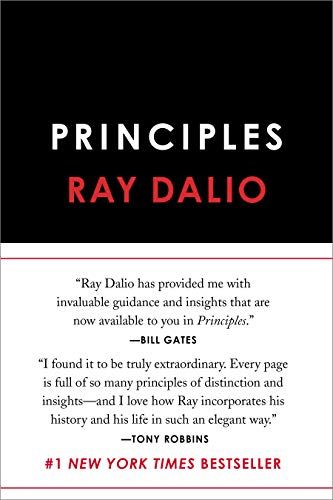
Principles
Life and Work
The Operating System for Life: Introducing Ray Dalio's Principles
The Operating System for Life: Introducing Ray Dalio's Principles
Nova: Welcome back to the show. Today, we are diving into a book that isn't just a collection of advice; it’s an attempt to reverse-engineer success itself. We’re talking about Ray Dalio’s monolithic work, "Principles: Life and Work."
Nova: : That title alone is a massive claim, Nova. Ray Dalio, the founder of Bridgewater Associates, one of the largest and most successful hedge funds in the world, essentially says he’s cracked the code for navigating life, economics, and investing. I’m curious, how many principles are we actually talking about here?
Nova: That’s the first shocker. Dalio didn't just write a book; he documented thousands of rules over decades. He started documenting them because he realized that every time he faced a major challenge, he had to relearn the lesson. So, he built a system to avoid that painful repetition. The core idea is that life, like investing, is a machine, and if you understand its mechanics, you can program yourself for success.
Nova: : A machine? That sounds incredibly cold, Nova. Are we talking about turning human existence into an algorithm? I feel like that’s where a lot of the controversy around this book starts.
Nova: It absolutely is. But Dalio argues that by treating reality as a machine, we can remove the emotion and ego that cloud our judgment. He believes that if you can codify your best thinking into principles, you can make better decisions consistently, especially when you’re under pressure. Think of it as creating an external hard drive for your brain’s best operating system.
Nova: : So, the goal isn't just to be rich, but to be consistently right, or at least consistently learning from being wrong? That’s a subtle but crucial distinction for a hedge fund manager.
Nova: Exactly. And to understand he felt the need to build this massive system, we have to go back to the moment that nearly broke him. That’s where our first deep dive begins: the catalyst for the entire Principles project.
Nova: : Lead the way. I’m ready for the origin story of this massive philosophical undertaking.
The Story of Dalio's Biggest Mistake
The Catalyst: From Ruin to Rulebook
Nova: The genesis of Principles is rooted in spectacular failure. In 1982, Dalio was running Bridgewater, and he made a massive, leveraged bet that the US economy was heading into a depression. He was absolutely certain, based on his analysis, that this was the truth.
Nova: : And what happened? Because if he was that certain, I assume he was correct, given his later success.
Nova: Quite the opposite. He was completely wrong. The economy did not crash; in fact, it started to recover, and he lost almost everything. He famously said he was so wrong that he had to lay off half his staff and even borrow money from his employees to keep the lights on. It was a moment of profound humility and terror.
Nova: : Wow. Losing everything because your conviction was too strong. That’s the ultimate ego check. How did that translate into a principle?
Nova: It taught him two things that became cornerstones. First, the danger of mistaking your strong belief for objective reality. He realized he was too close to the trade, too invested emotionally. Second, he realized that his intuition, while sometimes good, was unreliable under stress. He needed a system to check his own thinking.
Nova: : So, the first principle born from that fire must be something about humility or checking your ego. What was the immediate takeaway he codified?
Nova: One of the core Life Principles he developed is: "Don't confuse what you wish were true with what is really true." He realized that his for a depression was blinding him to the actual data suggesting recovery. He had to force himself to look at the reality, however painful.
Nova: : That’s powerful. It’s easy to find principles about diversification—like his advice to place many smaller bets rather than a few large ones—but this is about the of decision-making. Did he immediately start writing down rules after that 1982 event?
Nova: Not immediately, but the seed was planted. He started to see that every success and every failure could be broken down into a sequence of choices that followed or violated a rule. He began to treat problems like puzzles that had a repeatable solution structure. He started asking, "What is the underlying mechanism here?"
Nova: : So, the 1982 crisis provided the pain, and the subsequent need to survive provided the motivation to build the machine. It sounds like he was essentially creating a feedback loop for his own brain.
Nova: Precisely. And this leads us directly into the most famous, and perhaps most controversial, aspect of his management philosophy: the commitment to absolute honesty in the workplace.
Nova: : Ah, yes. The part where everyone has to tell you exactly what they think, even if it makes you look foolish. Let’s talk about Radical Truth and Radical Transparency. I need to know how that actually functions without turning an office into a battlefield.
The Mechanics of Idea Meritocracy
Radical Truth and Radical Transparency: The Engine of Improvement
Nova: Dalio’s Work Principle Number One is to "Trust in Radical Truth and Radical Transparency." This isn't just about being polite; it’s about creating an environment where the truth—no matter how uncomfortable—surfaces immediately so it can be dealt with.
Nova: : I’ve heard this described as brutal honesty. If I’m sitting in a meeting and I think your idea is terrible, I’m expected to say so, publicly, right then and there?
Nova: That’s the ideal. Dalio argues that hiding disagreement or weakness is the greatest threat to an organization because it prevents the necessary diagnosis of problems. He wants people to get their egos out of the way. He famously said that when people are radically transparent, they stop worrying about looking good and start worrying about achieving the best outcome.
Nova: : But doesn't that just create a culture of fear, or at least intense social anxiety? If I’m worried about my boss’s reaction, I’m going to self-censor, even if the culture it’s okay to speak up.
Nova: That’s the critical hurdle. Dalio recognized that. That’s why transparency isn't just about speaking; it’s about. Bridgewater famously recorded almost all meetings. Employees were encouraged to use tools like the 'Dot Collector'—an app where they could log real-time feedback on colleagues during meetings.
Nova: : Wait, they were rating each other the conversation? That sounds like a nightmare for introverts or anyone who needs a moment to process before responding.
Nova: It is intense. The idea behind the real-time logging is to capture the immediate, unfiltered reaction, which Dalio believes is often the most honest. If you wait 24 hours to give feedback, you’ve had time to rationalize, soften the blow, or let your ego build a defense. The real-time feedback loop is designed to force confrontation with reality instantly.
Nova: : So, the system is designed to overcome the natural human tendency toward self-preservation. But what about the of the truth? If everyone is speaking, how do you filter the noise from the signal?
Nova: That brings us to the next layer, which is arguably the most sophisticated part of his system: the Idea Meritocracy, powered by 'Believability Weighting.' Radical Truth gets the ideas on the table; Believability Weighting decides which ideas get the most influence.
Nova: : Believability Weighting. That sounds like a proprietary algorithm for human wisdom. Explain that to me. Are we still talking about a workplace, or is this a stock market ticker for opinions?
Nova: It’s a way of quantifying trust in expertise. Dalio realized that not all opinions are created equal. If you are a junior analyst who has been in the job for six months, your opinion on a complex macroeconomic shift should not carry the same weight as someone who has been studying that specific cycle for twenty years.
Nova: : Okay, I can see the logic there. So, you get a 'believability score' based on your track record in that specific domain?
Nova: Exactly. You earn believability points by being right repeatedly in a specific area. When a decision needs to be made, the system—or the meeting facilitator—weighs your input based on your historical believability score for that topic. It’s a systematic way of saying, 'Listen to the expert, not just the loudest voice.'
Nova: : That’s a fascinating attempt to quantify wisdom. It removes the hierarchy of title and replaces it with a hierarchy of proven competence. But I still worry about the human element. What if someone is brilliant but terrible at articulating their thoughts in the moment? Do they get penalized by the real-time logging?
Nova: That’s where the criticism often lands. Critics argue that this system favors those who are naturally aggressive communicators or those who master the system's mechanics, potentially silencing quieter, deeply thoughtful contributors. Dalio’s counter is that if you are truly brilliant, you will eventually earn believability points, and the system will amplify your voice over time, regardless of your initial social comfort level.
Nova: : It sounds like a high-stakes game of intellectual chess played under a microscope. It certainly explains why Bridgewater’s culture is so unique, and frankly, why many people find it intimidating. It’s a full-contact approach to organizational learning.
From Goals to Systematized Achievement
The Machine of Progress: The 5-Step Process
Nova: If Radical Truth and Transparency is the cultural fuel, the 5-Step Process is the engine that converts that fuel into forward motion. This is Dalio’s universal framework for achieving anything, whether it’s launching a new product or mastering the guitar.
Nova: : I’m familiar with the general idea of setting goals, but Dalio always frames this as a cyclical, almost mechanical process. Walk us through the five steps he insists upon.
Nova: Step one is simple: Have clear goals. You must know what you want. Step two is where the pain starts: Identify and don’t tolerate your problems. This is where Radical Truth comes in. You have to look at the obstacles without sugarcoating them.
Nova: : So, if I’m trying to write a book, Step 2 isn't just 'I need to write more chapters.' It’s 'I’m procrastinating because I’m afraid of criticism,' right?
Nova: Precisely. You must diagnose the root cause, which leads to Step 3: Diagnose the root causes of those problems. Dalio stresses that you must get past the symptoms. If you have a recurring problem, it means you have a flaw in your process or your thinking that needs fixing.
Nova: : This is where the machine analogy really clicks. You wouldn't just patch a leaky pipe; you’d find the faulty joint and replace it. What’s Step 4?
Nova: Step 4 is Design the plan. Once you know the root cause, you design a systematic solution. This solution becomes a new principle or a new procedural rule. For example, if the root cause of procrastination was fear of criticism, the design might be: 'All first drafts must be sent to three trusted readers within 48 hours of completion, no matter how rough.'
Nova: : And Step 5, the payoff? I assume that’s execution.
Nova: Yes, Step 5 is Do what's necessary to push through to completion. But Dalio adds a crucial layer here: you must track your progress against the design. If you fail to execute the plan, you loop back to Step 2: Identify the problem—which is now your failure to follow your own design. It’s a continuous loop of evolution.
Nova: : That’s incredibly rigorous. It forces accountability not just to the goal, but to the process you designed to achieve the goal. It sounds like the entire system is designed to make you a better 'machine designer' over time.
Nova: It is. And this process applies equally to his Life Principles and his Work Principles. The Life Principles are the overarching philosophy—like embracing reality, understanding people are wired differently, and using pain as a signal. The Work Principles are the application of that philosophy within the organizational structure, like the idea meritocracy we discussed.
Nova: : Is there a key difference in emphasis? Are the Life Principles more about internal peace, while the Work Principles are about external performance?
Nova: That’s a good way to frame it. The Life Principles are about achieving meaningful work and meaningful relationships—the two things Dalio says give life its greatest rewards. The Work Principles are the tools to build the environment where those meaningful relationships and high performance can coexist. For instance, a Life Principle might be to be radically open-minded; the Work Principle is to enforce that through believability weighting in meetings.
Nova: : It’s a comprehensive worldview. But I keep coming back to the sheer effort required. For the average person listening, who isn't running a multi-billion dollar fund, doesn't this level of systematization risk sucking the joy and spontaneity out of life?
Nova: That is the central tension we need to explore next. Is Dalio’s machine too rigid for the messy reality of human nature?
Is the System Too Cold for the Real World?
The Human Factor: Critique and The Big Cycles
Nova: We’ve established the system: Radical Truth, Idea Meritocracy, and the 5-Step Process. But the book has faced significant pushback. Many critics feel that Dalio’s framework, while perhaps effective for managing capital, is fundamentally dehumanizing for managing people.
Nova: : Exactly. If I’m constantly being evaluated in real-time on my 'believability score' for every contribution, I’m going to prioritize looking competent over taking necessary, but risky, creative leaps. Doesn't that stifle true innovation that often looks foolish at first?
Nova: That’s a valid concern, and it touches on the criticism that Dalio’s system might be better suited for optimizing known processes rather than fostering true, disruptive creativity. Some reviewers noted that Dalio’s focus on cycles and historical patterns—his work on 'The Changing World Order'—suggests he sees the world as deterministic, which can feel limiting.
Nova: : He sees history as a machine, right? A perpetual-motion machine of Big Cycles—the rise and fall of empires, currencies, and debt levels. That’s a huge part of his economic thinking that underpins the principles.
Nova: It is. He uses historical data, often spanning centuries, to argue that these cycles are predictable, if not precisely timed. The principle here is: Understand the big cycles so you don't get wiped out by them. For example, he advises diversification across uncorrelated assets precisely because he believes debt cycles are inevitable.
Nova: : But if history is just a set of repeating cycles, doesn't that discount the impact of truly novel factors, like, say, the rapid advancement of artificial intelligence, which is something Dalio himself has been accused of underestimating in his models?
Nova: That’s a key critique we found. Some analysts suggest that while his historical models are robust for analyzing past financial eras, they might struggle to account for technological shifts that fundamentally change the 'machine' itself. His principles are excellent for navigating known variables, but perhaps less robust for unprecedented ones.
Nova: : So, the system is optimized for efficiency and risk mitigation within a known framework, but perhaps less so for radical, paradigm-shifting innovation that doesn't fit the historical mold.
Nova: It’s a trade-off. Dalio prioritizes minimizing catastrophic risk—the 1982 mistake writ large—over maximizing speculative upside. His entire philosophy is built on surviving the downturns so you can be there for the upturns. His advice on diversification—many small bets—is a direct countermeasure to the risk of being completely wiped out by one wrong, high-conviction call.
Nova: : Let’s bring it back to the individual. For someone listening who is inspired but overwhelmed, what is the single most actionable takeaway that doesn't require installing a meeting recording app?
Nova: It has to be the mindset shift in the 5-Step Process. Forget the technology for a moment. Focus on Step 3: Diagnose the root cause. Most people stop at the symptom. If you’re constantly late, don't just set five alarms. Ask you hit snooze five times. Is it poor sleep hygiene? Is it a fear of the day ahead? Dig until you find the underlying, fixable mechanism. That act of deep, non-judgmental diagnosis is pure Dalio, and it requires zero software.
Nova: : That’s a fantastic distillation. It moves the focus from external compliance to internal intellectual honesty. It makes the system accessible.
Your Personal Operating System
Synthesis and The Path Forward
Nova: We’ve covered a lot of ground today, from the terror of losing everything in 1982 to the algorithmic precision of Believability Weighting. If we synthesize Ray Dalio’s "Principles," what are the essential takeaways for our listeners?
Nova: : I think the biggest takeaway is that success isn't magic; it's systematic. Dalio forces us to confront the idea that our best thinking should be externalized, tested, and improved, rather than kept locked away in our heads where ego can corrupt it. His core message is: codify your wisdom.
Nova: Absolutely. And the second key insight is the necessity of embracing pain and mistakes as data points, not personal failures. The pain you feel when you are wrong is the signal that your current understanding is flawed. If you don't feel that pain, you aren't learning fast enough.
Nova: : Which means we need to actively seek out people who will disagree with us—the 'thoughtful disagreers'—because they are the ones who will expose the blind spots in our personal operating system.
Nova: Precisely. And remember the difference between Life and Work. Your Life Principles should focus on what makes your existence meaningful—your relationships and your contribution. Your Work Principles are the specific rules you use to execute those life goals efficiently, whether that’s in your career, your finances, or your health regimen.
Nova: : It’s a demanding philosophy. It asks for relentless self-scrutiny. It’s not a light read, and it’s certainly not an easy culture to adopt, but it offers a powerful blueprint for anyone who wants to stop reacting to life and start designing it.
Nova: Indeed. Dalio’s work is a challenge to stop being a passenger in your own life and start being the engineer of your own machine. It’s about building a robust, error-correcting system that can withstand the inevitable shocks of reality.
Nova: : So, the next time you face a major setback, don't just recover. Stop, diagnose the root cause, design a new principle to prevent recurrence, and then execute that new rule rigorously. That’s the Dalio challenge.
Nova: A perfect summary. Thank you for joining us on this deep dive into the architecture of success. This is Aibrary. Congratulations on your growth!