The Silent Language: Unlocking Nonverbal Communication for Deeper Connections.
Golden Hook & Introduction
SECTION
Nova: Atlas, if you had to describe the power of unspoken communication, what five words would you use?
Atlas: Ooh, five words. Let’s see… Unseen signals, true thoughts, deep connections.
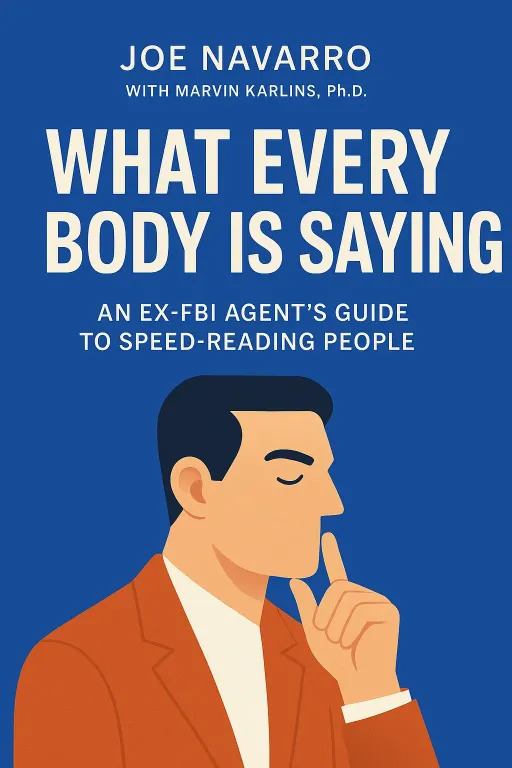
Nova: Oh, I love that! That’s spot on. Mine would be: Speak without words, truly understand. Because today, that’s exactly what we’re cracking open. We're diving into the silent language that shapes our world, inspired by two incredible books: "What Every BODY is Saying" by former FBI agent Joe Navarro, and "Presence" by social psychologist Amy Cuddy.
Atlas: Wait, a former FBI agent? That’s fascinating. So, this isn't just theory, this is like, real-world spy stuff?
Nova: Exactly! Navarro spent decades in counterintelligence, learning to read people when their words couldn't be trusted. His insights give us this unparalleled lens into what people are communicating, often without saying a single word. And it all starts with the cold, hard fact that communication is so much more than just the sounds we make.
Atlas: I guess that makes sense. Sometimes you just when someone isn't being entirely truthful, or when they’re super engaged, even if their words are neutral. It’s like a gut feeling, right?
Nova: It’s precisely that gut feeling, Atlas, but Navarro gives us the playbook to turn that intuition into an actionable skill.
Decoding the Silent Signals: Reading Others' Nonverbal Cues
SECTION
Nova: So, let’s talk about decoding these silent signals. Imagine Navarro in an interrogation room. He's not just listening to words; he's watching for what he calls "tells." These are tiny, often unconscious behaviors that reveal our true thoughts and feelings.
Atlas: Like sweating or fidgeting?
Nova: Those are the obvious ones, but Navarro goes deeper. He’s looking for things like a momentary lip compression, which often signals stress or disagreement, even if the person is smiling. Or a sudden shift in posture, perhaps a slight turning away, indicating discomfort or a desire to disengage. It’s about observing clusters of these behaviors, not just one isolated gesture.
Atlas: That makes me wonder, how do you even begin to learn that? And how do you know if someone’s just generally fidgety, rather than specifically stressed about what saying?
Nova: That’s a brilliant question, and it brings us to Navarro's "three C's": Context, Clusters, and Congruence. Context is crucial—a person fidgeting in an interrogation room is different from someone fidgeting in a waiting room. Clusters mean you look for multiple nonverbal cues occurring together. One tell might be an anomaly, but several in unison often paint a clear picture.
Atlas: So you’re saying, if someone is talking about how excited they are for a project, but their shoulders are hunched, their feet are pointed towards the door, and they keep touching their neck, that’s a cluster of incongruent signals?
Nova: Precisely! And that leads us to Congruence: do their nonverbal signals match their verbal message? If someone says, "Oh, I'm perfectly fine," but their face is tight and their hands are clenched, there's a lack of congruence, and the nonverbal usually tells the truer story.
Atlas: Wow. That’s actually really powerful. For someone who’s trying to connect more deeply, especially across cultures where verbal communication can already be tricky, understanding these unspoken cues could be a game-changer. It’s not about catching someone in a lie, it’s about genuinely understanding their comfort levels or intentions.
Nova: Exactly! It’s about building trust, not just detecting deception. When you can read these signals, you can adapt your approach, make people feel more at ease, and bridge understanding. It’s about empathy, really, understanding the unspoken needs and emotions of others.
Power Poses and Personal Presence: Shaping Your Inner and Outer World
SECTION
Nova: But what if the silent language isn't just about reading others, Atlas? What if it's also a powerful tool for shaping? For boosting our own confidence and presence?
Atlas: Oh, I like that! So, turning the mirror around, essentially? How does my own body language affect me?
Nova: That’s where Amy Cuddy’s work in "Presence" comes in. She explored how our body language doesn't just influence how others see us, but also how we see ourselves. Her research introduced the concept of "power posing."
Atlas: Power posing? That sounds a bit… like something out of a superhero movie. Is it really that impactful?
Nova: It sounds fantastical, but the science is compelling. Cuddy conducted studies where participants adopted what she called "high-power poses"—think standing tall, hands on hips like Wonder Woman, or leaning back with feet on the desk—for just two minutes. Another group adopted "low-power poses"—like hunching over, arms crossed.
Atlas: And what happened? Did they suddenly feel like superheroes?
Nova: Well, not quite flying, but close! The high-power posers experienced significant physiological changes. Their testosterone levels—associated with dominance and confidence—went up, and their cortisol levels—the stress hormone—went down. Conversely, the low-power posers saw the opposite effect.
Atlas: That’s incredible. So, just by changing how I stand, I can actually change my brain chemistry? That gives me chills. For someone who might get nervous before a big presentation or an important cross-cultural meeting, that could be a massive help.
Nova: Absolutely. It’s not about "fake it till you make it" in a superficial sense. Cuddy rephrased it as "fake it till you it." By adopting these power poses, even for a brief moment, you can actually more confident, reduce anxiety, and project a stronger, more authentic presence. It’s about harnessing your physiology to influence your psychology.
Atlas: So what are some simple, actionable power poses someone could use before, say, a daily communication challenge or a situation where they need to connect with diverse perspectives?
Nova: The classic "Wonder Woman" pose is fantastic: stand tall, feet apart, hands on hips, chest open. Another is the "CEO" pose: lean back in your chair, feet on the desk, hands behind your head. The key is to expand your body, take up space, and open your posture. Even in a restroom stall before a meeting, two minutes can make a difference. It’s a tiny step with a massive internal impact.
Synthesis & Takeaways
SECTION
Nova: So, by combining Navarro’s insights into decoding others' silent signals with Cuddy’s research on using our own body language to cultivate presence, we get a holistic approach to communication that transcends mere words. It’s about both receiving and transmitting with clarity and impact.
Atlas: It really is. It’s not just about what you say, but what you, and what you from others' unspoken cues. It makes every interaction so much richer, and honestly, more authentic, because you’re tapping into a deeper level of human connection.
Nova: Exactly. Understanding this silent language is key to building trust and connecting authentically, especially when you're trying to bridge diverse perspectives or navigate new cultural landscapes. It empowers you to not only read the room but also to own your space within it.
Atlas: So, for our aspiring communicators and global explorers out there, what’s one tiny step they can take today to start unlocking this silent language?
Nova: Here’s a challenge: today, observe a brief conversation without sound. Just for a minute or two. Try to infer the emotions and intentions of the speakers based only on their body language. It’s a powerful exercise that will open your eyes to a whole new dimension of communication.
Atlas: That’s brilliant. It's like turning up the volume on the unspoken. What a fantastic way to truly understand the world around us and within us.
Nova: Absolutely. The silent language is always speaking. It's time we learned to listen.
Atlas: This is Aibrary. Congratulations on your growth!