Beyond the Hype: The Science of Effective AI Integration in EdTech.
Golden Hook & Introduction
SECTION
Nova: Most people think AI is about building smart robots or complex algorithms that just 'do things.' But what if I told you that's actually the blind spot, the biggest misconception holding back true innovation, especially in a field as vital as education technology?
Atlas: Whoa, that’s a bold statement, Nova. I imagine a lot of our listeners, especially those in the AI native space, might feel like they’re already ahead of the curve. What exactly is this blind spot you're talking about?
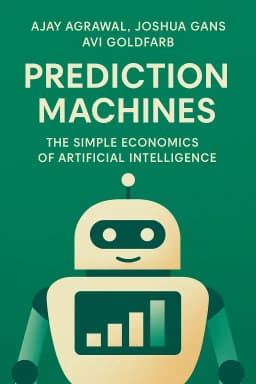
Nova: It's seeing AI as magic, rather than a tool that augments specific human capabilities. And today, Atlas, we're dissecting that blind spot through the lens of a truly foundational text: by Ajay Agrawal, Joshua Gans, and Avi Goldfarb. These are some of the sharpest minds in economics and management, and their work has profoundly shifted how businesses, from startups to giants, think about AI's strategic value.
Atlas: Oh, I like that. It's not just another tech book; it’s a strategic reframing. So, for us in edtech, especially those building 0-1 growth strategies, what's their big revelation? How do they cut through the hype?
AI as a Prediction Technology: Rethinking Value
SECTION
Nova: Their revelation is elegantly simple, yet profoundly transformative: AI is fundamentally a. It's not about replicating human intelligence in its entirety, but about making predictions cheaper, faster, and more accurate. Think about it: every decision we make, from what content to recommend to a student to how to staff a support team, involves a prediction.
Atlas: Okay, so you’re saying AI doesn't like us; it just predicts better? That’s a massive reframing. But how does that translate into tangible value for an edtech startup? I mean, we're not predicting stock prices; we're trying to improve learning outcomes and scale efficiently.
Nova: Exactly! And that's where the magic, or rather, the, happens. Let’s take a specific example: student engagement. An edtech platform might predict which students are at risk of dropping out based on their activity patterns, quiz scores, and forum participation. Traditionally, a human teacher or counselor might spot this, but with AI, that prediction becomes far more precise and scalable.
Atlas: So, instead of a teacher guessing, the AI flags it with, say, 80% certainty. But what does that for a CGO focused on growth? How does that prediction actually create value beyond just identifying a problem?
Nova: That's the key. Once you have a more accurate prediction, the comes from the human action you take of it. If you can predict with high accuracy that a student is about to disengage, you can proactively intervene. Imagine an AI identifying that students who spend less than 15 minutes on a specific module in the first 24 hours are 70% more likely to fail the course. A small improvement in that prediction—say, from 50% to 70% accuracy—allows your human mentors, tutors, or even automated nudges to reach out the problem becomes critical.
Atlas: That’s fascinating. So, the gain isn't in the AI itself, but in the of better predictions. It's about optimizing the cost of making a mistake. For a CGO, that could mean predicting which onboarding flows lead to higher retention, or which marketing channels predict the most engaged users.
Nova: Precisely. Agrawal, Gans, and Goldfarb argue that once you see AI as prediction, you start to rethink every decision in your business. Where could a better prediction, even a slightly better one, lead to significant gains in learning outcomes or operational efficiency? For an edtech startup, predicting which teaching methods work best for different learning styles, or even predicting future skill demands in the job market to inform curriculum development, becomes a core strategic advantage.
Human + Machine Collaboration: The Symbiotic Future of EdTech
SECTION
Atlas: That makes so much sense. It shifts AI from this abstract, scary concept to a concrete lever for improvement. But if AI is just about prediction, what about all the other things humans do? The creativity, the empathy, the strategic vision? That naturally leads us to the second key idea we need to talk about, which often acts as a critical complement: how do we effectively integrate these prediction machines with human ingenuity?
Nova: A brilliant segue, Atlas. This is where by Paul R. Daugherty and H. James Wilson comes into play. They reveal that the most successful companies aren't replacing humans with AI; they're creating a symbiotic relationship. They identify five distinct approaches for integrating AI, but the core message is clear: AI augments, it doesn't just automate.
Atlas: Okay, so augmentation over automation. I imagine a lot of our listeners are grappling with this. It sounds great in theory, but how do you actually that in an edtech startup? How do we avoid the trap of just using AI to cut costs, and instead use it to genuinely enhance human capabilities for growth?
Nova: Let's consider one of their approaches: "The Augmenter." In edtech, this could be an AI assistant that helps teachers personalize learning plans. The AI predicts a student's strengths, weaknesses, and preferred learning modalities. The human teacher then uses this prediction to craft a highly individualized curriculum, provide targeted feedback, and offer empathetic support—things AI simply can't do with the same nuance. The human's judgment, creativity, and emotional intelligence are amplified by the AI's predictive power.
Atlas: That's actually really inspiring. So, it's about amplifying the uniquely human skills in education: the mentorship, the inspiration, the complex problem-solving that requires intuition. I still struggle with that myself sometimes, thinking about where to put our limited resources. How do we, as CGOs, identify those specific human capabilities that AI can best augment to drive growth?
Nova: Daugherty and Wilson emphasize a shift from task-centric thinking to outcome-centric thinking. Instead of asking "What tasks can AI automate?", ask "What outcomes are we trying to achieve, and how can AI make our human efforts towards those outcomes more effective?" For a growth officer, this means looking at every stage of the customer journey—from acquisition to retention to advocacy—and identifying where human-AI collaboration can yield better predictions and more impactful human interventions. Can AI predict which prospective students are most likely to convert with a personalized outreach from a human admissions advisor? Can it predict which alumni are most likely to become evangelists with a tailored human engagement strategy?
Atlas: That’s a great way to put it. It’s about leveraging AI to make our human growth efforts smarter, more targeted, and ultimately, more human, by freeing us up for higher-value interactions.
Synthesis & Takeaways
SECTION
Nova: Absolutely. What emerges from both and is a powerful, unified message for edtech: AI isn't a silver bullet, nor is it a job-stealer. It's a strategic partner. It dramatically lowers the cost of prediction, allowing us to make better decisions faster. And when combined with human creativity, empathy, and strategic thinking, it unlocks unprecedented levels of innovation and impact in learning outcomes and operational efficiency.
Atlas: I can see that. For anyone leading an edtech startup, the deep question from the material really hits home: where in your venture could even a small improvement in prediction lead to a significant gain in learning outcomes or operational efficiency? It's not about adopting AI for AI's sake, but about surgically applying it where it can truly augment human potential.
Nova: Exactly. Start by identifying those high-value decision points where better predictions could make a difference, and then explore how human ingenuity can be amplified by those predictions. It's about building a future where learning is not just smarter, but profoundly more human because of AI, not despite it.
Atlas: That’s a fantastic framework to take away. Focus on prediction, then focus on augmentation. It demystifies AI and makes it actionable.
Nova: This is Aibrary. Congratulations on your growth!